BOFU Content and AI Search: Where Buying Answers Come From
When buyers ask ChatGPT what to buy, the answers are built overwhelmingly from third-party sources — Reddit in 62% of responses, your website almost never. Here's the measured picture of where AI buying advice comes from, and the split strategy that follows from taking it seriously.
By Nathan Rofkahr, Founder of Inbounder · Updated

Where AI Gets Its Buying Advice: The Measured Picture
A growing share of buying decisions now route through a chat box: "what's the best [category] for [situation]," "is X worth it," "alternatives to Y." The natural founder assumption is that AI visibility on those queries works like SEO — make your pages good and get cited. The measured reality is harsher and more specific.
The best current dataset is Siege Media's "Where AI Gets Its Buying Advice" study (March 2026): 1,000 buying-intent prompts run across major AI assistants, producing 57,095 citations, tracked via Peec.ai. The headline findings:
- Reddit appears in 62% of LLM responses to buying prompts — by far the most-cited single source.
- YouTube appears in roughly 25% of responses.
- G2 appears in ~5% — and review platforms as a class punch far above vendor sites.
- Most striking: 80–95% of citations go to third-party sources — communities, reviews, publishers, videos — rather than the vendors' own pages.
Sit with that last number, because it inverts the default content strategy. For buying queries specifically, AI assistants have effectively adopted the skeptical buyer's heuristic: don't ask the vendor, ask people who've used the thing. Your beautifully crafted comparison page is competing for a 5–20% sliver of citation space on ChatGPT-style surfaces, while conversations about you that you don't control fill the rest.
Standard epistemics before building on this: it's one study, from a single point in time in a fast-moving category, using one tracking methodology (Peec.ai's), published by a content marketing agency — take the precise percentages as a snapshot, not physics. But the direction — third-party dominance in AI buying answers — is consistent with the other citation analyses we've reviewed, and it's the premise this article reasons from.
What follows isn't "give up on BOFU pages." It's a more precise allocation: understand which AI surfaces your own pages can win (there's good news, and it's mechanical), which surfaces route through third parties, and how to show up in both — honestly, with measurement you can audit.
What 80–95% Third-Party Actually Means for You
The implications of third-party citation dominance, taken seriously rather than mourned:
Your BOFU pages' AI ceiling depends on the engine. On ChatGPT-style assistants for buying prompts, vendor pages are structurally minority citations — 5–20% of the space, per the Siege data. That's not zero (and "minority" still rewards being the best-formatted vendor source available), but it means no amount of on-page excellence buys you Reddit's 62% seat at that table.
The most-cited surfaces are earnable, not ownable. Reddit threads, YouTube reviews, G2 profiles — you can't control them, but you can legitimately participate: be a real presence in your category's communities, make sure reviewers have access and accurate information, keep your G2/Capterra profiles complete and your review base genuine. This is PR-and-community work with SEO-sized payoff, and most founders systematically underinvest in it because it doesn't feel like "content."
Third-party dominance is downstream of your BOFU positioning anyway. What do Reddit commenters and YouTube reviewers say about you? They repeat the comparisons and category framings that exist. The vendor who has published clear, honest comparison and alternatives content has seeded the language the third-party layer uses — your pages get paraphrased into threads even when they're not cited by engines. Influence without citation is real, if unmeasurable.
Mentions matter separately from citations. An AI answer can recommend your product by name without citing your site — sourced from a thread where someone praised you. For buying queries, that brand mention is the conversion event; the click was never coming anyway. This is why honest measurement (later section) counts mentions and citations as distinct things.
The moat got weirder. If answers assemble from community sentiment, then genuine user love — the thing you can only earn with a good product and honest dealings — is now literally a distribution channel. The vendors who treated buyers as marks are discovering their reputation is queryable. Build accordingly.
Where Your Own BOFU Pages Still Win
Here's the mechanical good news the third-party numbers obscure: AI surfaces differ in how they select sources, and the ones wired closest to classic search still reward classic ranking.
Google's AI Overviews and AI Mode are built directly on Google's index and retrieval — the sources they synthesize from correlate strongly with what ranks. Perplexity likewise runs live retrieval over web search results. On these surfaces, the path to citation runs straight through the SEO you're already doing: a comparison page that ranks top-5 for "X vs Y" is exactly the kind of source these engines lift into their answers. No separate mysticism required — the BOFU pages this cluster teaches are the AI strategy for retrieval-led engines.
ChatGPT-style assistants sit at the other pole: their browsing is more selective, their training-data priors favor high-authority third-party sources, and the Siege data's third-party dominance is most extreme there.
Why vendor BOFU pages remain competitive on retrieval-led surfaces for buying queries specifically:
- Vs-queries have thin SERPs. For "X vs Y," often the only substantive, current, structured sources on the open web are the two vendors' pages. When third-party coverage is sparse, engines cite what exists — and an honest, well-structured vendor comparison is frequently the best available source, not a grudging fallback.
- Tables and verdicts are liftable. Answer engines assemble structured comparisons, and a real HTML table with specific cells is the easiest raw material on the page. (Formatting section below.)
- Freshness is a vendor advantage. You know your pricing changed today; Reddit finds out in a month. Maintained BOFU pages are systematically fresher than the third-party layer, and freshness is a citation factor across every study in the category.
So the honest engine-by-engine summary for a founder: your pages → AI Overviews and Perplexity citations via rankings; third-party presence → ChatGPT-style answers; both → your buyers. The strategy that follows is a split allocation, next section. For the general mechanics of how these engines choose sources — beyond buying queries — see what is AI visibility.
The Split Strategy: Own Pages Plus Earned Presence
Taking the citation data seriously produces a two-track allocation — both tracks, deliberately, instead of all-in on either:
Track 1: Own-page BOFU, unchanged in substance, upgraded in format. Keep building the comparison and alternatives pages — they convert directly at the published bands, they win retrieval-led AI surfaces through rankings, and they seed the language the third-party layer repeats. The AI-era upgrades are formatting and maintenance (sections below), not a new content type.
Track 2: Earned third-party presence, treated as a first-class channel. Where the citations actually live, per the Siege data:
- Reddit (62% of responses): be genuinely present in your category's subreddits — answering questions where you have expertise, disclosing affiliation always, earning the right to be mentioned. Slow, unfakeable (next-to-last section covers why faking it backfires), and now directly queryable by every AI assistant.
- YouTube (~25%): the most underinvested surface. Product walkthroughs, honest comparison videos, and reviewer outreach all produce citable video assets. If you make one media bet beyond writing, the data says make it here.
- Review platforms (G2 ~5%, and the class punches above its weight): complete profiles, accurate info, and a steady genuine review base — asked for honestly from real users, never incentivized into fakery.
- Publisher roundups: the "best [category] tools" listicles engines cite are written by humans you can email. Accurate info and responsive access raise your odds of accurate inclusion.
Allocation guidance, craft not research: a founder-sized default is roughly two-thirds of effort on Track 1 while your BOFU keyword map is uncovered, shifting toward parity as the map completes — earned presence compounds slower but decays slower too. The tracks also reinforce: your honest comparison page is what a Redditor links when defending you; your G2 presence feeds the engines that skip your site; the full citation playbook covers the earned-mention machinery in depth.
What the split strategy explicitly is not: abandoning your site to go "do Reddit marketing." Astroturfed community presence is the one move on this page that can end in being banned, screenshotted, and worse off than silence.
Formatting BOFU Pages So Answers Can Lift Them
For the AI surfaces your pages can win, citation goes to the page that's easiest to quote accurately. The formatting disciplines, most of which are good SEO anyway:
Verdict-first, everywhere. The direct answer in the first sentences under the H1 and under every question-shaped heading. Answer engines assemble from passages; a self-contained verdict paragraph is a liftable unit, while a conclusion buried after 800 words of buildup is invisible. This is the same answer-first rule from the topical authority playbook — AI answers just raised its price.
Real HTML tables with specific cells. "From $29/seat, no API on starter plan" is quotable; a checkmark grid rendered as an image is invisible to every engine. Your comparison table is probably the single most liftable asset you can publish on a buying query.
Named, dated claims. "As of July 2026, X's Pro plan is $49/seat" gives an engine a claim it can attribute with confidence. Hedged mush ("X can be more expensive in some cases") gives it nothing. Note the alignment: the precise, sourced claim is also the honest one — the formatting incentive and the integrity incentive point the same direction.
Question-shaped headings with self-contained answers. "Can you migrate from X to Y?" followed by a complete two-sentence answer is a made-to-order answer-engine passage — and an FAQ-schema candidate at the same time.
Genuine freshness. The citation studies we've reviewed find engines favoring recent content, and buying answers especially (pricing goes stale in months). Real quarterly re-verification with a visible date — the maintenance discipline — is now doing double duty as AI-citation work. Cosmetic date bumps remain worthless on every surface.
What not to over-invest in: schema markup as an AI play (Ahrefs' 2025 1,885-page test found citations barely moved), and any vendor's "AI-optimize your content" rewriting service that amounts to the list above at a markup. The work is formatting clarity and maintained accuracy. You can do it in a text editor.
Measuring It Honestly: N-of-M on Buying Prompts
Whether any of this is working is an empirical question, and the buying-query context makes honest measurement both more important and more tractable — your prompt set is practically written for you.
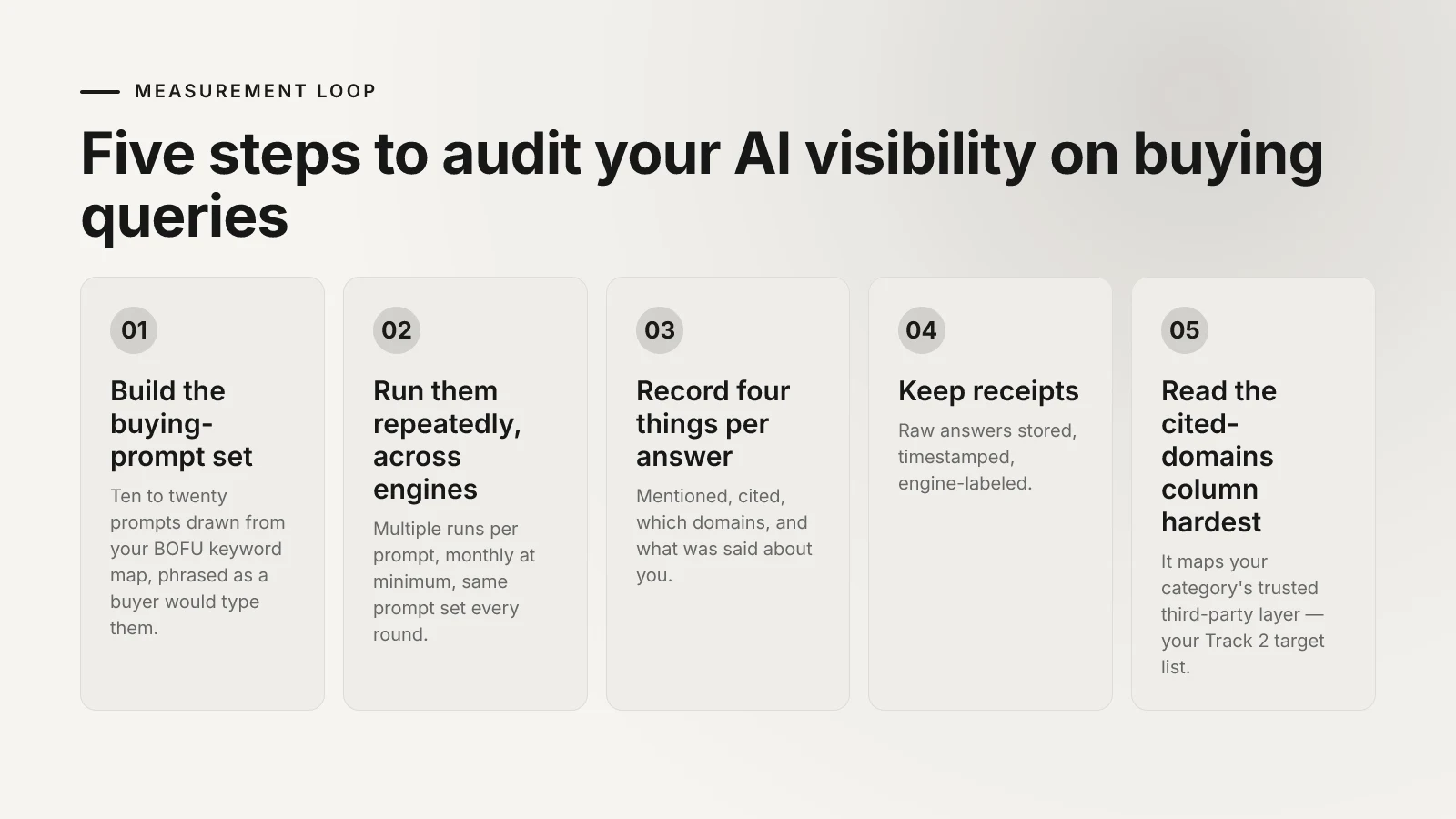
The method is the same N-of-M sampling our AI visibility guide details, pointed at BOFU prompts:
1. Build the buying-prompt set from your keyword map. Your BOFU keywords convert directly: "best [category] for [ICP]," "[competitor] alternatives," "[you] vs [competitor]," "is [category] worth it for [situation]." Ten to twenty prompts, phrased as a buyer would type them into a chat box.
2. Run them repeatedly, across engines, on a schedule. Answers are non-deterministic — a single run is an anecdote. Multiple runs per prompt, monthly at minimum, same prompt set every round.
3. Record four things per answer: Were you mentioned by name? Was your site cited as a source? Which domains were cited? And — specific to buying prompts — what was said: recommended, listed neutrally, or recommended-against. Sentiment is part of the result on commercial queries in a way it isn't for informational ones.
4. Keep receipts. Raw answers stored, timestamped, engine-labeled. A rate you can't audit is a rate you can't trust — this cluster's standard for every statistic applies to your own numbers too.
5. Read the cited-domains column hardest. For buying prompts it's a literal map of your category's trusted third-party layer — which subreddits, which reviewers, which roundups — i.e., your Track 2 target list, extracted from the engines themselves.
Expectations, calibrated by the citation data: your site appearing in a minority of ChatGPT-style answers while showing up via rankings in AI Overviews/Perplexity is the normal successful pattern, not a failure. For context on rates, the share-of-voice benchmarks piece covers what early data suggests is typical — directionally. Trends on a fixed prompt set beat absolute numbers; snapshots beat vibes; receipts beat everything.
(This exact loop — scheduled sampling on your prompts, mentions and citations counted separately, receipts stored — is what Inbounder's AI visibility module automates. A spreadsheet and a patient hour a month works too; the method is the point.)
What Not to Do (the Tempting Shortcuts)
Every finding in this article has a corresponding dark-pattern temptation. Naming them, because each one is both wrong and — the part that should matter even to the cynical — measurably self-defeating:
Don't astroturf Reddit. "Reddit is 62% of answers" has already spawned agencies selling manufactured mentions — fake accounts asking planted questions, employees posing as happy users. Communities detect this with depressing reliability; moderators ban, threads get edited into public warnings, and the whole episode becomes queryable by the same AI engines you were gaming. The legitimate version — disclosed, genuinely useful participation — is slower and is the only version that compounds.
Don't buy or fabricate reviews. The review-platform citation share makes fake G2/Capterra reviews tempting. Platforms invest heavily in detection, penalties include public flagging, and incentivized-review scandals are permanent search results. Ask real users, honestly, and accept the rating you've earned.
Don't fabricate proof on your own pages. Invented testimonials, imaginary case-study numbers, "rated 4.9 by thousands" without a source — wrong everywhere, and doubly exposed now that answer engines quote claims with attribution. A fabricated claim cited by an AI assistant is a fabrication amplified, and its debunking is amplified the same way. (Inbounder's generation pipeline blocks review and case-study claims without real proof behind them — a gate we built precisely because BOFU content makes this temptation structural. Enforce the same rule in whatever process you run.)
Don't buy "guaranteed AI citations." Nobody controls what engines cite; anyone guaranteeing placement is selling either astroturfing (see above) or nothing. The honest services in this space sell measurement and earned-media work — both real, neither guaranteeable.
Don't optimize for scores nobody can audit. Vendor "AI readiness" grades with hidden methodology are astrology with a dashboard. Your auditable N-of-M rate on your own prompts (previous section) tells you more than any proprietary 0–100 number.
The through-line of this whole article, and honestly this whole cluster: the answer layer is re-deriving buying advice from evidence of how products actually treat people. The durable strategy — honest pages, genuine presence, real proof, audited measurement — was already the right strategy. AI search just made the alternatives stop working faster.
Frequently Asked Questions
Where do AI assistants get their buying recommendations?
Overwhelmingly from third-party sources rather than vendor websites. Siege Media's March 2026 study of 1,000 buying prompts (57,095 citations, tracked via Peec.ai) found Reddit appearing in 62% of LLM responses, YouTube in roughly 25%, and G2 around 5% — with 80–95% of all citations going to third-party sources like communities, reviews, and publishers. AI assistants have effectively adopted the skeptical buyer's habit: ask people who've used the product, not the company selling it.
Can your own website get cited in AI buying answers?
Yes — mainly on the engines wired to classic retrieval. Google's AI Overviews/AI Mode and Perplexity draw sources from search results, so a comparison or alternatives page that ranks well is liftable material there, especially for "X vs Y" queries where vendor pages are often the only substantive current sources. ChatGPT-style assistants lean much harder on third-party sources for buying prompts, so expect minority citation share there even with excellent pages — that's the normal pattern, not a failure.
Should you do Reddit marketing to show up in AI answers?
Genuine participation, yes; manufactured presence, never. Reddit's 62% appearance rate in AI buying answers makes it a real channel, but the only version that works is being honestly present in your category's communities — answering questions where you have expertise, always disclosing your affiliation. Astroturfing (fake accounts, planted questions) is reliably detected, publicly punished by moderators, and the resulting threads become queryable by the same AI engines — leaving you worse off than silence.
How do you measure AI visibility on buying queries?
With sampled N-of-M measurement on a fixed prompt set built from your BOFU keywords: run 10–20 buying prompts repeatedly across engines on a schedule, and record per answer whether you were mentioned, whether your site was cited, which domains were cited, and what was actually said about you — keeping every raw answer as an auditable receipt. Report rates ("mentioned in 6 of 40 runs"), never ranks; AI answers are non-deterministic, so single runs are anecdotes and trends on a fixed set are the signal.
Does BOFU content still matter if AI answers cite third parties?
Yes, on three grounds. Your comparison and alternatives pages still convert the searchers who reach them directly (8.43% for comparison/alternatives intent in Grow & Convert's updated-2026 benchmarks). They win citations on retrieval-led AI surfaces — AI Overviews and Perplexity — through ordinary rankings. And they seed the language the third-party layer repeats: reviewers and community threads paraphrase the honest comparisons that exist. The measured shift argues for adding earned third-party presence, not for abandoning your own pages.
Related articles
BOFU Content: The Founder's Guide to Bottom-of-Funnel SEO
BOFU content answers the questions buyers ask right before they choose — and it converts at a different order of magnitude than everything else on your blog. Here's the full founder's guide: the data, the five formats, how it fits topical authority, and timelines nobody else will give you straight.
Comparison Page SEO: How to Build vs Pages That Convert
Comparison pages sit in the highest measured conversion band of any content type — and most of them still fail, because they're written as propaganda with a table. Here's the full craft: structure, the honesty that actually ranks, schema, and the failure modes that kill vs pages slowly.
The Alternatives Page Playbook: Structure, Honesty, SEO
"[Competitor] alternatives" sits in the highest-converting band anyone has published — someone actively leaving a product, shortlist in hand. Here's the full playbook: why they search, the page structure that serves them, why honesty is the ranking strategy, and the maintenance that keeps these pages alive.
What Is AI Visibility? The Honest Measurement Guide
Most of what's sold as an 'AI rank' is fiction — nobody can query chatgpt.com, and every tool approximates. Here's the honest N-of-M way to measure how often AI assistants actually cite you, receipts included.
How to Get Cited by ChatGPT (Without Domain Authority)
You can't outrank your way into ChatGPT's answers — about 90% of the pages it cites rank 21+ on Google. What works: retrievable, answer-first pages on a topic you cover completely, plus brand mentions on the third-party pages ChatGPT actually reads. Here's the four-step playbook, honest limits included.
AI Share of Voice: What's a Good Score in 2026?
The forming benchmarks: 10–15% AI share of voice is good, 25–40% is category-leader territory — both early-market and directional, not gospel. What the metric actually measures, the N-of-M arithmetic to calculate it honestly, and how to use soft benchmarks without fooling yourself.
Build topical authority with Inbounder
Visual topic clustering, AI-powered content generation, and direct CMS publishing — all in one platform.