AI Share of Voice: What's a Good Score in 2026?
The forming benchmarks: 10–15% AI share of voice is good, 25–40% is category-leader territory — both early-market and directional, not gospel. What the metric actually measures, the N-of-M arithmetic to calculate it honestly, and how to use soft benchmarks without fooling yourself.
By Nathan Rofkahr, Founder of Inbounder · Updated

What Is a Good AI Share of Voice in 2026?
A good AI share of voice in 2026 is 10–15% — your brand mentioned in roughly one in every eight sampled AI answers on your topic's prompts — with 25–40% marking category-leader territory. Both bands are early-market and directional: AI search benchmarks are still forming, so treat them as the current consensus reading, not gospel.
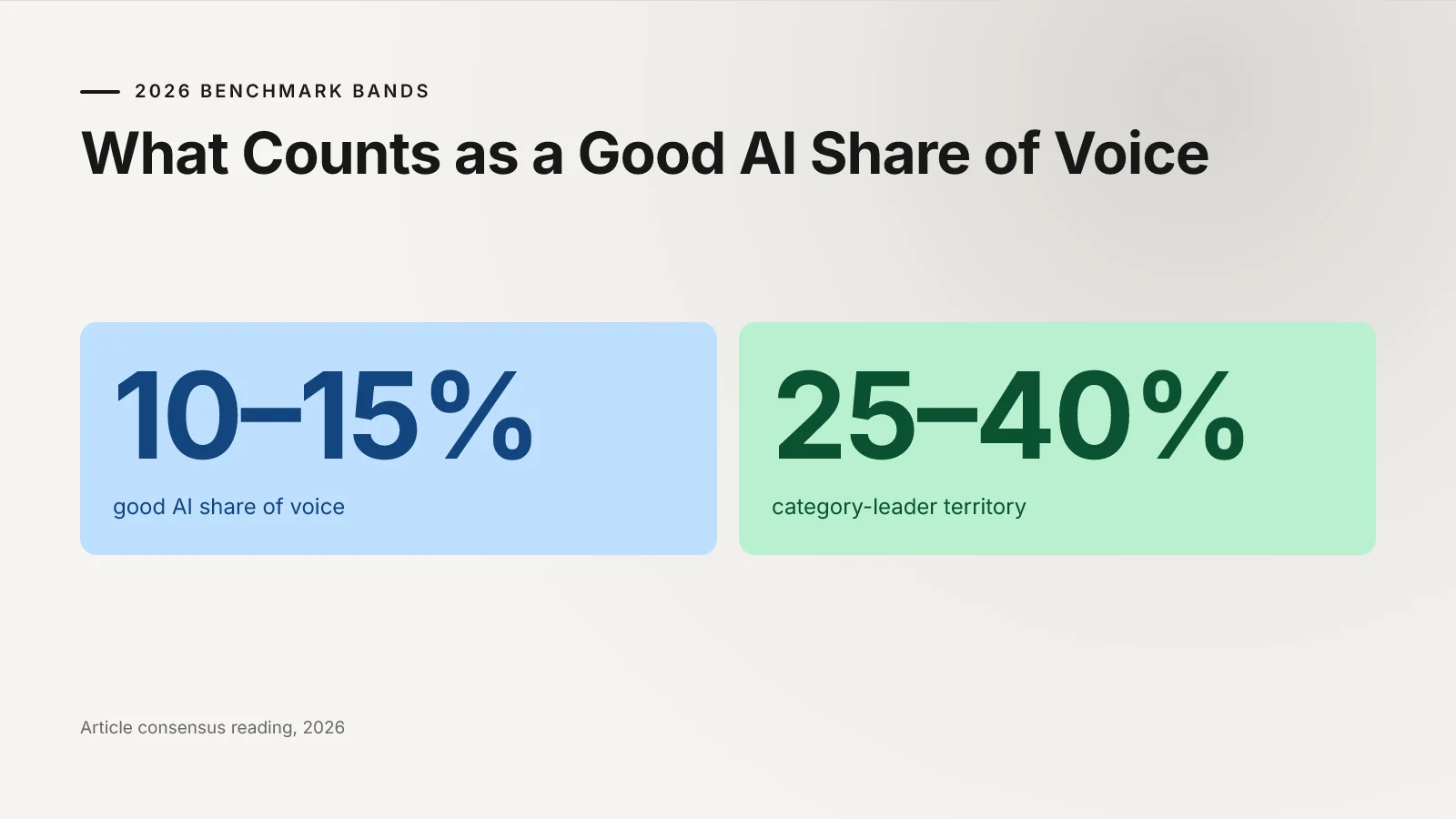
That's the answer. The rest of this page exists because a benchmark you can't interrogate is a benchmark that will eventually mislead you — and this particular number gets quoted with far more confidence than its foundations deserve.
AI share of voice is becoming the KPI language of AI search for a simple reason: rankings don't exist there. ChatGPT, Perplexity, Gemini, and Google's AI Mode generate every answer fresh, so there is no position to hold and no rank tracker to read. What can be measured is a share — out of all the AI answers sampled on the questions your buyers ask, what percentage mention your brand? When founders ask what counts as a good AI visibility score, this share is almost always the number behind the question.
The stakes are why the metric graduated from curiosity to scoreboard. Google made AI Mode the default experience for over a billion users in May 2026, roughly two-thirds of searches already end without a click (SparkToro), and Semrush found AI-referred visitors convert about 4.4x better than organic search visitors. Fewer clicks, better clicks — and share of voice is the closest thing to a scoreboard for whether you're in the answers at all.
One caution before the math: the 10–15% and 25–40% bands come from an early market — vendor indexes and practitioner samples, each built on different prompt sets — not from an audited industry standard, because none exists yet. They're useful the way early weather forecasts are useful: directionally right, precisely wrong. The rest of this guide is the honest way to use them anyway.
What Is AI Share of Voice, Exactly?
AI share of voice (SoV) is the percentage of sampled AI-assistant answers on a fixed set of your topic's prompts that mention your brand. Sample 100 answers across the questions your buyers actually ask; if your brand is named in 12 of them, your AI share of voice is 12%. It is a rate over a sample — never a position.
Three distinctions keep the metric honest:
- Mention-based vs citation-based. A mention is your brand named in the answer text; a citation is your domain linked as a source. The headline benchmarks — 10–15% good, 25–40% leaders — are mention-based: the share of answers that name you. Citation rate is a separate, usually lower number, and the two respond to different work, so track both separately.
- Answer share vs competitive share. Some tools define SoV differently: your share of all brand mentions in the category (your mentions divided by everyone's mentions) rather than the share of answers that mention you. Both are legitimate definitions; they produce different numbers from the same data. Know which one your tool reports before comparing anything to a benchmark.
- Share of voice vs rankings. Google rank tells you almost nothing here — Semrush found roughly 90% of the pages ChatGPT cites rank at position 21 or below on Google for the same query. You can own page one and be absent from every AI answer, or be invisible on Google and quietly dominate the answers.
If AI visibility is the discipline — measuring whether AI assistants mention or cite your brand at all — then share of voice is its headline metric: the one number that compresses a month of sampling into a sentence. Which is exactly why it's worth knowing how that number gets made.
How to Calculate AI Share of Voice: The N-of-M Math
The honest way to calculate AI share of voice is the N-of-M method: on a fixed prompt set, run every prompt multiple times per engine, and report mentions as N out of M total sampled answers — with every raw answer kept as a receipt. The formula is just:
AI share of voice = (answers mentioning your brand ÷ total sampled answers) × 100
The discipline is in how the sample gets built:
- Fix a prompt set from real buyer questions. Ten to twenty prompts like "best [category] for [use case]," "how do I [problem you solve]," and "[you] vs [competitor]" — not vanity prompts about your own brand name, which inflate the number and measure nothing.
- Run each prompt several times per engine, on a schedule. AI answers are non-deterministic; a single run is a coin flip wearing a lab coat. Repetition is what turns anecdotes into a rate.
- Count mentions and citations separately. They move differently and mean different things.
- Keep every raw answer, timestamped, with a label for how each engine was probed. A share of voice you can't audit is a claim, not a measurement.
A worked example with real arithmetic: fix 15 prompts, run each 4 times, across 2 engines. That's 15 × 4 × 2 = 120 sampled answers, so M = 120. Your brand is named in 14 of them: 14 ÷ 120 = 11.7% mention-based share of voice — inside the forming 10–15% "good" band. Your domain appears as a linked source in 6: a 5% citation rate. Next month, same prompt set and run counts, you're named in 19 of 120 — 15.8% — and now you have a trend, which is worth more than either snapshot.
This is the same sampling methodology behind what AI visibility is and how it's honestly measured; share of voice is that method's headline output. If a number ever arrives without its M — "you're at 23%!" — you don't have a share of voice. You have a decimal with good marketing.
How to Use AI Share of Voice Benchmarks Without Fooling Yourself
AI share of voice benchmarks in 2026 are soft — useful for orientation, dangerous for precision. Three properties of the measurement guarantee it:
- Sampling variance. Every SoV number is a statistical sample of a non-deterministic system — SparkToro's audit called AI search results "highly inconsistent." On a 120-answer sample, a move from 11.7% to 13.3% is two answers. That's wobble, not progress. Small samples turn pure noise into exciting-looking swings.
- Prompt-set dependence. Change the prompts and you change the number, often dramatically. A set salted with your brand name reads like market leadership; a set of hard category prompts reads like invisibility. The same brand in the same month can honestly measure 5% or 35% depending on what was asked. Every benchmark comparison silently assumes your prompt set resembles the one behind the benchmark — it probably doesn't.
- Per-engine differences. Engines retrieve from different indexes and weight sources differently, so being visible in Perplexity while absent from Gemini-grounded answers is normal. A blended average across engines can hide exactly the gap you need to see.
So use benchmarks in this order:
- Your own trend first. Fixed prompt set, same engines, same run counts, monthly. Moving from 6% to 12% over a quarter on a consistent method is real signal, whatever any benchmark says. Falling from 20% to 10% is a real warning, even though 10% is nominally "good."
- The category bands second. Under 10%: below the forming "good" line — the normal starting point if you've never deliberately worked on AI visibility. 10–15%: good. 15–25%: the unnamed middle — above good, short of leader. 25–40%: category-leader territory. Above 40%: either you genuinely dominate the category or your prompt set is flattering you — check which before celebrating.
- Cross-tool comparisons never. More on why below.
The bands are a weather report from an early market. Fly by your own instruments; use the weather for context.
What Moves AI Share of Voice
Third-party mentions move AI share of voice more than anything you publish on your own site — that's the clearest finding in the category. Ahrefs studied roughly 75,000 brands and found a brand's own content volume has approximately zero correlation with AI visibility, while mentions across the web and YouTube were the strongest factor in ChatGPT visibility. Share of voice is mostly earned on pages you don't own: reviews, comparison posts, listicles, community threads, podcasts.
Behind that headline, three levers with evidence:
- Earn mentions where engines already read. The domains cited in your sampled answers are a literal to-do list — every one is a surface where a mention of your brand would enter the answers' raw material. This is PR-shaped work, not publishing-shaped work, and it's the core of how to get cited by ChatGPT.
- Make your pages quotable. Princeton's GEO study (KDD 2024, ~10,000 queries) found adding quotations lifted generative-engine visibility about 41%, statistics about 31%, and cited sources about 28% — and Kevin Indig's citation study found 44.2% of ChatGPT citations point to the first 30% of a page. Answer-first pages are how your citation rate catches up with your mention rate.
- Cover your topic completely, and stay genuinely fresh. A connected cluster keeps you retrievable when engines research your subject, and freshness is measurably real: across 17 million citations, Ahrefs found ChatGPT cites URLs about 458 days newer than Google's organic results, and AirOps found content updated within three months is 3x more likely to be cited. Cosmetic date bumps earn nothing.
What doesn't move it: publishing more of the same (the volume correlation is ~zero), schema markup (Ahrefs' 1,885-page test — citations "barely moved"), and keyword stuffing (~zero effect in the Princeton study). If your plan for raising share of voice is "write more blog posts," the data says you'll be busy and invisible.
The Honest Limits of Every Share-of-Voice Number
No tool on the market measures your true AI share of voice — including the one we make. There is no API for chatgpt.com, gemini.google.com, or Google's AI Mode, so every vendor approximates consumer AI answers by querying provider APIs with web search or grounding enabled and counting what comes back. That's a reasonable proxy and the best anyone can do; it is not the thing itself. And personalization — what a specific buyer with a specific history saw in a specific session — is invisible to every vendor at any price.
The practical consequences:
- Numbers from different tools are not comparable. Different prompt sets, different engines, different run counts, and sometimes different definitions of share of voice entirely — answer share vs competitive mention share. Semrush's AI visibility toolkit runs a 126-million-prompt index; Ahrefs Brand Radar tracks 243 million prompts; Profound raised a $96M Series C at a roughly $1B valuation building enterprise AEO measurement (Fortune, Feb 2026). These are serious instruments — and a brand can still read 8% in one and 19% in another while both are internally consistent. Neither is lying. They're measuring different samples with different rulers.
- Scale doesn't buy certainty. A 243-million-prompt index has far narrower error bars than your 120-answer spreadsheet, but the same epistemic ceiling: an API approximation of engines nobody can query directly.
- Precision claims are the tell. Anyone selling a universal, decimal-point AI share of voice — "you're at 23.4% against an industry average of 14.1%" — without publishing the prompts, run counts, and raw answers behind it is overclaiming. The honest ceiling for this category is a sampled rate with disclosed methodology.
Our own bias, disclosed: Inbounder's visibility module reports share of voice exactly this way — N of M sampled answers, per engine, receipts attached — because that's the only version of the number we'd trust ourselves.
So measure with a fixed prompt set and a method you could publish. Judge your trend monthly and the benchmarks loosely — 10–15% is good, 25–40% is leading, and both are pencil marks on a wall that's still being built. The founders who win this metric won't be the ones with the prettiest score; they'll be the ones whose brand keeps showing up when the sample gets drawn, because the web genuinely talks about them.
Frequently Asked Questions
What is AI share of voice?
AI share of voice is the percentage of sampled AI-assistant answers on your topic's prompts that mention your brand. Run a fixed set of buyer questions through engines like ChatGPT and Perplexity repeatedly; if your brand is named in 12 of 100 sampled answers, your AI share of voice is 12%. It's measured by sampling because AI answers are generated fresh each time — there are no fixed positions to track, only rates over a sample.
What is a good AI share of voice?
Early benchmarks treat 10–15% — your brand named in roughly one of every eight sampled AI answers on your topic's prompts — as good, with 25–40% as category-leader territory. These bands are directional, not audited standards: the market is young, and any score depends entirely on which prompts were sampled, how many times, and on which engines. Your own trend on a fixed prompt set is the more reliable signal than any absolute number.
How do you measure AI share of voice?
Use the N-of-M method: fix 10–20 prompts your buyers actually ask, run each several times per engine on a schedule, and divide the answers mentioning your brand by the total sampled answers. For example, 15 prompts run 4 times across 2 engines is 120 answers; named in 14 of them, your share of voice is 11.7%. Keep every raw answer as a receipt so the number can be audited, and keep the prompt set fixed between rounds so the trend is real.
Is a 10% AI share of voice good?
Yes — 10% sits at the bottom of the forming "good" band of 10–15%, meaning your brand appears in one of every ten sampled AI answers on your topic's prompts. Most brands don't reach that without deliberate work on third-party mentions and answer-first content. Whether it's good for you depends on trajectory: 10% up from 4% last quarter is a strong signal, while 10% down from 20% is a warning, whatever the benchmark says.
What's the difference between AI share of voice and AI citation rate?
Share of voice counts mentions — your brand named in the answer text — as a percentage of all sampled answers, while citation rate counts your domain being linked as a source. They move differently: mentions come mostly from third-party coverage like reviews, comparisons, and community threads, while citations come mostly from your own retrievable, answer-first pages. The 10–15% "good" benchmark refers to mention-based share of voice; citation rates typically run lower.
Why do different tools report different AI share of voice numbers?
Because they measure different samples with different rulers: different prompt sets, engines, run counts, and sometimes different definitions entirely — the share of answers mentioning you versus your share of all brand mentions in the category. No API exists for consumer engines like chatgpt.com, so every tool approximates via provider APIs on its own sample. Numbers from different tools aren't comparable; pick one method, keep it consistent, and track your trend inside it.
Can you rank well on Google and still have near-zero AI share of voice?
Yes, and it's common — Semrush found roughly 90% of the pages ChatGPT cites rank at position 21 or below on Google for the same query, so rankings and AI answers are barely correlated. Share of voice is driven mostly by third-party mentions of your brand — the strongest factor in Ahrefs' study of about 75,000 brands — not by ranking positions. A brand that dominates page one but is absent from reviews, comparisons, and communities can be invisible in AI answers.
Related articles
What Is AI Visibility? The Honest Measurement Guide
Most of what's sold as an 'AI rank' is fiction — nobody can query chatgpt.com, and every tool approximates. Here's the honest N-of-M way to measure how often AI assistants actually cite you, receipts included.
How to Get Cited by ChatGPT (Without Domain Authority)
You can't outrank your way into ChatGPT's answers — about 90% of the pages it cites rank 21+ on Google. What works: retrievable, answer-first pages on a topic you cover completely, plus brand mentions on the third-party pages ChatGPT actually reads. Here's the four-step playbook, honest limits included.
Build topical authority with Inbounder
Visual topic clustering, AI-powered content generation, and direct CMS publishing — all in one platform.