What Is AI Visibility? The Honest Measurement Guide
Most of what's sold as an 'AI rank' is fiction — nobody can query chatgpt.com, and every tool approximates. Here's the honest N-of-M way to measure how often AI assistants actually cite you, receipts included.
By Nathan Rofkahr, Founder of Inbounder · Updated

What Is AI Visibility?
AI visibility is how often — and how prominently — AI assistants like ChatGPT, Perplexity, Gemini, and Google's AI Overviews mention or cite your brand when they answer the questions your buyers ask. It's the successor metric to rankings for a growing slice of search: an answer engine doesn't show ten blue links, it shows one synthesized answer, and either you're in it or you don't exist.
The stakes stopped being theoretical this year. Google made AI Mode the default experience in May 2026 for over a billion users. Roughly two-thirds of searches already end without a click (SparkToro), and Pew found people click results about half as often when an AI summary is present — 8% versus 15%. Meanwhile the traffic that does arrive from AI answers is unusually valuable: Semrush found AI-referred visitors convert around 4.4x better than organic search visitors. Fewer clicks, better clicks, and a brand-new scoreboard nobody agreed on how to read.
Here's the problem this guide exists to fix: most of what's sold as an "AI visibility score" hides how the number was made. Vendors show you a confident 0–100 dial and skip the part where every measurement in this category is a statistical sample dressed in a dashboard. So this is the guide that publishes the methodology. You'll get the honest mechanics of measurement — including what nobody can measure, us included — a named method you can run yourself (the N-of-M method), a straight look at the tool landscape, what actually moves the number according to the largest studies available, and a free 30-minute spot check you can do today. No fake precision anywhere.
Why AI Visibility Is Not the Same as Rankings
Being ranked by Google and being cited by AI assistants are different games with different physics — Semrush research found that roughly 90% of the pages ChatGPT cites rank in position 21 or below on Google for the same query. Page three and beyond, in other words, is where most ChatGPT citations live. If rankings predicted citations, that number would be near zero.
The differences run deeper than one correlation:
- Rankings are positional; citations are probabilistic. Google assigns your page a slot you can check twice and get twice. An AI assistant generates each answer fresh — the same prompt on two runs can cite different sources, mention different brands, or skip citing anything at all. Search Atlas found ChatGPT cites only about 8% of the search results it retrieves while answering.
- Rankings reward the page; citations reward the passage. Engines lift the clearest extractable claim from wherever it lives — Kevin Indig's citation study found 44.2% of ChatGPT citations point to the first 30% of a page's content. A great answer buried under 800 words of throat-clearing loses to a direct one placed high.
- Evidence beats rank. Princeton's GEO study (KDD 2024, ~10,000 queries) found pages ranked around fifth gained up to 115% more generative-engine visibility when their content carried quotable evidence. The levers that move citations are not the levers that move rank.
None of this makes SEO obsolete — you still have to be indexed and retrievable before you can be citable, which is why topical coverage still matters. It means visibility in AI answers is a separate metric that needs its own measurement. For the mechanics of how LLMs retrieve and choose sources in the first place, see LLM SEO, explained for founders.
Can You Actually Measure AI Visibility?
Yes — but only by sampling, and you should walk away from anyone who claims otherwise. We say this as a company that ships an AI visibility tool. Three facts define what's honestly measurable:
1. Nobody can query the consumer engines. There is no API for chatgpt.com, gemini.google.com, or Google's AI Overviews. Every tool on the market — every single one, ours included — approximates consumer AI answers by calling provider APIs (OpenAI, Anthropic, Google) with web search or grounding enabled and recording what comes back. That's a reasonable proxy, and it's the best anyone can do. It is not the thing itself, and a tool that implies it's reading real user sessions inside ChatGPT is misleading you.
2. Answers are non-deterministic. Ask the same question twice and you'll get different answers — SparkToro's audit of AI search results called them "highly inconsistent." A single run is an anecdote. Only repeated runs of the same prompt produce a rate you can trust.
3. Nobody sees personalization. Consumer AI answers vary with a user's history, location, and session context. No vendor at any price measures what your specific buyer saw last Tuesday.
The consequence: a deterministic "you rank #3 in ChatGPT" is fiction — there is no position to hold. What can honestly be measured is a sampled citation rate: on a fixed set of prompts, run repeatedly, how many answers out of the total mentioned or cited you — with the raw answers stored so anyone can audit the number. We hold our own product to this standard: every engine we probe carries a plain-language label of exactly what it is — an API approximation with live web access, "not the claude.ai consumer UI" — and that label ships verbatim in the interface. Demand the same from anyone who wants your money.
The N-of-M Method: Honest AI Visibility Measurement
The N-of-M method measures AI visibility as a sampled citation rate: across M total answer runs on a fixed prompt set, your brand was mentioned or cited N times — and every run's raw answer is kept as a receipt. It's the methodology this site uses on itself, and it has five steps:
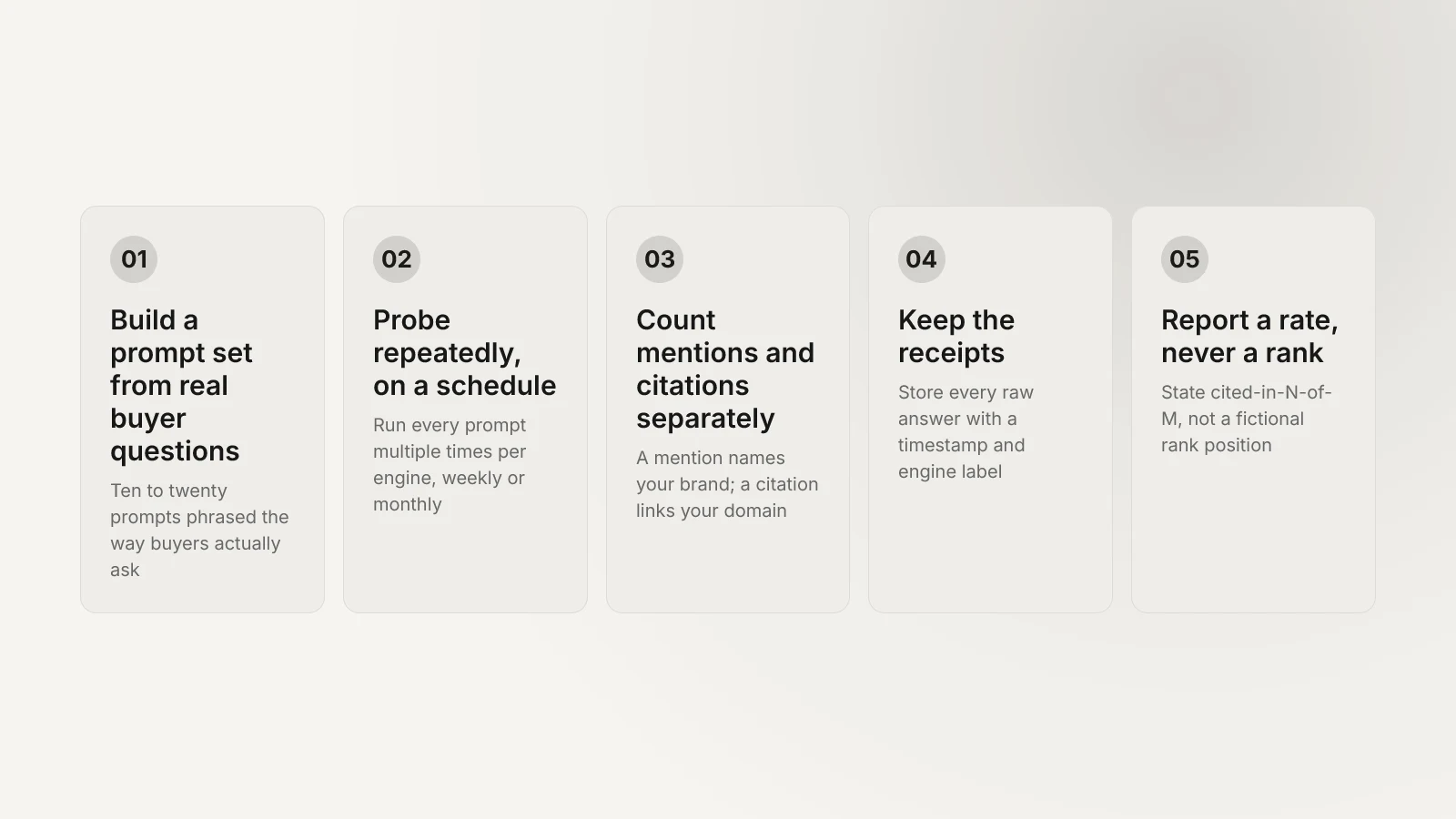
1. Build a prompt set from real buyer questions. Ten to twenty prompts phrased the way buyers actually ask: "best [category] for [use case]," "how do I [problem you solve]," "[you] vs [competitor]," "is [category] worth it." Not vanity prompts about your brand name — prompts where you deserve to appear but might not.
2. Probe repeatedly, on a schedule. Run every prompt multiple times per engine, weekly or monthly. Non-determinism is the whole reason M exists; one run per prompt is a coin flip pretending to be a measurement.
3. Count mentions and citations separately. A mention is your brand named in the answer text; a citation is your domain linked as a source. They move differently and both matter — track both.
4. Keep the receipts. Store every raw answer with a timestamp and an engine label that says exactly how it was probed. A number you can't audit is a number you can't trust — or publish.
5. Report a rate, never a rank. "Cited in 4 of 20 Claude-style runs this month, up from 1 of 20" is an honest sentence. "You rank #4 in AI" is not.
A worked example: 12 prompts, 3 runs each, across 2 engines is 72 answers — M = 72. Your brand appears in 9 of them (a 12.5% mention rate) and your domain is cited in 4 (a 5.6% citation rate). For context while benchmarks mature: early share-of-voice benchmarks treat 10–15% as good and 25–40% as category-leader territory. Directional, not gospel — the trend on your own fixed prompt set is the real signal.
AI Visibility Tools: An Honest Look at the Landscape
AI visibility tools all work the same way underneath — prompts in, API answers out, brand and domain counts aggregated — and the serious ones are real, well-funded products, not vaporware. The category consolidated fast:
| Tool | Scale | Built for |
|---|---|---|
| Semrush AI visibility toolkit | 126M-prompt index | Enterprise and agency suites |
| Ahrefs Brand Radar | 243M tracked prompts | Brand share tracking inside Ahrefs |
| Profound | Enterprise AEO platform; raised a $96M Series C at a ~$1B valuation (Fortune, Feb 2026) | Enterprise brands |
| Inbounder | N-of-M sampling on your own buyer prompts, receipts stored | Founders — disclosure: that's us |
Two honest observations about this table. First, the big indexes are genuinely useful — 126 million or 243 million prompts reveal category-level share of voice in a way a small sample can't, and if you're an enterprise with the budget they're real measurement. Second, every row has the same epistemic limit: all of them, us included, approximate consumer engines through provider APIs, because that's all anyone can do. Scale doesn't change what's knowable; it changes the confidence interval. Our angle isn't that we measure something others can't — it's that we publish the sampling math, show the receipts, and price it for a founder instead of a Fortune 500 martech line item.
So evaluate any tool — including ours — with four questions:
- Can I see the exact prompts behind my number?
- How many runs produced it — an N-of-M rate, or one run dressed up?
- Can I read the raw answers, the receipts?
- Is each engine labeled with how it's actually probed?
A vendor who answers all four plainly is selling measurement. A vendor with a smooth 0–100 "AI rank" and no answers is selling vibes at enterprise prices. We dissect that failure mode — readiness grades posing as citation measurements — in do AEO scores predict AI citations?
What Actually Moves AI Visibility
Third-party mentions of your brand move AI visibility more than anything you publish on your own site. That's the headline finding of Ahrefs' study of roughly 75,000 brands: a brand's own content volume showed approximately zero correlation with AI visibility, while mentions across the web and YouTube were the strongest factor in ChatGPT visibility. Publishing more posts about yourself doesn't make AI assistants trust you; other people talking about you does.
What the evidence says works:
- Earn third-party mentions. Reviews, comparison posts, community threads, podcasts, YouTube — the sources AI engines already cite for your category. This is a PR-shaped problem more than a content-shaped one, and it's the core of how to get cited by ChatGPT.
- Format answer-first. Princeton's GEO study (KDD 2024) measured what makes generative engines quote a page: adding quotations lifted visibility around 41%, statistics around 31%, and cited sources around 28%. Put the direct answer in the first sentence under every question-shaped heading — Kevin Indig's citation study found 44.2% of ChatGPT citations come from the first 30% of a page.
- Stay genuinely fresh. Across 17 million citations, Ahrefs found ChatGPT cites URLs about 458 days newer than Google's organic results, and AirOps found content updated within three months is 3x more likely to be cited. Real updates — new data, new sections — not cosmetic date bumps, which earn nothing.
- Cover your topic completely. Deep, interlinked coverage is what makes your site retrievable when engines research your subject; it's the rankings half of the equation and the floor under everything above. If you're measuring that side too, start with how to measure topical authority.
What doesn't move it: schema markup (Ahrefs tested 1,885 pages — citations "barely moved"), keyword stuffing (effectively zero in the Princeton study), and volume for volume's sake. If your content strategy is "more," AI visibility is where that stops working.
Measure It Yourself, Free, in 30 Minutes
You can run an honest N-of-M spot check today with nothing but a spreadsheet and the free tiers of ChatGPT and Perplexity. The 30-minute version:
Minutes 0–10: write 10 buyer prompts. Steal phrasing from sales calls, support tickets, and Reddit threads in your niche: "best [category] for [your ICP]," "how do I [problem]," "[competitor] alternatives," "is [category] worth it for [use case]." One row each in the spreadsheet.
Minutes 10–25: run them. Open a fresh chat for every prompt — logged out or in a clean session where possible, to minimize personalization. Run each prompt once in ChatGPT with web search and once in Perplexity. For each answer record three things: Were you mentioned? Was your domain cited as a source? Which domains were cited? Screenshot every answer — those are your receipts.
Minutes 25–30: tally. Count your N-of-M per engine: "mentioned in 2 of 10 ChatGPT answers, cited in 0." Then read the cited-domains column slowly — it's the most valuable part of the exercise, because it's a literal list of who the engines trust for your category and where your mention-building effort should go next.
Be honest with yourself about what you just built: one run per prompt is a snapshot, not a trend, and non-determinism means the numbers will wobble between sessions. The fix is repetition — same prompt set, monthly, more runs per prompt as your patience allows. If you'd rather not spend that hour by hand every month, this exact loop — scheduled repeated runs, mentions and citations counted separately, every raw answer stored as a receipt — is what Inbounder's AI visibility module automates. Either way, the methodology is now yours, which is the point.
What Should an AI Visibility Score Tell You?
An honest AI visibility score is a sampled citation rate with receipts — "cited in N of M runs on this prompt set, over this period" — not a proprietary 0–100 number with the methodology hidden. Hold every score to that standard, whether it comes from a six-figure enterprise platform or your own spreadsheet.
What a real score can tell you:
- The trend. On a fixed prompt set, moving from 2-of-40 to 9-of-40 over a quarter is a genuine signal that your mention-building and answer-first formatting are landing.
- Per-engine differences. It's normal to be visible in Perplexity and invisible in Gemini-grounded answers, or the reverse — engines retrieve from different indexes and weight sources differently, and the gap tells you where to look.
- The gap list. The domains cited instead of you are a ranked to-do list for outreach, guest content, and reviews.
What no score can tell you, at any price:
- What one specific user saw in one specific session — personalization is invisible to every vendor.
- Your visibility on prompts nobody sampled — a score is only as broad as its prompt set.
- A guarantee. Anyone promising a specific citation outcome is selling something other than measurement.
The honest posture for a founder in 2026: measure with a method you could publish — here it is, N-of-M with receipts — spend the real effort on third-party mentions and answer-first content, and judge the trend quarterly, not the snapshot daily. AI visibility is the new scoreboard, and it rewards what search always eventually rewarded: being genuinely worth citing. The measurement just got honest enough to prove whether you are.
Frequently Asked Questions
What is AI visibility?
AI visibility is how often AI assistants such as ChatGPT, Perplexity, Gemini, and Google's AI Overviews mention or cite your brand when answering the questions your buyers ask. Unlike a Google ranking, it isn't a fixed position — AI answers are generated fresh each time — so honest measurement means sampling: running a set of real buyer prompts repeatedly and recording the rate at which your brand appears.
What is a good AI visibility score?
Early benchmarks put 10–15% share of voice — being mentioned in roughly one in eight AI answers on your topic's prompts — as good, with category leaders reaching 25–40%. Treat these numbers as directional: the category is young, and any score depends entirely on which prompts were sampled and how many times they were run. The trend on a consistent prompt set matters more than the absolute number.
How do AI visibility tools actually work?
Every AI visibility tool works the same way underneath: it sends prompts to AI-model APIs with web search or grounding enabled, records which brands and domains appear in the answers, and aggregates the results. No tool queries chatgpt.com or the other consumer apps directly — no ranking API exists for AI assistants — so every number you see is an approximation built from sampled API answers. Good tools disclose that plainly; bad ones dress it up as a deterministic rank.
Can you track your ranking in ChatGPT?
No — there is no such thing as a ChatGPT ranking. ChatGPT generates each answer on the fly, results vary between runs and between users, and OpenAI offers no ranking API. What you can track honestly is a citation rate: how many times, out of M sampled runs on a fixed prompt set, your brand was mentioned or your domain was cited. Any tool showing you a stable 'position' in ChatGPT is presenting a probabilistic sample as a deterministic fact.
Why doesn't ChatGPT mention my brand?
Usually because the wider web barely mentions it. Ahrefs' study of roughly 75,000 brands found third-party web and YouTube mentions are the strongest factor in ChatGPT visibility, while a brand's own content volume shows almost no correlation. The fix is earning mentions in the review sites, comparison posts, and communities AI engines already cite for your category — plus keeping your most citable pages genuinely fresh and formatted so a single passage answers a question outright.
Is AI visibility the same as GEO or AEO?
They're related but not the same thing. GEO (generative engine optimization) and AEO (answer engine optimization) describe the practice of optimizing content and brand presence to appear in AI answers, while AI visibility is the measurement layer — the metric that tells you whether any of that work is paying off. You optimize with GEO and AEO tactics; you verify with AI visibility measurement.
How often should you measure AI visibility?
Monthly is the practical floor for a manual spot check, and weekly automated sampling is better — AI answers change fast content updated within three months is 3x more likely to be cited, per AirOps and individual runs are noisy, so more frequent sampling separates signal from wobble. Whatever cadence you pick, keep the prompt set fixed between rounds; change the prompts and you've started a new measurement, not continued the old one.
Related articles
How to Get Cited by ChatGPT (Without Domain Authority)
You can't outrank your way into ChatGPT's answers — about 90% of the pages it cites rank 21+ on Google. What works: retrievable, answer-first pages on a topic you cover completely, plus brand mentions on the third-party pages ChatGPT actually reads. Here's the four-step playbook, honest limits included.
LLM SEO (LLMO), Explained for Founders
LLM SEO, LLMO, AEO, GEO — four acronyms, one overlapping practice. What actually puts you in AI answers is two mechanisms on different clocks, and most advice conflates them.
AI Share of Voice: What's a Good Score in 2026?
The forming benchmarks: 10–15% AI share of voice is good, 25–40% is category-leader territory — both early-market and directional, not gospel. What the metric actually measures, the N-of-M arithmetic to calculate it honestly, and how to use soft benchmarks without fooling yourself.
Do AEO Scores Actually Predict AI Citations?
Every AEO checker will grade your page in seconds. None of them can tell you whether ChatGPT actually cites you — because a readiness score and a citation measurement are different instruments, and this category keeps selling one dressed as the other. Here's the honest split.
Build topical authority with Inbounder
Visual topic clustering, AI-powered content generation, and direct CMS publishing — all in one platform.