Measuring Topical Authority: 5 Essential Metrics
Measuring topical authority requires tracking five specific metrics that most SaaS founders completely ignore, even while obsessing over vanity numbers like domain authority.
By Nathan Rofkahr, Founder of Inbounder · Updated

Key Takeaways
- Topical keyword coverage ratio tells you how much of your topic you've actually addressed versus how much you're missing
- Cluster-level ranking averages expose weak spots that page-level tracking hides completely
- Organic share of voice is the closest proxy to measuring topical authority against competitors
- Content depth scoring quantifies whether your articles are genuinely comprehensive or just long
- Topically relevant backlink ratio matters far more than raw backlink count for authority signals
- No single metric captures topical authority; you need all five working together in a dashboard
- You can set up basic measurement for all five metrics in under 30 minutes using free and low-cost tools
If You Can't Measure It, You Can't Grow It
Why There's No Single "Topical Authority Score" (Yet)
Topical authority is the degree to which search engines recognize a website as a credible, comprehensive source on a specific subject area. And frustratingly, Google doesn't hand you a neat score for it.
There's no "Topical Authority: 74/100" sitting in your Search Console. Not yet, anyway. Google's helpful content documentation makes clear that demonstrating expertise across a topic matters for rankings, but the search giant keeps the exact mechanics under wraps. So you're left assembling the picture from multiple data points.
That's actually fine. Relying on a single score would be misleading. Topical authority measurement refers to the practice of using multiple proxy metrics to assess how thoroughly and credibly your site covers a given subject. Think of it like diagnosing engine trouble. No single gauge tells the whole story, but oil pressure, temperature, RPMs, and fuel level together paint an accurate picture.
The five metrics below are those gauges. Each captures a different dimension of authority, and together they give you something you can act on.
Metric 1: Topical Keyword Coverage Ratio
How to Calculate Your Coverage vs. Total Topic Keywords
Topical keyword coverage ratio is the percentage of relevant keywords within your topic that your site has published content targeting.
Most teams think they've "covered" a topic because they wrote 15 articles. But when you map those 15 articles against the 200+ keywords that exist within that topic space, you realize you've addressed maybe 8% of the territory. That gap? That's where competitors are eating your lunch.
Calculating this is straightforward, though it takes some upfront work:
- Map the full keyword universe for your topic using Ahrefs, Semrush, or even Google's "People Also Ask" and autocomplete suggestions. Export everything.
- Group keywords into subtopics and remove duplicates or near-duplicates that a single article would satisfy.
- Cross-reference against your published content to see which subtopics you've addressed and which remain open.
- Divide covered subtopics by total subtopics. That's your coverage ratio.
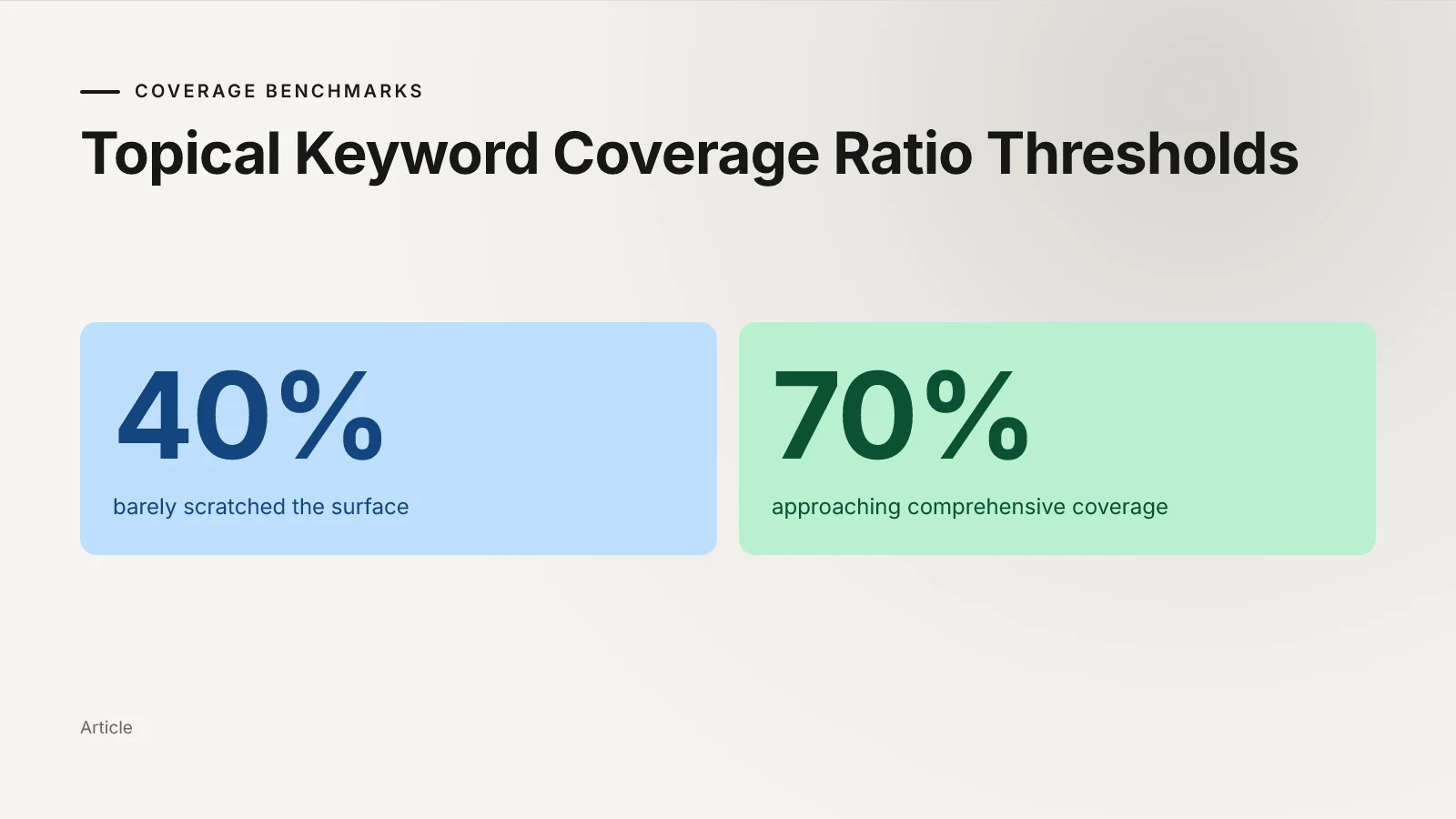
Below 40% means you've barely scratched the surface. Between 40–70%, you're building momentum. Above 70%, you're approaching the kind of comprehensive coverage that search engines associate with genuine expertise.
But raw coverage alone is misleading. Publishing thin, 300-word stubs on 50 subtopics won't impress Google or your readers (and it won't impress anyone else either). Which is exactly why you need the next four metrics alongside this one.
Metric 2: Average Ranking Position by Topic Cluster
Tracking Cluster-Level Rankings in Google Search Console
Average ranking position by topic cluster is the mean search position across all keywords within a single content cluster, rather than looking at pages individually.
This is where most measurement goes sideways. You check rankings page by page, see one article at position 3 and another at position 47, and you have no idea whether your cluster is winning or losing overall. Page-level tracking is like judging a basketball team by one player's stats. You need the team average.
Google Search Console gives you this data for free. Filter your Performance report by query, then manually group queries by cluster topic. If you're using Ahrefs or Semrush, you can tag keyword groups and track average position over time at the group level.
What makes this metric powerful is the trend line, not any single snapshot. When your cluster average drops from position 32 to position 18 over three months, that's a strong signal Google is granting you more topical authority in that space. The opposite trend, even while individual pages fluctuate, signals a problem.
Semrush's published research on topical authority reaches the same conclusion: sites with comprehensive, interlinked topic clusters consistently outrank sites publishing isolated, unconnected content. That compounding effect is the whole thesis behind building topical authority systematically.
One nuance worth paying attention to: informational keywords in your cluster will typically rank faster than commercial ones. So if your cluster average improves but your money pages lag, that's normal. The informational content builds the authority that eventually lifts the commercial pages. Patience matters here. If you are deciding what counts as one cluster before you measure it, start with what a topic cluster is and how the pages should link.
Metric 3: Organic Traffic Share Within Your Niche
Using Share of Voice Tools to Benchmark Authority
Organic share of voice (SOV) is the percentage of all organic clicks for a defined set of keywords that land on your site versus competitors.
This is arguably the single most useful proxy for measuring topical authority because it's inherently competitive. Your coverage ratio might be 80%, but if three competitors each have 90%+ coverage and stronger backlink profiles, your actual authority in the market could still be weak. SOV tells you the truth (whether you want to hear it or not).
Both Ahrefs and Semrush offer share of voice tracking. The setup involves defining a keyword set that represents your topic, then monitoring what percentage of estimated traffic across those keywords flows to your domain. Ahrefs' Share of Voice feature within their Rank Tracker is particularly clean for this.
According to the Content Marketing Institute's B2B Content Marketing Report (CMI), only about a third of B2B marketers systematically track competitive content performance. That's a massive blind spot. If you're not benchmarking against competitors, you're flying blind, celebrating your own traffic numbers while a rival quietly dominates the keyword set you care about.
Track SOV monthly. A rising share of voice, even by 1–2 percentage points per month, means your topical authority strategy is working. Flat or declining SOV with increasing content output? Something structural needs to change, likely your internal linking architecture or content depth.
Metric 4: Content Depth Score per Cluster
How to Use Clearscope or Surfer SEO for Depth Analysis
Content depth score is a numerical grade assigned by content optimization tools that measures how thoroughly an article covers the semantic entities and subtopics that top-ranking pages address.
You can publish 50 articles on a topic and still lack authority if every article skims the surface. Search engines evaluate comprehensiveness at the page level and the site level. Depth scoring tools like Clearscope, Surfer SEO, and MarketMuse reverse-engineer what "comprehensive" means for any given query by analyzing top-ranking content.
Surfer SEO's Content Score feature, for example, evaluates your content against the top 10 SERP results for a target keyword, grading you on term usage, heading coverage, content length, and semantic relevance. According to Surfer's own documentation, a score above 70 generally correlates with page-one potential.
The real insight comes from averaging these scores across an entire cluster. A cluster with 20 articles averaging a depth score of 45 is a cluster that looks thin to Google, regardless of volume. Twelve articles averaging 78 will likely outperform it. Every time.
Run a depth audit quarterly:
- Pull every article in a cluster
- Score each one in your optimization tool of choice
- Calculate the cluster average
- Identify the bottom 20% and prioritize those for rewrites
This is tedious work. Nobody loves it. But it's the difference between teams that build genuine authority and teams that just build content libraries. Quantity without depth is noise.
Metric 5: Topically Relevant Backlink Ratio
Filtering Your Backlink Profile by Topical Relevance
Topically relevant backlink ratio is the percentage of your total backlinks that come from websites and pages within the same subject area as your content.
A hundred backlinks from random directories and off-topic blogs won't move the needle the way 15 links from respected sites in your niche will. Google's systems have grown increasingly sophisticated at evaluating link context. A link to your SaaS pricing guide from a well-known SaaS review site carries dramatically more authority signal than a link from a general news aggregator.
Ahrefs documented this principle extensively in their analysis of topical authority, showing that sites like Healthline built dominant positions in health content not just through volume but through earning backlinks overwhelmingly from health-related domains (Ahrefs). Healthline's backlink profile is disproportionately weighted toward medical, wellness, and health education sites. That topical concentration reinforces the authority signal Google associates with their domain for health queries.
To calculate your own ratio, export your backlink profile from Ahrefs or Semrush, categorize referring domains by topic relevance (even a rough manual classification works), and divide topically relevant links by total links. If you're below 30% topical relevance, your link building strategy needs a topical focus.
Link context and topical proximity between linking pages shape how search algorithms interpret authority signals. The mechanism makes intuitive sense: a recommendation from someone in your field carries more weight than one from a stranger in an unrelated industry.
Summary: Build Your Topical Authority Dashboard
Pull these five metrics into a single view, whether that's a Google Sheet, a Notion database, or a Looker Studio dashboard. Track them monthly. The combination tells you what no single metric can: whether you're actually building authority or just building a content library.
Your dashboard columns:
- Topic cluster name
- Keyword coverage ratio (%)
- Average cluster ranking position
- Organic share of voice (%)
- Average content depth score
- Topically relevant backlink ratio (%)
Color-code each by performance threshold. Green means progressing. Red means stalled. This visual snapshot, updated monthly, becomes your strategic compass for content investment decisions.
Action Steps: Set Up Measurement in 30 Minutes
- Minutes 1–10: Export your target keyword list from Semrush or Ahrefs. Group by cluster. Calculate coverage ratio per cluster.
- Minutes 10–15: Set up keyword group tracking in your rank tracker. Pull initial cluster average positions.
- Minutes 15–20: Configure share of voice tracking for your primary topic against 3–5 competitors.
- Minutes 20–25: Run your five weakest-performing articles through Clearscope or Surfer SEO. Record depth scores.
- Minutes 25–30: Export your backlink profile. Flag the top 50 referring domains as "topically relevant" or "off-topic." Calculate the ratio.
That's your baseline. From here, measuring topical authority becomes a monthly habit, not a guessing game. And if you're still building out your ecommerce topical strategy, these same five metrics apply regardless of your vertical.
Frequently Asked Questions
What is topical authority in SEO?
Topical authority is a site's perceived expertise and comprehensiveness on a specific subject, as evaluated by search engines. It's built through publishing deep, interlinked content across all subtopics within a niche, supported by relevant backlinks and consistent topical focus.
How do you measure topical authority without a dedicated tool?
You can measure it using free tools like Google Search Console for cluster rankings, spreadsheets for keyword coverage calculations, and manual backlink categorization from Ahrefs' free tier. No single paid tool is required, though premium tools speed up the process significantly.
What is a good topical keyword coverage ratio?
A coverage ratio above 70% indicates strong topical comprehensiveness. Below 40% means significant gaps remain. Between 40–70%, you're building but still have meaningful ground to cover relative to the full keyword universe for your topic.
How often should you measure topical authority metrics?
Monthly tracking strikes the right balance. Topical authority builds gradually, so weekly checks create noise. Quarterly reviews risk missing trends. Monthly measurement lets you spot momentum shifts and course-correct before wasting resources on underperforming clusters.
Does topical authority matter more than domain authority?
They measure different things. Domain authority reflects overall site strength, while topical authority reflects depth within a specific subject. A site with modest domain authority but exceptional topical depth can outrank high-DA sites for niche queries. For SaaS companies targeting specific verticals, topical authority often delivers faster ranking gains.
Can you lose topical authority over time?
Yes. If competitors publish more comprehensive content, your share of voice declines. If your content becomes outdated, depth scores drop relative to fresher SERP results. Topical authority requires ongoing maintenance, not just initial buildout.
Related articles
How to Build Topical Authority: The 90-Day Founder Sprint (2026)
You build topical authority by publishing one interlinked cluster — a pillar plus about 12 answer-first articles on a topic you can own — in a focused 90-day sprint. Here is the exact plan, including what 13 unindexed articles on our own site taught us to do differently.
B2B Topical Authority Strategy: The Authority Grid for SaaS Founders
A B2B topical authority strategy works when you cover one buyer job completely — problem-aware to product-aware — before touching the next. The Authority Grid turns that rule into a plan a founder can actually execute.
Internal Linking for Topical Authority: The Hub–Spoke–Mesh Method
Structure internal links in three layers: a hub pillar linking down to every supporting article, spokes linking back up, and a mesh between siblings where the overlap is real. Here's the full method — shaped by the indexing failure on our own blog.
Build topical authority with Inbounder
Visual topic clustering, AI-powered content generation, and direct CMS publishing — all in one platform.