How to Build Topical Authority: The 90-Day Founder Sprint (2026)
You build topical authority by publishing one interlinked cluster — a pillar plus about 12 answer-first articles on a topic you can own — in a focused 90-day sprint. Here is the exact plan, including what 13 unindexed articles on our own site taught us to do differently.
By Nathan Rofkahr, Founder of Inbounder · Updated

How Do You Build Topical Authority? The Short Answer
You build topical authority by choosing one narrow topic your business should own, mapping every question a real buyer asks about it, and publishing a fully interlinked cluster — one pillar page plus roughly twelve supporting articles — where each page answers its question in the first two sentences. Search engines grant authority to sites that cover a subject completely and connect that coverage with internal links, not to sites with the biggest backlink profiles. Done as a focused push, you'll have the whole asset built and indexed inside 90 days, with your first real ranking data arriving right behind it.
That's the entire method. Everything below is the execution plan, which we call the 90-Day Founder Sprint: 15 days of auditing and mapping, 30 days of publishing, 25 days of linking and on-page work, and 20 days of measurement and promotion. It assumes no content team, a young domain, and a founder's calendar — a few focused hours a week, not a marketing department.
One thing before you start. We published an earlier version of this playbook before we had fully lived it. Then Google declined to index 13 of our own articles for five straight months, and we learned exactly which steps are optional and which are load-bearing. That story is next, because it's the difference between this sprint working and it quietly failing.
We Published 13 Articles. Google Indexed Zero.
In February 2026 we published a 13-article topical authority cluster on this site. The writing was solid. The topical map was real. Five months later, Google Search Console showed zero of the 13 indexed. Not ranking badly — not indexed at all, parked in "Crawled – currently not indexed."
The autopsy was humbling, because every wound was self-inflicted:
- No in-body internal links. Our articles listed related posts in a sidebar, but the article bodies contained zero actual links — while literally preaching a "no dead ends" rule. To a crawler, we'd published 13 near-orphan pages and called it a cluster.
- Two pages, one intent. We had a "9 proven steps" guide and a separate "90-day roadmap" that cross-referenced each other and split a single search intent. Google had no reason to pick either. The page you're reading is the merge.
- Buried answers. Our definitions sat at the bottom of FAQ sections, under slow-burn intros ("You've probably been there..."). Nothing quotable appeared in the first screen of any page.
- Cosmetic freshness. We bumped "updated" dates without changing the content underneath. Our opinion after living it: that fools no one, and it spends your credibility.
None of this is exotic. It's the boring stuff every guide lists and almost every founder skips — we skipped it too. The Sprint below bakes each lesson in: internal links go live on day one, one page per intent, the answer comes first, and the date only moves when the content does.
The 90-Day Founder Sprint at a Glance
The Sprint produces one pillar page and about twelve cluster articles in 90 days, on a schedule a solo founder can actually keep.
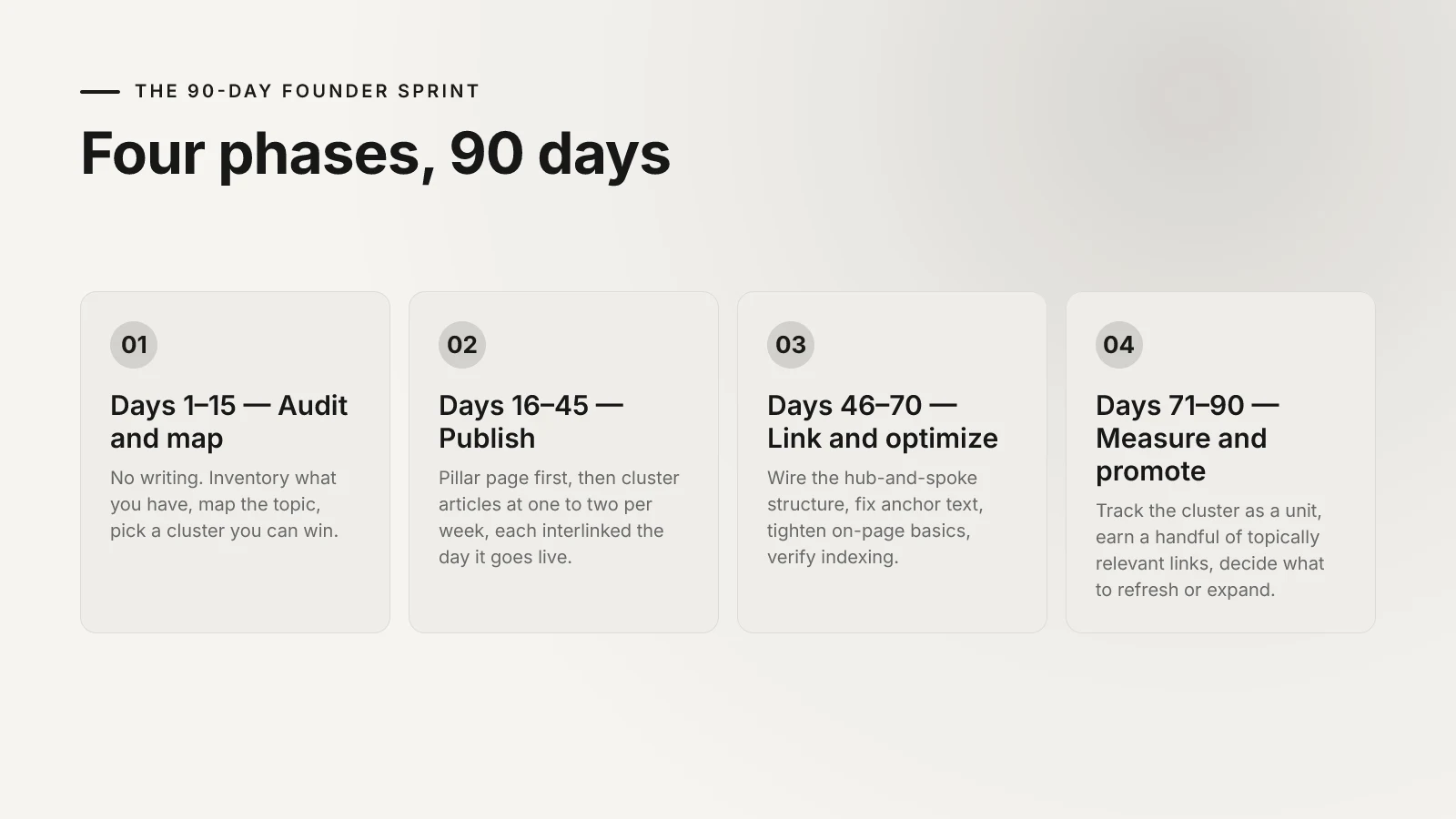
- Days 1–15 — Audit and map. No writing. Inventory what you have, map the topic, pick a cluster you can win. Output: a one-tab spreadsheet.
- Days 16–45 — Publish. Pillar page first, then cluster articles at one to two per week, each one interlinked the day it goes live.
- Days 46–70 — Link and optimize. Wire the hub-and-spoke structure, fix anchor text, tighten on-page basics, verify indexing.
- Days 71–90 — Measure and promote. Track the cluster as a unit, earn a handful of topically relevant links, decide what to refresh or expand.
If the pillar-and-cluster model itself is new to you, read the topic clusters primer first — this guide assumes you know the vocabulary.
Be clear about what the Sprint won't do: it won't get you rankings by day 90. New pages on young domains typically need three to six months to find their level, so the sprint's job is to build the asset, get it indexed, and start the clock. Months four through six are when the compounding shows up. Anyone promising page one on a fresh domain in 90 days is selling something.
Days 1–15: Audit, Map, and Pick a Fight You Can Win
Resist the urge to write. The first two weeks are pure analysis, and skipping them is how you end up with forty posts and no authority.
Step 0: confirm Google can index you at all. Before planning a single article, open Search Console and check the index status of your existing pages. Publishing into a site Google won't index is rowing a boat that isn't in the water — we did it for five months. If pages sit in "Crawled – currently not indexed," diagnose that first: internal linking, sitemap, duplicate intents, thin pages.
Days 1–5: run a coverage audit. Inventory every URL you have and tag each by subtopic. You're hunting three things: gaps (subtopics with no coverage), overlaps (two pages chasing one intent — merge them, don't keep both), and orphans (pages nothing links to). The topical authority audit checklist walks through this step by step.
Days 6–12: build the topical map. One spreadsheet: subtopic, target query, searcher intent, content format, priority, and which pillar it belongs to. Map the full universe before prioritizing — the goal is to see the whole territory, then claim a defensible piece of it. The full walkthrough lives in how to create a topical map.
Days 13–15: pick a fight you can win. Choose the narrowest topic that your product credibly owns and buyers actually search. Complete coverage of a narrow topic beats partial coverage of a broad one — that's the entire trade a small site makes, and it's a good trade. A pillar plus twelve articles can fully cover "dunning emails for SaaS." It cannot fully cover "email marketing."
Days 16–45: Publish the Pillar First, Then the Clusters
Now you write — but the order matters. The pillar page goes first, always, because cluster articles need a hub to link to on the day they're born. Orphans-then-cleanup is the mistake we already made for you.
Your pillar is a comprehensive 2,500–4,000 word guide covering the whole topic at overview depth, with a linked table of contents that mirrors your map. Then publish cluster articles at one to two per week, each going deep on one subtopic and one intent.
Two rules for every page:
- Answer first. The first sentence under the H1 — and under every heading — directly answers the question the heading asks. Definitions never live at the bottom of an FAQ. This is what makes a page quotable, by search engines and by AI assistants alike.
- Interlink at publish, not later. Every cluster article links to the pillar and at least one sibling in its body, with descriptive anchor text, before you hit publish. "We'll wire the links in a cleanup pass" is how a cluster becomes 13 orphans.
Ignore volume benchmarks built for content teams. A founder shipping one genuinely connected, answer-first article per week will build more authority than a scattershot blog shipping five. If you draft with AI to hit that cadence — most of our customers do — the founder's job is the map, the opinions, and the edit; when we run this for Inbounder customers, the tool extracts your brand voice and plans the cluster, but the judgment stays yours.
Days 46–70: Internal Linking — the Phase That Actually Builds Authority
This is the phase we skipped, and it cost us five months. Internal links are how Google discovers your pages and understands that they form a cluster rather than a pile. Content without linking architecture is just inventory.
The structure is hub and spoke, with a mesh on top:
- Every cluster article links to its pillar (spoke to hub)
- The pillar links to every cluster article (hub to spoke)
- Related cluster articles link to each other (spoke to spoke — the part everyone forgets)
Spend these weeks going back through every page. Confirm each cluster piece links to the pillar with descriptive anchor text — "how to reduce involuntary churn," not "click here." Vary the anchors; five identical anchor texts pointing at one page reads as templated. Then add the spoke-to-spoke links wherever two articles genuinely relate.
Finish with a no-dead-ends sweep: every page in the cluster must have at least two in-body links pointing out and at least one pointing in. If a page fails that test, it isn't part of your cluster yet, whatever your sidebar says.
The internal linking guide for topical authority covers the full architecture, including how to audit it. Once the links are live, resubmit your sitemap and request indexing on the pillar — then verify in Search Console that pages are actually moving out of "crawled, not indexed." Trust the report, not the publish button.
Days 71–90: Measure Like a Founder, Not a Dashboard Tourist
Total organic traffic is a vanity metric during a sprint. Measure the cluster as a unit, because that's the level at which authority exists.
Track weekly, straight from Search Console:
- Indexed pages in the cluster — the gating metric. Nothing else matters until this is 100%. Ask us how we know.
- Query coverage per cluster — how many distinct queries in your topic the cluster gets impressions for. Growth here is the earliest authority signal, months before rankings look good.
- Average position across the cluster — the whole cluster's trend, not one post's.
- Pages ranking for queries you never targeted — the clearest sign Google has generalized your authority beyond individual keywords.
The measuring topical authority guide turns these into a simple scorecard. (Inbounder pulls this view from your connected Search Console automatically, but a spreadsheet works fine.)
Spend the remaining time earning a small number of topically relevant links — a niche podcast, a guest post on an industry blog, one piece of original data worth citing. Relevance beats raw domain metrics here: a link from a site in your topic passes topical signal a generic high-DA link doesn't.
Day 90 is a review, not a finish line: what's indexed, what's getting impressions, which gaps the data revealed. That review is the first fifteen days of your next sprint.
The AI Search Layer: Ranked by Google, Cited by ChatGPT
Here's what's changed since this playbook was first written: the same work now determines whether ChatGPT, Perplexity, and Google's AI Overviews cite you when they answer your buyers' questions. AI assistants don't check domain authority scores before citing a source — no engine ever did, as Google has said plainly about Moz's DA metric, and the topical authority vs domain authority breakdown covers why. What gets a page cited is being the clearest, most complete answer to a specific question.
That's precisely what the Sprint builds, if you hold two disciplines:
- Comprehensive clusters make you retrievable. An engine assembling an answer about your topic keeps landing on your pages because you cover every angle, not one viral post.
- Answer-first formatting makes you quotable. AI answers are stitched from passages, so a heading that asks a real question followed by a first sentence that answers it is a liftable unit. A definition buried under 800 words of throat-clearing is not.
This isn't just intuition. Princeton's GEO study (KDD 2024) found that adding citations, quotations, and statistics to pages improved their visibility in generative engine answers by up to 40% — concrete, attributable claims are what these systems prefer to quote.
Be honest about the limits, though: a small site won't be cited for everything, and nobody can guarantee AI citations. What you can do is measure reality — sample real prompts, record how many times out of how many runs you're actually cited, and watch the trend. That honest N-of-M sampling is exactly how Inbounder's AI visibility tracking works, and it beats every vendor's vibes-based "AI score."
How Do You Create Long-Tail Content Clusters That Build Topical Authority?
You create long-tail content clusters by taking one narrow subtopic from your topical map, finding every specific long-tail question buyers ask about it, and answering each one with its own focused article — all interlinked with the pillar and each other. Long-tail queries (specific, lower-volume, 4+ word searches) are where young sites win first: competition is thinner, intent is clearer, and each answered question strengthens the whole cluster.
The founder-sized process:
- Pick one subtopic from your map — narrow enough that 8–12 questions cover it completely.
- Harvest the long-tail questions. Google's People Also Ask, your sales calls and support tickets, Reddit threads in your niche, and AI assistants themselves (ask ChatGPT what people ask about the topic) are all free sources.
- One question, one article, one intent. Each long-tail piece answers its question in the first sentence and goes deep on that question only — no padding toward a word count.
- Interlink at publish. Every long-tail article links up to the pillar and sideways to at least one sibling; the pillar links down to each. That linking is what turns scattered answers into a cluster that compounds.
- Let the cluster earn the head term. Ranked long-tail articles accumulate the topical signals that eventually let the pillar compete for the broad query you couldn't win on day one.
The topical map guide covers the mapping step in detail, and the 90-day sprint above is exactly this process run on a calendar.
After Day 90: What Compounds and What Decays
Topical authority compounds — every new article makes the existing ones stronger — but only if you maintain it. The post-sprint rhythm is quarterly.
Each quarter, run a short version of the day 1–15 audit: what's declining and needs a refresh, what new subtopics have appeared that competitors now cover, and what's stuck on page two that deeper content or better internal links could move. A real refresh changes substance — new sections, updated examples, links to newly published siblings. Only touch the "updated" date when you've actually done that; we stopped cosmetic date bumps on this site and recommend you never start.
When the first cluster is indexed, earning impressions, and holding its own, either deepen it or start the adjacent cluster your map already identified — and interlink the two from day one.
The founders who win search in 2026 aren't the ones publishing the most content. They're the ones publishing the most connected content, formatted so both Google and AI assistants can lift the answer straight off the page. Build the system. The citations follow.
Frequently Asked Questions
What is the 90-Day Founder Sprint?
The 90-Day Founder Sprint is a phased plan for building topical authority on a solo founder's schedule: days 1–15 for auditing and topical mapping, days 16–45 for publishing one pillar page and roughly twelve cluster articles, days 46–70 for internal linking and on-page work, and days 71–90 for measurement and topically relevant link building. Every page is interlinked at publish and formatted answer-first.
How long does it take to build topical authority?
Expect three to six months from consistent publishing to the first measurable movement, and longer on competitive topics — and that clock only starts once your pages are actually indexed, which is why the Sprint checks index status before anything else. The 90 days builds and wires the asset; the compounding typically shows up in months four through six.
Can a brand-new site with no domain authority do this?
Yes — topical authority is the small site's realistic path, because it rewards complete coverage of a narrow topic rather than backlink volume. Domain authority is a third-party metric from Moz, not something Google uses, and AI assistants don't check it before citing a source either. Pick a topic narrow enough that twelve articles can cover it completely, and you're competing on depth, where a focused founder can win.
How many cluster articles do you need per pillar page?
Most effective clusters run 8–20 articles per pillar; the Sprint targets about twelve because that's what fits in 90 days at a founder's cadence of one to two articles per week. The right number falls out of your topical map: cover every meaningful subtopic and stop. Padding a cluster with keyword-variant near-duplicates hurts you — we learned that by publishing two pages for one intent and getting neither indexed.
Do you need to be a subject matter expert to build topical authority?
You need access to real expertise, and as a founder you usually are the expert — that's an advantage no content agency can fake. Your product decisions, customer conversations, and failures are exactly the first-hand material that makes pages worth ranking and citing. If AI helps you draft, your job is the map, the opinions, and the edit.
Does topical authority get you cited by ChatGPT and AI Overviews?
It's the foundation, but not a guarantee. Comprehensive clusters make your site retrievable when AI engines research your topic, and answer-first formatting makes individual passages quotable — Princeton's GEO research found concrete, well-attributed claims measurably improve visibility in generative answers. Nobody can promise citations, so measure honestly: sample real prompts, record N-of-M citation rates, and track the trend.
How can I create long-tail content clusters to build topical authority?
Pick one narrow subtopic, collect the specific long-tail questions buyers ask about it (People Also Ask, support tickets, Reddit, AI assistants), and answer each with its own focused, answer-first article — interlinked with the pillar and each other. Long-tail clusters win first on young sites because competition is thin and intent is clear, and their rankings accumulate into the topical authority that later lets your pillar compete for head terms.
Should you update old content or only publish new articles?
Both. Your day 1–15 audit will surface existing pages to refresh, overlapping pages to merge and redirect, and orphans to link into the cluster — fixing those is often faster than writing new content, because those pages already have history. Just make refreshes real: change the substance, then the date. Cosmetic date bumps with unchanged content earn nothing.
Related articles
Topical Authority vs Domain Authority: Key Differences
Topical authority vs domain authority is the SEO debate that quietly separates teams who rank from teams who chase vanity metrics for years.
How to Create a Topical Map: 5 Easy Steps (2026)
Creating a topical map is the single most strategic move you can make before publishing another word of content. Yet most SaaS founders skip it entirely.
Internal Linking for Topical Authority: The Hub–Spoke–Mesh Method
Structure internal links in three layers: a hub pillar linking down to every supporting article, spokes linking back up, and a mesh between siblings where the overlap is real. Here's the full method — shaped by the indexing failure on our own blog.
Measuring Topical Authority: 5 Essential Metrics
Measuring topical authority requires tracking five specific metrics that most SaaS founders completely ignore, even while obsessing over vanity numbers like domain authority.
Topical Authority Audit: 7-Step Checklist (+ AI Citation Readiness)
A topical authority audit is a systematic check of how well you cover your subject — and, in 2026, whether AI tools cite you at all. Here's the 7-step checklist we ran on our own site, inline and ungated.
Build topical authority with Inbounder
Visual topic clustering, AI-powered content generation, and direct CMS publishing — all in one platform.