Topical Authority vs Domain Authority: Key Differences
Topical authority vs domain authority is the SEO debate that quietly separates teams who rank from teams who chase vanity metrics for years.
By Nathan Rofkahr, Founder of Inbounder · Updated

Key Takeaways
- Domain Authority is a Moz-created metric, not a Google ranking factor, and chasing it in isolation wastes time and budget
- Topical authority reflects how comprehensively your site covers a subject, which directly influences how Google evaluates your content
- Sites with lower DA routinely outrank higher-DA competitors when they demonstrate deeper topical coverage
- Link building still matters, but the relevance and topical alignment of those links matters far more than raw DA numbers
- Shifting your strategy toward building topical authority compounds over time, creating a durable competitive moat that's hard to replicate
- You can measure topical authority through entity coverage, SERP feature presence, and content depth ratios
Stop Chasing Domain Authority
The Metric Google Actually Uses (Spoiler: It's Not DA)
You've probably watched a competitor's blog post, published on a site with a DA of 22, sit comfortably above your own page on a DA-58 domain. Frustrating. Also completely predictable once you understand what's happening under the hood.
Domain Authority is a score developed by Moz that predicts how likely a website is to rank in search engine results. It ranges from 1 to 100, calculated primarily from the quantity and quality of backlinks pointing to a domain. Moz has been transparent about this: DA is their proprietary metric. Google does not use it. Google has never used it. John Mueller from Google's Search Relations team has stated this explicitly and repeatedly.
So why does the SEO industry still treat DA like gospel? Partly because it's easy to measure. Partly because it correlates loosely with rankings, the same way shoe size correlates loosely with reading ability in children (both increase with age, but one doesn't cause the other). That correlation tricks people into thinking DA drives rankings. It doesn't.
What Google does care about is whether your site demonstrates genuine expertise on a topic. That's where topical authority enters the picture, and it changes everything about how you should think about content strategy.
Step 1: Understand What Domain Authority Actually Measures
How DA Is Calculated (And Its Limitations)
Moz's DA algorithm evaluates your backlink profile using data from their Link Explorer index. It factors in the number of linking root domains, the total number of links, and a proprietary "MozRank" and "MozTrust" score. The result is a logarithmic scale, which means moving from DA 20 to 30 is far easier than moving from 70 to 80.
Logarithmic scale means each point becomes exponentially harder to earn as you climb higher. Think of it like leveling up in a video game where every new level requires double the experience points.
The limitations are real and worth naming:
- DA doesn't account for content quality, topical relevance, or user experience signals
- It can be artificially inflated through spammy link-building tactics that don't improve actual rankings
- DA fluctuates when Moz updates their link index, even if nothing about your site changed
- Two sites with identical DA scores can have wildly different ranking potential depending on their content depth
Why High DA Doesn't Guarantee Rankings
Consider a scenario you've likely encountered. A large media site with DA 90 publishes a thin 400-word article about SaaS pricing models. Your site, at DA 40, has a 3,000-word guide covering pricing psychology, competitive analysis frameworks, and implementation steps, plus ten supporting articles on related subtopics. For the query "SaaS pricing strategy," your comprehensive coverage signals to Google that you're the more authoritative source on this specific topic. DA 90 means nothing if the content is shallow and disconnected from a broader topical ecosystem.
Moz's own documentation acknowledges this. They describe DA as a "comparative metric" best used for tracking your own progress over time, not as a predictor of ranking for any specific query. Yet entire SEO strategies still revolve around inflating this one number.
Step 2: Understand How Topical Authority Works Differently
Google's Knowledge Graph and Entity-Based Search
Topical authority is the degree to which a website is recognized as a comprehensive, trustworthy source on a specific subject area. Unlike DA, it isn't a single score you can pull from a tool. It's an emergent property of how thoroughly your content covers a topic and how those pieces interconnect.
Google's approach to understanding content has shifted dramatically toward entity-based search. Entity-based search refers to Google's method of understanding content through recognized concepts (entities) and their relationships, rather than just matching keywords. The Knowledge Graph, which Google launched in 2012, now contains billions of entities and the connections between them.
When your site publishes a cluster of deeply interlinked content around a topic (covering the main concept plus every meaningful subtopic, question, and related entity) Google starts recognizing your site as a topical authority for that subject. That's why topical relevance in link building matters so much more than raw link volume.
The mechanism works like this: Google crawls your content cluster and maps it against its own understanding of the topic. If your coverage aligns closely with the entities and relationships Google expects to see, your site earns higher trust for related queries. Each new piece of relevant content strengthens the signal. It compounds.
NerdWallet: Topical Depth Beating Raw Domain Strength
NerdWallet provides one of the clearest examples of topical authority in action. According to analysis published on Ahrefs' blog, NerdWallet built its organic dominance in personal finance not through having the highest DA in the space, but through exhaustive topical coverage. They didn't just write about "credit cards." They built content covering every angle: best cards for students, cards for bad credit, balance transfer strategies, rewards optimization, issuer comparisons, application tips, and dozens of related subtopics.
This approach created a content ecosystem where every article reinforced the others. Google could map NerdWallet's content against its Knowledge Graph for personal finance and find comprehensive, interconnected coverage. The result? NerdWallet ranks for hundreds of thousands of finance-related keywords, frequently outranking banks and financial institutions with significantly stronger backlink profiles.
But the takeaway isn't "write more content." It's "cover your topic so thoroughly that Google can't ignore your expertise." That's a fundamentally different strategy than chasing DA points through link acquisition.
Step 3: See the Head-to-Head Comparison
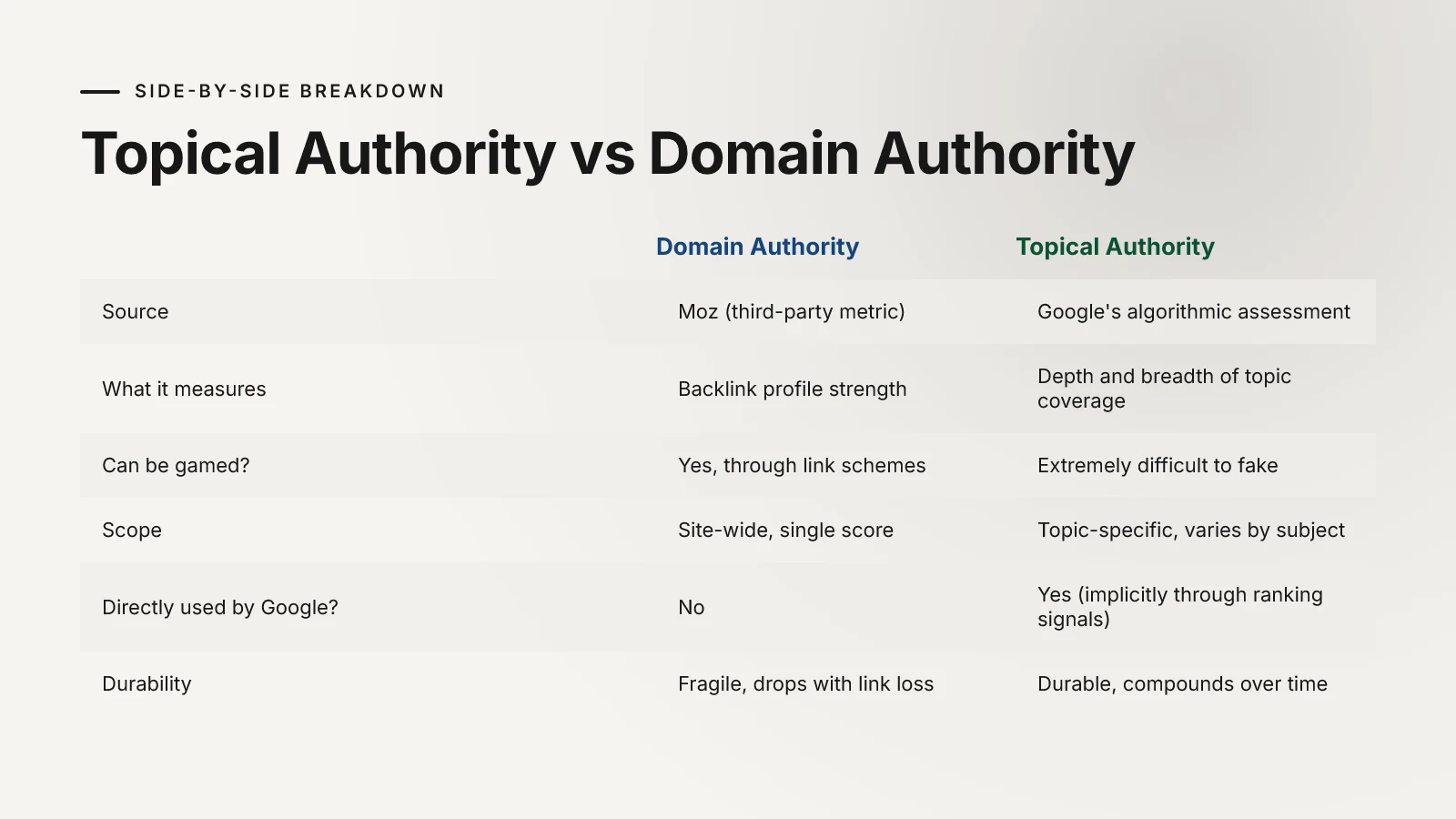
Topical Authority vs Domain Authority: Side-by-Side Breakdown
| Factor | Domain Authority | Topical Authority |
|---|---|---|
| Source | Moz (third-party metric) | Google's algorithmic assessment |
| What it measures | Backlink profile strength | Depth and breadth of topic coverage |
| Can be gamed? | Yes, through link schemes | Extremely difficult to fake |
| Scope | Site-wide, single score | Topic-specific, varies by subject |
| Directly used by Google? | No | Yes (implicitly through ranking signals) |
| Time to build | Months (link acquisition) | Months to years (content depth) |
| Durability | Fragile, drops with link loss | Durable, compounds over time |
Topical authority marketing is the practice of strategically building comprehensive content coverage around specific topics to earn Google's trust and rank for related queries. It's a fundamentally different approach than DA optimization because it focuses on the thing Google actually evaluates rather than a proxy metric.
And the distinction matters most when you're deciding where to spend limited resources. Every hour spent on a generic guest post to boost DA is an hour not spent on a supporting article that deepens your topical coverage. For most SaaS companies in 2026, the math favors topical depth.
Step 4: Decide Where to Focus Your SEO Efforts
When DA Still Matters (And When It Doesn't)
Let's be honest: DA isn't completely useless. Dismissing it entirely would be overcorrecting.
Backlinks remain a significant ranking factor. A strong backlink profile (which is what DA approximates) still helps. But the nuance matters. The topical relevance of a linking domain plausibly matters more than raw link quantity — though we have not found a public study that isolates the effect, so treat it as a working assumption rather than a measured result. A link from a niche-relevant site with DA 30 often moves the needle more than a link from an irrelevant DA-80 site.
DA still serves a purpose in these specific contexts:
- Competitive benchmarking: Comparing your backlink growth trajectory against competitors over time
- Link prospecting: Quickly filtering potential link partners during outreach campaigns
- Site health monitoring: Sudden DA drops can signal lost backlinks worth investigating
But if you're using DA as your primary SEO KPI (or worse, making strategic decisions based on it) you're optimizing for the wrong thing. It's like tracking how many miles you drive instead of whether you're heading in the right direction.
How to Shift Your Strategy Toward Topical Depth
This is where strategy gets practical. Shifting from DA-centric to topical-authority-centric SEO means restructuring how you plan, create, and interlink content.
Content cluster model is an SEO architecture where a comprehensive pillar page covers a broad topic, supported by cluster articles that address specific subtopics, all interlinked to signal topical comprehensiveness to search engines.
For ecommerce brands, this shift looks different than for SaaS. If you're selling products, check out the topical authority system built specifically for ecommerce. But the core principles apply everywhere:
- Audit your existing content against a complete topic map. Identify gaps where subtopics have zero coverage.
- Prioritize depth over breadth. Ten thorough articles on closely related subtopics outperform fifty shallow posts scattered across unrelated keywords. Every time.
- Interlink aggressively. Every cluster article should link to the pillar and to 2–3 sibling articles. This isn't optional, it's how Google understands the relationship between your content pieces.
- Earn topically relevant links. When you do pursue backlinks, prioritize sources within your niche. A link from a finance blog to your finance content carries more topical signal than a link from a general news site.
If this feels like a significant strategic overhaul, that's because it is. And if you'd rather have experts handle the transition, a topical authority service can accelerate the process considerably.
Summary: Topical Authority Wins the Long Game
SEO in 2026 rewards depth. Google's algorithms have grown increasingly sophisticated at identifying which sites genuinely understand a topic versus which sites simply accumulated links. Topical authority marketing aligns your strategy with how search engines actually work, rather than optimizing for a third-party approximation.
DA isn't dead. But treating it as your north star metric is like judging a restaurant by its Yelp review count instead of the food. The correlation exists. The causation doesn't.
Action Steps: Pivot From DA Chasing to Topic Dominance
- This week: Pick your single most important topic and map every subtopic, question, and related entity using Google's "People Also Ask" and a tool like AlsoAsked or Ahrefs' Content Explorer
- This month: Publish 3–5 cluster articles that fill the biggest gaps in your topical coverage, interlinked to your existing pillar content
- This quarter: Shift 60% of your link-building budget toward earning links from topically relevant sources, even if they have lower DA scores
- Ongoing: Track your rankings for topic clusters, not just individual keywords. When you start ranking for queries you never specifically targeted, topical authority is working.
Frequently Asked Questions
What is the difference between topical authority and domain authority?
Domain authority is a third-party score from Moz that estimates ranking potential based on your backlink profile. Topical authority is Google's implicit assessment of how comprehensively your site covers a specific subject. DA is a proxy metric. Topical authority reflects what Google actually evaluates when deciding which content to rank.
Does Google use Domain Authority as a ranking factor?
No. Google has confirmed repeatedly that Domain Authority is not a ranking factor. DA is a Moz proprietary metric. While backlinks (which DA approximates) do influence rankings, the DA score itself plays no role in Google's algorithm.
Can a low-DA site outrank a high-DA site?
Absolutely. Sites with lower DA outrank higher-DA competitors regularly when they demonstrate stronger topical coverage. NerdWallet, Healthline, and other content-focused sites built their dominance through topical depth, not by having the highest DA in their space.
How do you measure topical authority?
There's no single score like DA. Instead, you measure topical authority through entity coverage ratios, SERP feature presence (like featured snippets and People Also Ask), ranking breadth across a topic cluster, and internal linking depth. Several tools approximate it, but the best signal is ranking for queries you didn't explicitly target.
How long does it take to build topical authority?
Most sites see meaningful results within 4–8 months of consistent, strategically planned content publishing. The timeline depends on competition, your existing content foundation, and how comprehensively you cover the topic. Unlike link building, topical authority compounds, meaning each new piece makes every existing piece stronger.
Should you stop building backlinks and focus only on topical authority?
No. Backlinks still matter. The shift is in how you approach them. Prioritize topically relevant links over high-DA but irrelevant ones. And rebalance your effort: if you're spending 80% of your SEO budget on link building and 20% on content, consider flipping that ratio. The content depth creates the foundation that makes every link more effective.
What is domain authority stacking, and does it work?
Domain authority stacking is the tactic of building networks of subdomains, web 2.0 properties, or expired domains that link to each other to inflate a site's perceived authority. It's a descendant of PBN link schemes, it violates Google's spam policies, and any gains tend to evaporate at the next spam update — sometimes taking the whole site down with them. The durable alternative is the one this article describes: earning topical authority with complete, interlinked coverage, which compounds instead of getting penalized.
Related articles
How to Build Topical Authority: The 90-Day Founder Sprint (2026)
You build topical authority by publishing one interlinked cluster — a pillar plus about 12 answer-first articles on a topic you can own — in a focused 90-day sprint. Here is the exact plan, including what 13 unindexed articles on our own site taught us to do differently.
Measuring Topical Authority: 5 Essential Metrics
Measuring topical authority requires tracking five specific metrics that most SaaS founders completely ignore, even while obsessing over vanity numbers like domain authority.
Topical Relevance in Link Building: Proven Guide
Topical relevance in link building determines whether your backlinks actually move rankings or just pad a spreadsheet. And most link building budgets bleed money on links that look impressive but...
Build topical authority with Inbounder
Visual topic clustering, AI-powered content generation, and direct CMS publishing — all in one platform.