B2B Topical Authority Strategy: The Authority Grid for SaaS Founders
A B2B topical authority strategy works when you cover one buyer job completely — problem-aware to product-aware — before touching the next. The Authority Grid turns that rule into a plan a founder can actually execute.
By Nathan Rofkahr, Founder of Inbounder · Updated

The Answer, Up Front
The right topical authority strategy for a B2B SaaS is to pick the single job your ideal customer most urgently needs done, cover that job completely — from the first symptom of the problem to the final vendor comparison — and interlink every piece before you write about anything else. Depth on one job beats breadth across ten. You have topical authority when a buyer can go from "why is this happening to us" to "this is the tool we're buying" without ever leaving your site.
That's the whole strategy. The rest of this page is the system for executing it. We call the system the Authority Grid, and it exists because most founders do the opposite: eighty posts across twelve topics, none covered deeply enough for Google, an AI assistant, or a buyer to trust.
If you've been publishing for a year and organic pipeline is still a rounding error, sprawl is almost always why. Not effort. Not writing quality. Sprawl.
The Authority Grid: Rows Are Jobs, Columns Are Awareness
The Authority Grid is a table you can sketch in ten minutes.
Rows are your ICP's jobs-to-be-done. Not your features — their jobs. "Recover failed payments." "Pass the security review." "Forecast pipeline without hiring RevOps." A typical B2B SaaS has three to six rows that actually matter.
Columns are funnel stages, defined by what the buyer is aware of:
- Problem-aware: they feel the pain but don't know a category of solution exists
- Solution-aware: they know the problem has a name and are evaluating approaches
- Product-aware: they're comparing specific vendors and building the internal case
Each cell is a cluster candidate: a pillar page or a small set of tightly interlinked articles serving that job at that stage.
Two rules make the Grid work.
Rule one: own one full row before starting the next. A complete row means a buyer can travel the entire journey for that job on your site. Three cells filled across three different rows means nothing is complete, and no authority accrues anywhere.
Rule two: gaps in a row are gaps in your authority. If you have problem-aware and product-aware content but nothing in between, buyers arrive, learn their pain is real, then leave and let a competitor teach them the solution. The competitor gets the shortlist spot.
The Grid is a topical map with opinions. For the general mapping method, read how to create a topical map. The Grid adds the one constraint that makes a map executable for a founder: sequence. One row at a time.
Walking One Row End-to-End
Say you sell a churn-prevention tool for subscription SaaS. Your rows might be: reduce involuntary churn, win back cancelled customers, forecast MRR, cut onboarding time-to-value. You pick "reduce involuntary churn" because it sits closest to what your product actually does.
Problem-aware cell. The buyer sees revenue leaking and doesn't know why. You write: "Why customers churn without cancelling." "How to separate involuntary from voluntary churn in your billing data." "What failed payments cost a SaaS at $50k MRR." No product pitches here. You're naming a pain the buyer can't articulate yet, in their words.
Solution-aware cell. Now the problem has a name. This is where your pillar lives: "Dunning management: the founder's guide." Around it: "Dunning emails vs. in-app prompts." "Card retry logic: what actually recovers payments." "Build vs. buy for payment recovery." The pillar argues a point of view. A pillar that reads like a Wikipedia entry builds nothing.
Product-aware cell. The buyer is shortlisting. "Best dunning tools for bootstrapped SaaS." "YourTool vs. the incumbent." An ROI calculator. An implementation guide showing exactly what week one looks like. This is where the row converts, and it's the cell most founders never build because it feels salesy. Build it. Buyers want it.
Then interlink the row. Every problem-aware piece links forward to the pillar. The pillar links down to every product-aware page. Product-aware pages link back up. The row becomes one connected argument — the same hub-and-spoke structure covered step by step in how to build topical authority. That row is a topic cluster: one page for the whole job, and one page for each narrower question.
Only when this row is complete — written, interlinked, indexed — do you start "win back cancelled customers." Not before.
The AI Shortlist: Where B2B Buying Starts Now
Here's the part most topical authority advice hasn't caught up with. A growing share of B2B buying no longer starts with ten blue links. It starts with a founder or a VP asking ChatGPT or Perplexity: "What are the best dunning tools for a bootstrapped SaaS?" The shortlist forms before anyone visits a website.
So what gets a SaaS onto that shortlist? Not domain authority. Two things:
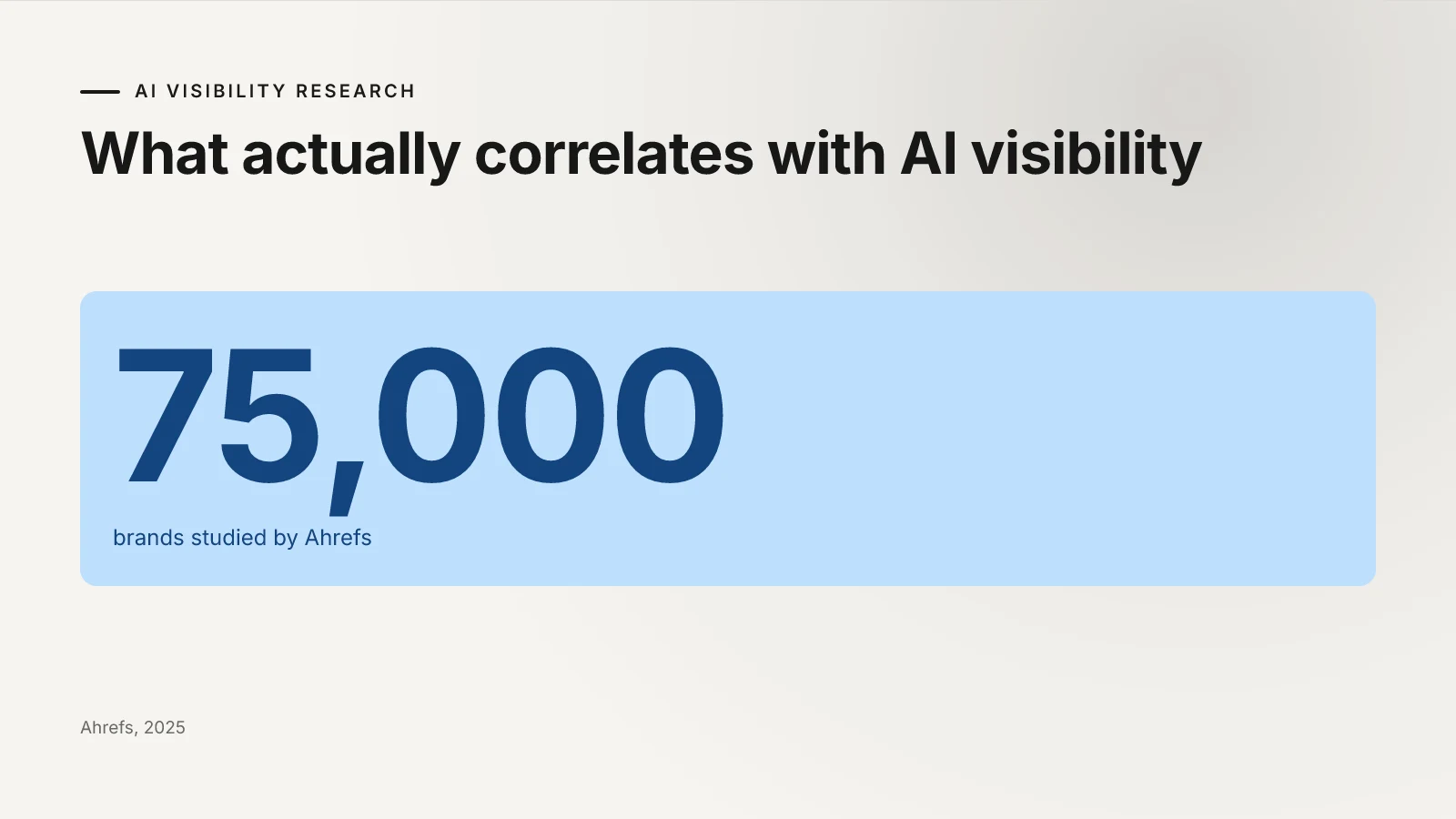
- Third-party coverage. AI assistants lean heavily on what other people say about you: review sites, comparison posts, community threads, YouTube walkthroughs, niche newsletters. Ahrefs studied roughly 75,000 brands in 2025 and found branded web mentions were the strongest correlate of AI visibility — while raw content volume showed close to zero correlation.
- Comprehensive first-party clusters. When an assistant answers the earlier questions in the journey — "what is involuntary churn," "how does dunning work" — it retrieves and cites pages that answer directly and completely. Complete rows are retrievable rows. Scattered posts aren't.
This is why the Grid is your AI strategy, not just your Google strategy. The problem-aware and solution-aware columns earn citations inside AI answers, which is how buyers meet your brand in the assistant. The product-aware column plus third-party mentions earn you the shortlist itself.
One honest caveat: there is no such thing as tracking your "AI ranking." What you can do is ask the assistants your buyers' real shortlist prompts on a schedule and count how often you appear — a plain N-of-M number, re-sampled monthly. Pair that with the classic metrics in measuring topical authority and you have an honest dashboard.
How Long This Actually Takes
Straight answer: a full row is usually 12 to 20 pieces. Writing them yourself at two hours a week takes six to nine months. AI drafting compresses the writing to weeks. It does not compress Google's clock: expect three to six months after indexing before a row shows real movement, longer in a competitive space. Anyone promising topical authority in 30 days is selling something.
And note the word indexing, because publishing is not the finish line. We learned this the embarrassing way: our own blog sat at thirteen published articles and zero indexed for months. Every strategy on this page is worthless if Google isn't indexing the pages. Before you write anything new, run a topical authority audit and check the page indexing report in Search Console. Fix the plumbing first.
The honest sequence for a founder at DR 5 with twenty pages on the site: audit and fix indexing in week one. Sketch the Grid and pick your row the same week. Fill the row over one to three months, depending on how much of the drafting you automate. Interlink and submit for indexing as you go. Then spend the following months earning third-party mentions for that row while the rankings compound. Slow is normal. Scattered is fatal.
Filling Your First Row: Action Steps
- Write down three to six jobs-to-be-done in your customers' own words. Pull them from sales calls, support tickets, and cancellation reasons — not from your feature list.
- Sketch the Grid and place your existing content in it. Most founders find a scatterplot: a dozen cells touched, zero rows complete. That picture is the diagnosis.
- Pick the row closest to revenue. Not the highest search volume — the row where a completed journey most plausibly ends in your product.
- Validate the row with keyword research so every cell targets queries buyers actually type, then map the pillar and supporting pieces for each cell.
- Publish the solution-aware pillar first, fill outward toward both edges of the row, and interlink every piece as it goes live.
- Once the row is indexed, shift your marginal hour from writing to earning mentions: reviews, comparison posts, communities, podcasts. That's what moves the AI shortlist.
This is also exactly the workflow Inbounder automates. Give it one URL and it runs the keyword research, builds the topical map, drafts publish-ready articles for the row, and queues the social promotion. You still pick the row and own the point of view. The machine just fills cells faster than two hours a week ever could.
Either way — tool or by hand — the strategy doesn't change. One row. End to end. Then the next.
Frequently Asked Questions
What is a B2B topical authority strategy?
A B2B topical authority strategy is a content approach where a business covers one core subject in interconnected depth so search engines, AI assistants, and buyers recognize it as the authority on that subject. In practice: pick one job your ideal customer needs done, cover it from problem-aware to product-aware content, interlink everything, and only then move to the next topic.
What is the Authority Grid?
The Authority Grid is a planning table for B2B SaaS content. Rows are your ICP's jobs-to-be-done, columns are funnel stages (problem-aware, solution-aware, product-aware), and each cell is a content cluster candidate. You build authority by completing one full row before starting the next; gaps in a row are gaps in your authority.
How long does it take to build topical authority in B2B?
Expect three to six months after your content is indexed before a completed row shows meaningful ranking movement, and six to twelve months to genuinely own it. A full row is typically 12 to 20 interlinked pieces. AI tools compress the writing time, not the trust-building time.
How does topical authority get a SaaS mentioned by ChatGPT and Perplexity?
Two inputs matter most: third-party mentions of your brand across the web, and complete first-party topic coverage that AI systems can retrieve and cite. Ahrefs' 2025 analysis of roughly 75,000 brands found branded web mentions were the strongest correlate of AI visibility, while content volume showed almost none — and domain authority is not the lever either way.
Can a small SaaS out-build bigger competitors on topical authority?
Yes, and it's the most reliable advantage a small company has. Authority is assessed per topic, not per brand size. A founder who completes one full row on a niche job-to-be-done will beat an enterprise blog that touched that job with two shallow posts. Narrow and complete beats big and scattered.
Should I fix anything before starting the Grid?
Yes — indexing. Confirm in Google Search Console that your existing pages are actually being indexed before you write new ones. Publishing into an indexing problem builds nothing; we made that mistake ourselves with thirteen published articles and zero indexed.
Related articles
How to Build Topical Authority: The 90-Day Founder Sprint (2026)
You build topical authority by publishing one interlinked cluster — a pillar plus about 12 answer-first articles on a topic you can own — in a focused 90-day sprint. Here is the exact plan, including what 13 unindexed articles on our own site taught us to do differently.
How to Create a Topical Map: 5 Easy Steps (2026)
Creating a topical map is the single most strategic move you can make before publishing another word of content. Yet most SaaS founders skip it entirely.
Topical Authority Audit: 7-Step Checklist (+ AI Citation Readiness)
A topical authority audit is a systematic check of how well you cover your subject — and, in 2026, whether AI tools cite you at all. Here's the 7-step checklist we ran on our own site, inline and ungated.
Measuring Topical Authority: 5 Essential Metrics
Measuring topical authority requires tracking five specific metrics that most SaaS founders completely ignore, even while obsessing over vanity numbers like domain authority.
Build topical authority with Inbounder
Visual topic clustering, AI-powered content generation, and direct CMS publishing — all in one platform.