Topical Relevance in Link Building: Proven Guide
Topical relevance in link building determines whether your backlinks actually move rankings or just pad a spreadsheet. And most link building budgets bleed money on links that look impressive but...
By Nathan Rofkahr, Founder of Inbounder · Updated

Key Takeaways
- Links from topically relevant sites consistently outperform high-DA links from unrelated domains in ranking impact
- Auditing your current backlink profile for topical alignment reveals how much of your budget has been wasted on irrelevant links
- Competitor backlink reverse-engineering is the fastest way to build a list of niche-specific link prospects
- Original research and data studies within your topic earn the most relevant, high-quality links over time
- Outreach emails that emphasize topical fit instead of generic flattery see significantly higher placement rates
- Building topical authority through proven steps compounds the value of every link you earn
High-DA Links From Irrelevant Sites Are Wasting Your Budget
Time to be blunt about something. That link from a general news aggregator with a DA of 75? It's probably doing less for your SaaS product page than a DA 35 link from a niche blog covering your exact category.
Topical relevance is the degree to which a linking page's subject matter aligns with your content's subject matter. When a cybersecurity blog links to your cybersecurity tool, Google reads that as a contextual endorsement. When a cooking website links to your cybersecurity tool because you sponsored a recipe roundup, Google reads that as... confusing, at best.
Why Google Weighs Topical Relevance in Backlinks
Google's ranking systems have evolved well beyond counting links. The shift toward understanding topics (not just keywords) means the context surrounding a link matters enormously. A link embedded in a paragraph about endpoint security, on a page about endpoint security, on a site that publishes about security, sends a very different signal than the same anchor text dropped into an unrelated guest post.
Ahrefs' analysis of link building strategies (Ahrefs) found that links from topically relevant pages carry more weight for rankings than links from high-authority but unrelated domains. This lines up with what Google's own documentation on link analysis has described for years: relevance and context are core to how links get evaluated.
Topical authority marketing is the practice of building your site's perceived expertise in a specific subject area through content depth, internal linking, and (this is the part most people underinvest in) earning backlinks from other authoritative sources within the same topic.
Think about it from Google's perspective. If dozens of cybersecurity sites link to your resource, that's a cluster of experts vouching for you within their domain. But if dozens of random sites link to you, that's noise. The signal-to-noise ratio of your backlink profile is, in many ways, more important than its raw size.
Step 1: Audit Your Current Backlink Profile for Relevance
Before you build a single new link, you need to understand what you're working with. Most teams skip this step because auditing feels tedious. This is where you find out whether your past efforts built a foundation or a house of cards.
How to Categorize Links by Topical Alignment
Pull your full backlink profile from Ahrefs, Semrush, or Moz. Then sort referring domains into three buckets:
- Highly relevant – Sites covering your exact topic or industry. A project management SaaS getting links from productivity blogs, agile methodology sites, or business operations publications.
- Adjacent relevant – Sites in a related but broader space. That same SaaS getting links from general business or startup-focused publications. These still carry topical weight, just less of it.
- Irrelevant – Sites with no topical connection. Coupon directories, random blog networks, sponsored posts on lifestyle sites. These links might not hurt you, but they're not helping your topical profile.
Link relevance ratio is the proportion of your backlinks that come from topically aligned sources compared to your total backlink profile. If you're sitting at 20% relevant links, you have a massive opportunity. If you're at 60% or higher, you're in strong shape and should focus on deepening that advantage.
Now here's where it gets interesting. When you measure your topical authority, you'll often find that sites with fewer total backlinks but higher relevance ratios outrank competitors with massive but unfocused link profiles. Research from Moz on domain authority factors has consistently shown that link quality signals, including topical alignment, predict ranking performance better than raw link volume.
Step 2: Identify Topically Relevant Link Prospects
So now you know where you stand. The next step is building a targeted prospect list, and the fastest method is stealing your competitors' homework (ethically, of course).
The Competitor Backlink Reverse-Engineering Method
Take your top three ranking competitors for your core keywords. Pull their backlink profiles and filter for referring domains with a DR (Domain Rating) above 20. Then cross-reference those domains against your own profile.
The gaps are your prospect list. But don't just grab every domain your competitor has that you don't. Filter ruthlessly for topical alignment. A competitor in the HR software space might have links from HR industry publications, workforce management blogs, and business process sites. Those are gold. They might also have links from general tech roundups or sponsored content on unrelated platforms. Skip those.
Backlink gap analysis is the process of identifying referring domains that link to your competitors but not to your site, filtered for relevance and authority.
Finding Niche-Specific Resource Pages and Blogs
Beyond competitor analysis, look for resource pages within your topic. These are pages specifically designed to curate useful links for a particular audience. Search operators like "your topic + resources" or "your topic + useful links" surface these quickly.
Also consider:
- Industry association websites that maintain member or resource directories
- Niche newsletters that regularly link to tools and guides
- Academic departments or research centers maintaining reading lists in your field
- Podcast show-notes pages from shows covering your topic
For B2B topical authority strategies, these niche resource pages often convert at higher rates than massive publications because the audience is already deeply engaged with the subject.
Step 3: Create Link-Worthy Assets Within Your Topic
You can't pitch for links if you have nothing worth linking to. And "check out our product page" isn't it. (Trust me, everyone tries this. Nobody bites.)
Original Research, Data Studies, and Definitive Guides
The assets that earn the most topically relevant links share one trait: they give other writers in the space something to reference. Original data is the single most effective link magnet because it creates citable facts that don't exist anywhere else.
Link-worthy asset is a piece of content specifically designed to earn backlinks by providing unique value (original research, comprehensive guides, free tools) that other publishers in the space want to reference.
Consider what Backlinko has done repeatedly. Brian Dean's original research posts, like his analysis of Google ranking factors published on Backlinko, earned thousands of backlinks specifically because they provided proprietary data that SEO writers needed to cite. Every time someone wrote about ranking factors, they linked back to the study. The links came from SEO blogs, digital marketing publications, and marketing education sites. All topically relevant.
The mechanism is simple but powerful. When you publish data that becomes the go-to reference for a specific claim within your niche, every future article on that subtopic becomes a potential link source. You're not chasing links. You're creating gravity.
For SaaS founders, this might look like surveying your user base, analyzing anonymized product usage data, or compiling industry benchmarks. A project management tool could publish "2026 State of Remote Team Productivity" based on anonymized task completion data. Every remote work blog, HR publication, and productivity writer becomes a potential linker.
Original, data-backed content is consistently judged more trustworthy than opinion pieces — and that trust translates directly into other publishers' willingness to cite and link to it.
Step 4: Outreach With Topical Context
Even the best content won't earn links if your outreach reads like spam. And most outreach does.
How to Pitch for Relevance, Not Just Authority
The typical outreach email says something like: "I noticed you wrote about X. We have a great resource on Y. Would you consider linking to it?" That's a stranger asking for a favor with zero context about why it matters.
Topically relevant outreach flips this entirely. You're not asking for a link. You're pointing out a gap in their content that your resource fills, for the benefit of their readers.
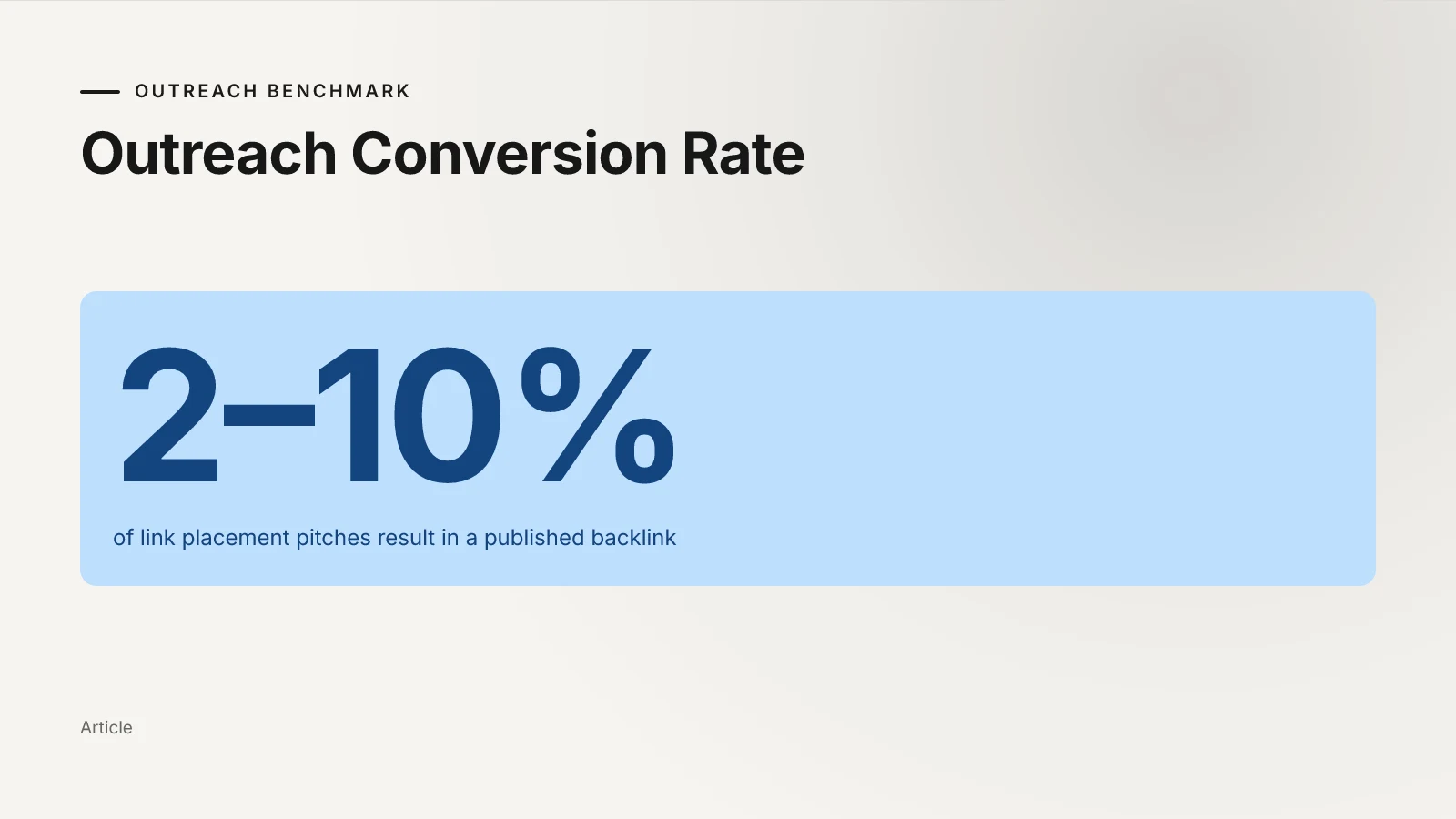
Outreach conversion rate refers to the percentage of link placement pitches that result in a published backlink, typically ranging from 2–10% depending on targeting quality and pitch relevance.
Email Templates That Emphasize Topical Fit
Your outreach should demonstrate you've actually read their content and understand their audience. A strong pitch includes three elements:
- Specific reference to a piece of their content and what it covers well
- The gap your resource fills, framed as value for their audience
- Why you're relevant, establishing that you operate in the same space
Skip the flattery. Skip the "I'm a big fan of your work." Instead, show topical alignment through specificity. "Your guide on container security covered runtime protection thoroughly but didn't address image scanning. Our research on container vulnerability trends includes data that might strengthen that section for your readers."
That kind of pitch works because it speaks the prospect's language. It proves you understand their topic, which is exactly the topical relevance signal you want in the resulting link.
Strengthening your internal linking structure also amplifies the value of every external link you earn, because link equity flows more efficiently through a well-organized site.
Summary: Relevance Beats Raw Authority Every Time
The shift from "get the highest DA links possible" to "get the most topically relevant links possible" isn't a minor tweak. It's a fundamentally different strategy that changes who you target, what you create, and how you pitch.
And the compounding effect is real. Each relevant link reinforces your site's topical profile, which makes future content more likely to rank, which attracts more organic links from relevant sources. It's a flywheel, not a one-time campaign.
Action Steps: Shift Your Link Building to Topical Relevance
- This week: Export your backlink profile and categorize every referring domain as highly relevant, adjacent, or irrelevant. Calculate your relevance ratio.
- Next week: Run backlink gap analysis on your top three competitors, filtered for topically aligned domains only. Build a prospect list of 50+ relevant sites.
- Within 30 days: Identify one original research angle based on data you already have access to. Outline the study, survey, or data analysis.
- Within 60 days: Publish your link-worthy asset and begin outreach to your prospect list using topically specific pitches.
- Ongoing: Track new links by topical relevance, not just DA. Adjust your strategy based on which content themes attract the most relevant links.
Frequently Asked Questions
What is topical relevance in link building?
Topical relevance in link building is the alignment between a linking site's subject matter and the content it links to. A backlink from a site covering the same topic as your page sends a stronger ranking signal than a link from an unrelated site, even if the unrelated site has higher domain authority.
How do you measure if a backlink is topically relevant?
Review the linking page's content, the site's overall topic focus, and the surrounding anchor context. Tools like Ahrefs and Semrush categorize referring domains by topic. If the linking site regularly publishes content in your niche and the specific page discusses your subject area, the link qualifies as topically relevant.
Does Domain Authority still matter for link building in 2026?
DA still provides a useful baseline for filtering out very low-quality sites. But DA alone, without topical relevance, produces diminishing returns. A DA 40 link from a niche-relevant publication will typically outperform a DA 70 link from an unrelated general site for ranking purposes.
How many topically relevant links do you need to see results?
There's no universal number because it depends on your competitive space. In low-competition niches, even 10–15 highly relevant links to a key page can produce noticeable ranking improvements. In competitive markets, you'll need sustained link acquisition over months. Focus on the relevance ratio of your profile rather than hitting a specific count.
What types of content attract the most topically relevant backlinks?
Original research, data studies, and comprehensive guides consistently attract the most relevant links. These assets give other writers in your space something to cite that they can't find elsewhere. Free tools and calculators also perform well when they solve a specific problem within your niche.
Can irrelevant backlinks hurt your rankings?
A few irrelevant links won't damage your site. But a profile dominated by off-topic links (especially if they look like paid placements or link schemes) can dilute your topical signals and potentially trigger manual review. The goal isn't to disavow every irrelevant link, it's to shift the overall ratio toward relevance over time.
Related articles
How to Build Topical Authority: The 90-Day Founder Sprint (2026)
You build topical authority by publishing one interlinked cluster — a pillar plus about 12 answer-first articles on a topic you can own — in a focused 90-day sprint. Here is the exact plan, including what 13 unindexed articles on our own site taught us to do differently.
Measuring Topical Authority: 5 Essential Metrics
Measuring topical authority requires tracking five specific metrics that most SaaS founders completely ignore, even while obsessing over vanity numbers like domain authority.
B2B Topical Authority Strategy: The Authority Grid for SaaS Founders
A B2B topical authority strategy works when you cover one buyer job completely — problem-aware to product-aware — before touching the next. The Authority Grid turns that rule into a plan a founder can actually execute.
Build topical authority with Inbounder
Visual topic clustering, AI-powered content generation, and direct CMS publishing — all in one platform.