Bottom of Funnel Keywords: How to Find High-Intent Terms
Bottom-of-funnel keywords are the searches buyers make right before choosing — and they're systematically invisible in volume-sorted keyword tools. Here's how to find them: modifier patterns by business type, the conversion bands each intent carries, and a 0–3 scoring system that formalizes the judgment.
By Nathan Rofkahr, Founder of Inbounder · Updated

What Are Bottom-of-Funnel Keywords?
Bottom-of-funnel (BOFU) keywords are searches that signal an active buying decision: the searcher is comparing options, checking prices, looking for alternatives, or verifying that a solution fits their situation. "Asana vs Trello," "Mailchimp alternatives," "CRM for real estate agents," "accounting software pricing" — each one is a person mid-decision, and each converts to pipeline at rates informational keywords never touch.
The defining property isn't volume or length — it's what the searcher does next. After an informational search, they read and leave. After a BOFU search, some meaningful fraction starts a trial, books a call, or buys. That behavioral difference is measurable: Grow & Convert's conversion data (updated 2026, N=95 articles of their client work, vendor-published) puts comparison/alternatives keywords at 8.43% visitor-to-lead conversion against ≤1% for top-of-funnel terms.
BOFU keywords are also systematically undervalued by the standard research workflow. Keyword tools sort by volume; BOFU terms are low-volume almost by definition (few people are choosing a CRM this month; many are asking what a CRM is). Sort any keyword list by volume and the buying-intent terms sink to the bottom or vanish into "0 searches/month" — where, as we'll cover, they're often still worth writing for.
This guide is the finding-them half of BOFU strategy: the modifier patterns that surface high-intent terms for each business type, the sources beyond keyword tools, and the business-potential scoring system that turns "this feels high-intent" into a repeatable 0–3 judgment. What to build once you have the list is the BOFU content guide; how many you need is its own honest answer.
The Conversion Bands: What Each Intent Is Worth
Not all buying-intent keywords are equal, and the differences are measured. Grow & Convert's intent-level conversion data (updated 2026, N=95 articles, vendor-published — their clients, their tracking) is the most detailed public dataset we know of that breaks visitor-to-lead conversion out by keyword intent:
| Intent type | Example | Conversion band |
|---|---|---|
| Comparison / alternatives | "Notion alternatives" | 8.43% |
| Versus | "Notion vs Confluence" | 5.45% |
| Main category | "team wiki software" | 4.85% |
| Jobs-to-be-done | "how to document team processes" | 2.44% |
| TOFU / high-volume | "what is knowledge management" | ≤1% |
How to use the bands without over-trusting them:
- As a priority order. With limited writing hours, work down the table: alternatives and versus pages first, then category pages, then jobs-to-be-done. This single rule out-performs most editorial calendars.
- As a value multiplier for keyword comparison. A 100-visit/month alternatives keyword at ~8% is worth more pipeline than a 2,000-visit informational keyword at ≤1%. Multiply realistic traffic by the band before comparing keywords, and volume-based intuitions invert.
- Not as a promise. The bands are one agency's client portfolio. Your category's buying dynamics, your page quality, and your offer all move the numbers. Direction and rough magnitude transfer; decimals don't. Benchmarks, not guarantees.
One nuance worth knowing: jobs-to-be-done keywords (2.44%) look like the weakest BOFU band, but they're often the largest pool and the least competitive — nobody's money pages target "how to collect testimonials from clients," yet the searcher plausibly buys testimonial software this quarter. In niches where the comparison keywords are locked up by incumbents and review sites, JTBD terms are frequently where a young site gets its first BOFU wins.
Modifier Patterns for SaaS
Everything in this section and the three that follow is craft knowledge — practitioner pattern-matching, not measured research. These modifier patterns are how working SEOs actually find BOFU keywords, and they're reliable in the way experienced judgment is reliable, but nobody has studied their conversion rates individually. Label your own confidence accordingly.
For SaaS, the pattern families, roughly in descending intent:
- Brand-pair patterns: "[competitor] vs [competitor]", "[competitor] alternatives", "[competitor] competitors", "apps like [competitor]", "[competitor] review". Generate these mechanically from your real competitor list — including tools you're adjacent to rather than identical with, since "alternatives to X" searchers often want something different-shaped, cheaper, or simpler than X.
- Commercial category patterns: "[category] software", "[category] tool", "best [category] software", "[category] platform". The 4.85% band. Competitive, but they're the queries that define your market.
- Segment and use-case patterns: "[category] for [ICP]" — for startups, for agencies, for nonprofits, for freelancers; "[category] for [platform]" — for Shopify, for Slack. Lower volume, sharper fit, much weaker competition.
- Money patterns: "[competitor] pricing", "[category] cost", "is [competitor] worth it", "[competitor] free trial", "free [category] software". Budget questions are buying questions.
- Migration and integration patterns: "switch from [competitor]", "[competitor] export data", "does [tool] integrate with [tool]", "[tool] [platform] integration". Tiny volumes; the searcher is halfway out a competitor's door or verifying stack fit before purchase.
- JTBD patterns: "how to [job your product does]" — "how to send automated invoice reminders", "how to track feature requests". The trick is distinguishing jobs your product completes (BOFU-adjacent) from general education (TOFU). Ask: could the honest answer to this query be "use software like ours"? If yes, it's a JTBD keyword.
Modifier Patterns for Ecommerce, Services, and Local
Same caveat as above — practice, not research. The pattern families shift with the business model:
Ecommerce. Buying intent concentrates on product-selection and trust queries:
- "best [product] for [use/person]" — best running shoes for flat feet, best coffee grinder for espresso
- "[brand/product] vs [brand/product]" and "[product] review", "[product] worth it"
- Compatibility and spec queries — "does [product] fit [model]", "[product] size guide", "[accessory] for [product]"
- Deal-stage queries — "[brand] discount code", "[product] sale", "cheapest [product]" (high intent, but often better served by merchants and coupon sites; pick these fights selectively)
- "[product] alternatives" / "dupe" queries where a famous product anchors the category.
Services (B2B and professional). The buying searches are cost- and trust-shaped:
- "[service] cost" / "[service] pricing" / "how much does [service] cost" — the single most underused BOFU pattern in services; firms avoid publishing prices, so honest cost-explainer pages rank and convert on candor
- "best [service] agency/firm for [niche]", "[competitor agency] alternatives"
- "hire [role]" vs "[service] agency" vs DIY comparisons — "in-house vs agency [function]"
- "[service] examples", "[service] case study" — late-stage validation queries (only target these with real work you can show).
Local. Intent is geographic and urgent:
- "[service] near me", "[service] in [city/neighborhood]", "[city] [service] cost"
- "emergency [service]", "same day [service]", "open now"
- "best [service] [city]" and "[business] vs [business]" for local rivalries
- Review-shaped queries — "[business] reviews" — which you influence through review platforms more than your own site.
Across all four business types, the meta-pattern is identical: money, comparison, fit, and exit. Any query expressing one of those four is worth scoring — which is what the next sections formalize.
Mining Sources Keyword Tools Can't See
Keyword tools under-report BOFU terms structurally — low volumes fall below reporting thresholds, and long-tail phrasings fragment across variants the tools don't aggregate. The highest-value BOFU keywords often come from sources that aren't keyword tools at all:
Your own funnel. Sales calls, demo recordings, onboarding surveys, and support tickets are transcripts of buying decisions. Every "we were also looking at X" names a vs-page; every "does it work with Y" names an integration page; every "we switched from Z because…" names an alternatives angle plus the exact pain to lead with. Fifteen minutes with your last ten sales conversations typically yields more BOFU pages than an afternoon in a keyword tool.
Competitor review sites. G2, Capterra, and TrustRadius reviews of your competitors are structured lists of pains and switching triggers, in buyers' own vocabulary. The "what do you dislike?" sections are alternatives-page outlines written by your future customers.
Community threads. Reddit, niche Slacks and Discords, and industry forums surface the comparison questions people ask when they don't trust vendor content — "anyone actually used X for Y?". These phrasings are your JTBD and use-case keywords, and (as the AI-search article covers) these same threads are disproportionately what AI assistants cite for buying queries.
Autocomplete and People Also Ask. Type "[competitor] vs" or "[category] for" into Google and harvest the completions — real query data, free, volume-blind.
Search Console, once you have any traffic. Filter queries for "vs", "alternative", "pricing", "best", "cost". Impressions on a BOFU query you haven't targeted is Google telling you a page is missing.
On zero-volume keywords: a term your sales calls surface repeatedly but tools report as 0 searches/month is usually under-measured, not absent — and even at genuinely tiny volume, the published 8%-band economics make a page worth an afternoon. Write for the buyer you've heard, not the volume you can't verify.
Business-Potential Scoring: Formalizing the Judgment
"High intent" is a feeling until you score it. The cleanest formalization is the business-potential score popularized by Ahrefs: rate every keyword 0–3 on one question — how naturally can your product be the answer to this search?
- 3 — Your product is the answer. The searcher's problem is what you sell. "Payroll software for restaurants" when you sell restaurant payroll. The page can honestly center your product.
- 2 — Your product helps meaningfully, but isn't the whole answer. "How to run payroll for tipped employees" — your product does this, but the honest page is mostly method with your product inside it.
- 1 — Your product is mentionable, barely. "Restaurant profit margins" — you could appear in a paragraph without embarrassment, no more.
- 0 — No honest connection. "Best restaurant POS systems" when you don't touch POS. Traffic bait. Skip it regardless of volume.
The score works because it forces the question conversion actually depends on: what can this page honestly pitch? A score-3 keyword at 50 searches a month beats a score-1 keyword at 5,000 for pipeline — the conversion bands above are, in effect, what happens when score-3 pages meet buying-intent queries.
Two scoring disciplines that keep the system honest:
- Score against your real product, not your roadmap. A 3 you can't deliver on yet is a 1 with wishful thinking. (This matters doubly for AI-assisted drafting — a page claiming capabilities you lack converts trials into churn.)
- Score before checking volume. Volume anchors judgment; scoring first keeps intent primary and volume a tiebreaker.
This is exactly the system Inbounder's keyword research bakes in: every keyword carries a business-potential score (0–3) and a funnel-stage chip, so a keyword list reads as a prioritized map — and the Content Health panel will flag a portfolio whose keywords include zero BOFU intents at all, citing the same Grow & Convert bands this article does. A spreadsheet column works too. What matters is that intent and business potential get scored at all, because volume-only lists reliably bury every keyword worth having.
From Keyword List to Content Plan
The finishing sequence, once you have a scored list:
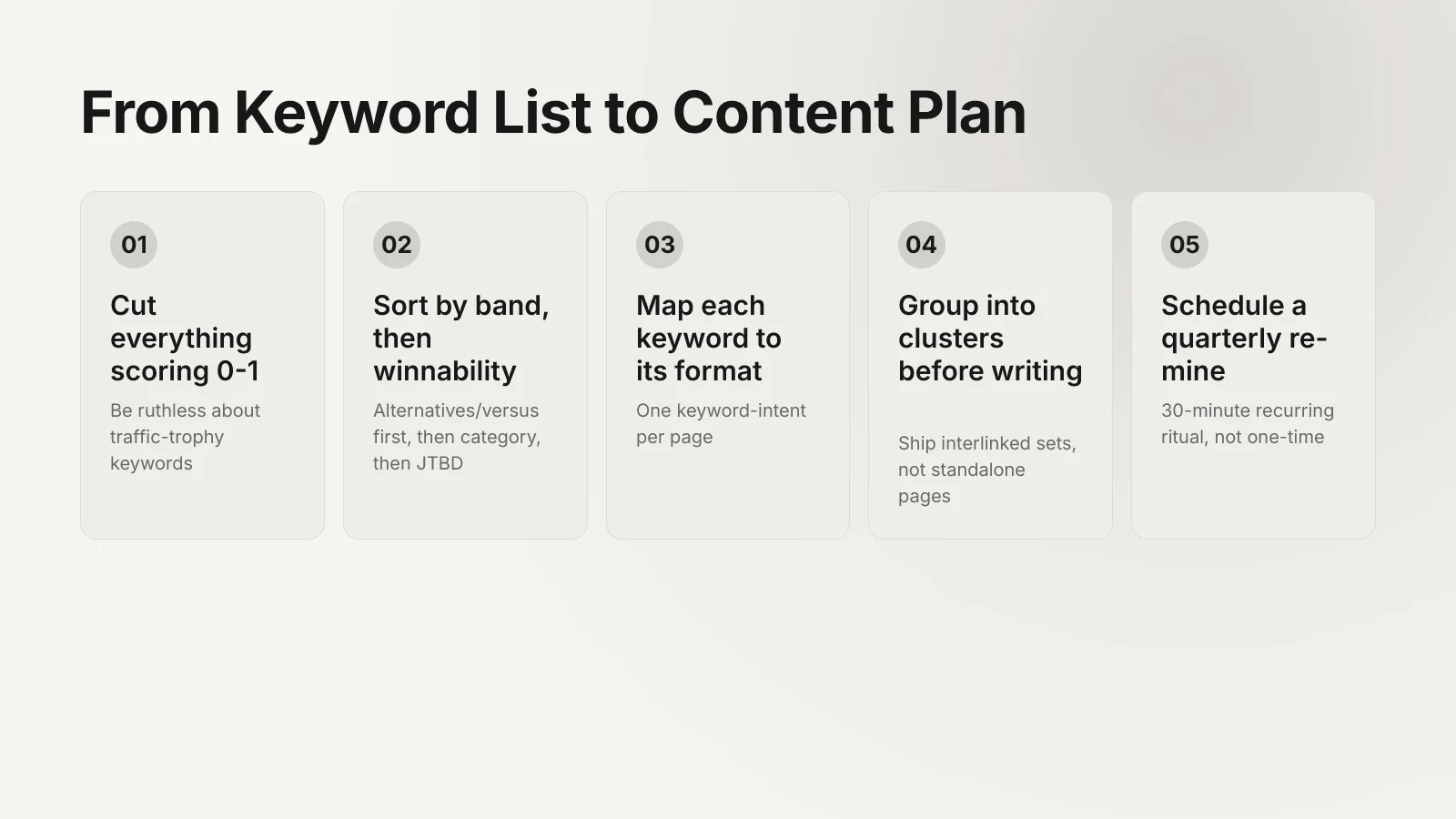
1. Cut everything scoring 0–1. Be ruthless; these are the keywords that turn blogs into traffic trophies. Keep 1s only where they serve a deliberate topical-coverage purpose inside a cluster.
2. Sort what remains by band, then winnability. Alternatives/versus first, then category, then use-case and JTBD. Within a band, eyeball the current top 10: forums, thin listicles, and stale pages are winnable; entrenched head-to-head pages from incumbents may need your domain to age first — park those for round two.
3. Map each keyword to its format. Vs-keywords get comparison pages; alternatives keywords get alternatives pages; category and segment keywords get landing-style pages; JTBD keywords get honest how-to articles with your product inside. One keyword-intent per page — two pages splitting one intent is how you lose both.
4. Group into clusters before writing. Keywords sharing a topic should ship as interlinked sets, per the topic cluster model — a comparison page, its alternatives sibling, and two supporting JTBD articles linking each other beat the same four pages published as strangers.
5. Schedule a quarterly re-mine. BOFU keyword spaces shift — competitors launch and die, pricing changes, new "vs" pairs appear. The sales-call and review-mining passes are 30-minute quarterly rituals, not one-time projects.
A last calibration note: after all this filtering, most founder-run companies end up with a 20–50 keyword map. That's not a thin result — it's the honest size of most niches' buying-intent surface, and per the post-count analysis, covering it completely is worth more than any volume of content beyond it.
Frequently Asked Questions
What are bottom of funnel keywords?
Bottom-of-funnel keywords are searches that signal an active buying decision — comparing options ("X vs Y"), seeking exits ("X alternatives"), checking budget ("[category] pricing"), or verifying fit ("[category] for agencies", "does X integrate with Y"). They're defined by what the searcher does next: unlike informational queries, a meaningful fraction of BOFU searchers starts a trial or books a call, which is why published benchmarks put their conversion at roughly 2–8% versus ≤1% for informational terms.
How do you find high-intent keywords without expensive tools?
Mine sources that aren't keyword tools: your own sales calls and support tickets (every "we also looked at X" is a comparison keyword), competitor reviews on G2 and Capterra (switching triggers in buyers' vocabulary), community threads, Google autocomplete ("[competitor] vs…"), and Search Console queries filtered for "vs", "alternatives", "pricing", and "cost". These surface the low-volume, high-intent terms that volume-sorted tools bury or miss entirely.
Are zero-volume keywords worth targeting?
Often, yes — when they're buying-intent terms. Keyword tools under-report long-tail queries structurally, so a question your sales calls raise repeatedly but tools show as 0 searches/month is usually under-measured rather than absent. At the published conversion bands for comparison and alternatives intent (8.43%, vendor-published by Grow & Convert), even a handful of monthly visitors from a genuinely buying-stage query can justify a page.
What is a business potential score in keyword research?
A 0–3 rating (popularized by Ahrefs) of how naturally your product can be the answer to a search: 3 means the product is the answer, 2 means it helps meaningfully, 1 means it's barely mentionable, 0 means no honest connection. Scoring intent before volume keeps keyword lists prioritized by pipeline value — a score-3 keyword at 50 searches a month typically outproduces a score-1 keyword at 5,000. Inbounder's keyword research displays this score plus a funnel-stage chip on every keyword.
Which BOFU keywords should you target first?
Work down the measured conversion bands: alternatives and versus keywords first (8.43% and 5.45% in Grow & Convert's updated-2026 data), then main category keywords (4.85%), then jobs-to-be-done terms (2.44%). Within each band, prefer keywords where the current results are weak — forums, thin listicles, outdated pages — and park entrenched incumbent battles for after your site has aged. Bands are vendor-published benchmarks, so treat the ordering as reliable and the decimals as approximate.
Related articles
BOFU Content: The Founder's Guide to Bottom-of-Funnel SEO
BOFU content answers the questions buyers ask right before they choose — and it converts at a different order of magnitude than everything else on your blog. Here's the full founder's guide: the data, the five formats, how it fits topical authority, and timelines nobody else will give you straight.
How Many BOFU Posts Do You Need to Generate Leads?
Nobody will give you a straight answer to this question because the straight answer is uncomfortable: there is no verified threshold. Here's what the measured data actually supports — one ranking BOFU post can generate leads, most new pages don't rank, and the famous frequency numbers are zombies.
Pain Point SEO: The Grow & Convert Framework, Explained
Pain Point SEO wasn't invented by a tool vendor — it was coined in 2018 by the agency Grow & Convert, who then spent years publishing the conversion data to back it. Here's the framework explained faithfully, the numbers behind it, and an honest account of what changes when software runs it.
Comparison Page SEO: How to Build vs Pages That Convert
Comparison pages sit in the highest measured conversion band of any content type — and most of them still fail, because they're written as propaganda with a table. Here's the full craft: structure, the honesty that actually ranks, schema, and the failure modes that kill vs pages slowly.
Topic Clusters: What They Are and How to Build One (2026)
A topic cluster is a group of pages on one subject: a pillar page that covers the whole topic, plus supporting pages that each answer one narrower question. Every supporting page links to the pillar, the pillar links to each of them, and related pages link to each other. Those links show search engines and AI assistants that your site covers the subject end to end.
Build topical authority with Inbounder
Visual topic clustering, AI-powered content generation, and direct CMS publishing — all in one platform.