Comparison Page SEO: How to Build vs Pages That Convert
Comparison pages sit in the highest measured conversion band of any content type — and most of them still fail, because they're written as propaganda with a table. Here's the full craft: structure, the honesty that actually ranks, schema, and the failure modes that kill vs pages slowly.
By Nathan Rofkahr, Founder of Inbounder · Updated

Why Comparison Pages Convert (and the Caveats)
A comparison page targets the moment a buyer has finalists — "X vs Y" — and wants a structured verdict. It's the single highest-converting content format with published measurement behind it: Grow & Convert's conversion data (updated 2026, N=95 articles of their own client work) puts comparison/alternatives keywords at 8.43% visitor-to-lead conversion, with dedicated "versus" keywords at 5.45% — against ≤1% for informational content and a 0.5–2% blended blog average.
Hedges first, because we quote these numbers a lot in this cluster and they deserve their labels every time: the data is vendor-published — measured by an agency on its own client portfolio — and N=95 articles is one portfolio, not a meta-analysis. Your numbers will differ with category, traffic quality, and page craft. Treat 8.43% as "comparison intent converts at multiples of informational intent," not as a number to put in your forecast. Modeled, not guaranteed.
Why the format converts even at a discount to the benchmark: the searcher has done the hard funnel work themselves. They know the category, they've shortlisted, they have budget implied by the shortlist. Your page isn't creating demand — it's adjudicating a decision already in motion. That's also why comparison pages are disproportionately worth maintaining: small traffic, huge per-visitor value.
And why most vs pages still underperform: they're written as propaganda. A page where the home team wins every row is recognized instantly by exactly the skeptical, decision-stage reader it targets — and bounced. The craft of comparison pages is maybe 30% SEO structure and 70% credibility engineering, which is why this guide spends as much time on honesty as on headings. What follows: the page anatomy, the honest-comparison ethos, query types, schema, failure modes, and maintenance. For the sibling format — "X alternatives" list pages — see the alternatives page playbook.
Anatomy of a Comparison Page That Ranks
The structure below is practitioner consensus — craft, not measured research — refined by what decision-stage readers actually need:
1. Verdict first. The opening two or three sentences answer the question: who is each product actually for, and what's the honest difference? "X is stronger for [use case]; Y wins for [other use case]; here's how to tell which you are." Answer-first formatting serves skimming buyers, and it's what makes the page quotable by search engines and AI assistants alike. Never open with "choosing software is hard."
2. Comparison table above the fold. Rows for the criteria buyers in your category genuinely weigh — pricing model, core capabilities, integrations, support, learning curve — with specific cells ("from $29/seat", "no API on starter plan"), not checkmark theater. The table is the most-read, most-screenshot, most-cited element on the page; build it to stand alone.
3. Criteria-by-criteria deep sections. One H2 per major criterion, comparing both products concretely with screenshots or numbers where possible. This is where the page earns rankings — thin tables rank briefly; substantiated sections rank durably.
4. Pricing, treated seriously. Real numbers, real tiers, the gotchas (per-seat cliffs, feature gates). Pricing sections carry outsized conversion weight because they're the section buyers can't get from either vendor cleanly.
5. "Choose X if / choose Y if" close. Segment the verdict by situation. This section does double duty: it converts readers whose situation favors you, and it's the concession mechanism that makes the whole page credible.
6. FAQ block. The long-tail questions around the pair ("can you migrate from X to Y", "does X have a free plan") — each a featured-snippet and AI-answer candidate.
7. A dated, honest changelog line. "Compared against X's pricing as of July 2026." Signals maintenance to readers, and commits you to it.
One page per pair. "X vs Y vs Z" three-ways serve a different, rarer query — build them separately if the search data supports it, and never as a substitute for the head-to-head.
Honesty Is the Strategy, Not a Constraint
Everything about a comparison page's audience argues for radical honesty, and it's worth spelling out the mechanism rather than asserting the virtue:
The reader is at peak skepticism. They know you wrote the page. They are specifically scanning for the tell that it's rigged — and a clean sweep for the home team is that tell. A page that concedes real points reads as information; a page that doesn't reads as an ad, and decision-stage readers bounce ads.
Concessions are what make your wins believable. "Y's mobile app is better than ours; if field work is your primary use, that probably decides it" costs you the readers you were going to lose anyway — and buys credibility with everyone else for the rows you claim. One genuine concession is worth ten adjectives.
Honest pages survive contact with the competitor's fans. Vs pages get read by both products' communities, cited in both products' sales calls, and posted in forums. A rigged page becomes a screenshot used against you; an honest one becomes the neutral-enough reference even rivals link to — and those links and mentions are the ranking fuel vs pages otherwise struggle to earn.
Honesty compounds into AI answers. As buying research shifts into AI assistants (the BOFU × AI-search article has the citation data), balanced comparison content is the shape of source that answer engines can safely quote. Propaganda gets paraphrased against you or skipped.
We hold ourselves to this in public: Inbounder's own comparison pages — six of them, Jasper for example — name real competitor strengths and tell certain readers to choose the other tool. That costs conversions from bad-fit visitors, which is fine, because bad-fit signups were going to churn anyway.
Two hard rules that follow: no fabricated proof — invented review counts, fake testimonials, unverifiable "users prefer us 3-to-1" claims are both wrong and counterproductive with this audience (Inbounder's article generation blocks unproven review/case-study claims mechanically; adopt the same rule by whatever means). And no strawman versions of the competitor — compare against their current product, priced correctly, at its best. If you can't win an honest comparison for anyone, that's positioning feedback, not a content problem.
The Three Kinds of Comparison Queries
"Comparison page SEO" actually covers three distinct query types with different searchers, different competition, and different pages:
1. You-vs-competitor ("[your brand] vs [competitor]"). The searcher already knows you exist — these queries only have volume once you have brand presence. Highest conversion relevance, lowest difficulty (few third parties bother), and you should own every such pair the moment the query exists. Build these first even at zero reported volume; the searches begin the day a prospect first shortlists you, long before tools register them.
2. Competitor-vs-competitor ("[rival A] vs [rival B]"). The searcher is choosing between two products, neither of which is yours. Counterintuitive and underused: you write the honest referee page, adjudicate the pair fairly, and introduce yourself as the alternative worth knowing about — positioned, not forced ("if neither fits because [situation], that's the gap we built for"). These pages capture buyers earlier than your own vs-pages can, in exactly your category, at decision stage. The honesty bar is even higher here: the page only works if the A-vs-B verdict is genuinely useful to someone who never clicks your CTA.
3. Roundups ("best [category] software"). Technically main-category keywords (the 4.85% band in Grow & Convert's data) rather than versus-keywords, but buyers use them the same way. Competitive — you're against review sites and affiliates — and awkward on your own domain (a list where you're #1 of 10 has the credibility problem squared). Often better won via third-party placements than your own blog; the AI-search article covers why that's doubly true now.
Sequencing for a typical founder: all of type 1 immediately (usually 3–8 pages), then type 2 pairs where two incumbents dominate shortlists, then decide whether type 3 is winnable on your domain or better pursued off it. Each pair gets one page, one intent, maintained — which beats twenty thin permutations every time.
Schema Markup: What Helps, Hedged
Schema markup on comparison pages is worth doing, with expectations set correctly: structured data helps machines parse your page and makes you eligible for richer results — it is not a rankings lever, and in the AI-citation context specifically, Ahrefs' 2025 test of 1,885 pages found citations "barely moved" by schema. Do it for eligibility and parseability, not as a growth tactic.
What's actually applicable:
- Product schema for each compared product where you can be accurate — name, description, offers (pricing) if stable. Marking up a competitor's product commits you to keeping their pricing current in your markup, not just your prose; only do it if your maintenance cadence is real.
- FAQPage schema on the FAQ block — the most reliably useful markup on comparison pages, making each Q&A pair an eligible rich result and a cleanly liftable passage.
- Table markup discipline. Not schema, but adjacent: use a real HTML table for the comparison table, with header cells, not a div-grid or an image. Machines can only cite tables they can parse, and screenshots of tables are invisible to every engine.
- Review/AggregateRating schema: only with real reviews. Marking up ratings you can't substantiate is the structured-data version of fabricated proof — it violates Google's guidelines, risks manual actions, and it's the exact claim type that should never appear without evidence anyway. If you don't have verifiable review data, skip the markup entirely; an absent star rating harms nothing.
Implementation is an afternoon: JSON-LD in the page head, validated with Google's Rich Results Test. Worth that afternoon; not worth a sprint. The ranking work on comparison pages remains the unglamorous kind — substantive criteria sections, honest tables, internal links from your money pages, and freshness that's real rather than cosmetic. Schema is seasoning, and the industry's habit of selling it as a main course is one more place to keep your skepticism.
Failure Modes: How Vs Pages Die
Comparison pages fail in predictable ways, and every one is preventable:
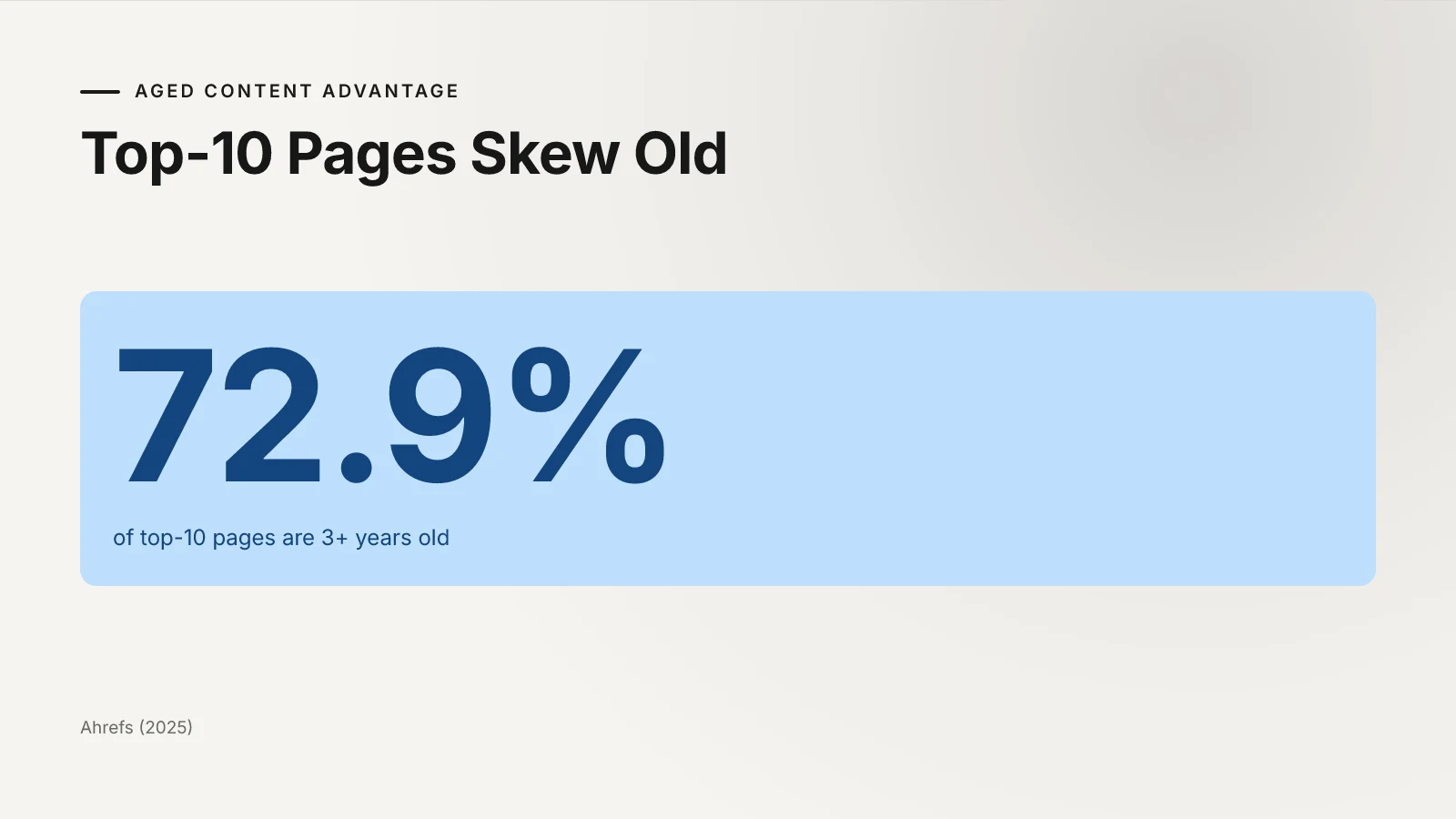
Staleness — the big one. A vs page cites the competitor's 2024 pricing, a plan they renamed, a feature gap they closed. Decision-stage readers verify claims in real time (both tabs are open), and one stale fact collapses the page's authority entirely — worse than no page, because now you look either lazy or dishonest. Comparison pages are perishable goods: they need quarterly review as a floor, immediate updates when a competitor ships a pricing change, and the visible "as of [date]" line that keeps you accountable. Note the structural advantage here: Ahrefs' time-to-rank data (updated 2025) found 72.9% of top-10 pages are 3+ years old — a maintained page compounds age and freshness, which is precisely the combination competitors' abandoned vs pages can't match.
Bias, obvious and subtle. The clean-sweep table is the obvious version. The subtle versions: criteria chosen so you win ("supports [your unique feature]: ✓/✗" as row one), the competitor's screenshots from three UI generations ago, weasel comparatives ("more intuitive") with no observable content. Readers catch all of it.
Thinness. A table and 300 words ranks briefly, then loses to any substantiated page. The vs queries deserve 1,500+ words of genuine analysis — if you can't write that much honestly about the pair, you don't know the competitor well enough to compare publicly yet.
Cannibalization. "X vs Y," "X vs Y pricing," "X vs Y for agencies" as three pages splitting one intent — none ranks. One page per pair; subtopics are H2s, not URLs.
Orphaning. Vs pages hidden in the blog archive with no links from the homepage, pricing page, or related articles. Your highest-value pages deserve your strongest internal links — from every page where a comparing buyer might be standing.
Legal carelessness. Comparative advertising is legal in most jurisdictions when claims are accurate and verifiable — which is one more reason every cell in your table should be sourceable. Screenshot your evidence at update time; competitors' pages change and you want receipts for what you claimed when.
Measuring Comparison Pages Properly
Comparison pages will look like failures in a traffic dashboard and like your best marketing in a revenue dashboard. Measure them accordingly:
Per-page conversion, not traffic. A vs page drawing 150 visits a month at anywhere near the published bands is producing meaningful pipeline — judge it against the 8.43%/5.45% benchmarks (with their vendor-published caveats), not against your blog's traffic median. If it converts under ~1% with real traffic, the page has an honesty or offer problem, not an SEO problem.
Rankings on the exact pairs. Track each "X vs Y" query explicitly. These queries have tiny volumes and general rank trackers often ignore them; check Search Console directly. Impressions rising on a pair you haven't published yet is a page requisition.
Assisted influence. Vs pages act mid-journey: prospects read them, then book a demo from the homepage days later. Last-click attribution will systematically under-credit them — log the softer signals (sales calls mentioning the page, its URL in chat transcripts) before concluding a page "doesn't convert."
Freshness debt. Track a simple list: each comparison page, last verified date, competitor pricing checked date. This is the operational metric that predicts the others — the decay failure mode is a missed maintenance cadence showing up six months later as sliding rankings.
Citation presence. Comparison content is exactly what AI assistants synthesize for "X vs Y" prompts. Sample your pairs as prompts and record whether your page — or anyone's — gets cited, using the same honest N-of-M receipts method our AI-visibility guide details. Even a small monthly sample tells you whether the answer layer knows your page exists.
Expected timeline, stated plainly: pairs involving your own brand can rank in weeks (low competition); competitor-pair and category pages follow the standard months-long arc — Ahrefs' base rates (1.74% of new pages reach top-10 within a year) apply in full, softened by how uncontested many vs queries are. Judge the portfolio at six months, per the cluster's planning math. And the page you publish this quarter, maintained honestly, is compounding toward the aged top-10 cohort the whole time.
Frequently Asked Questions
What conversion rate should a comparison page get?
The best published benchmark is 8.43% visitor-to-lead for comparison/alternatives keywords, with dedicated "versus" keywords at 5.45% — from Grow & Convert's measurements across 95 of their client articles (updated 2026, vendor-published). Treat these as directional bands, not promises: they establish that comparison intent converts at multiples of informational content (≤1%), while your actual rate depends on category, traffic quality, and how credible the page is. A vs page converting under 1% with real traffic usually has an honesty or offer problem rather than an SEO problem.
Should you mention competitors by name on your website?
Yes — buyers are searching your brand against competitors by name whether you participate or not, and the page that answers "X vs Y" honestly will exist either way; the only question is who writes it. Comparative content is legal in most jurisdictions when claims are accurate and verifiable, so keep every table cell sourceable, compare against the competitor's current product at its best, and screenshot your evidence when you update.
How do you make a comparison page rank on Google?
Structure it answer-first (verdict in the opening sentences), lead with a real HTML comparison table, then substantiate with criteria-by-criteria sections totaling 1,500+ words of genuine analysis — thin table-only pages rank briefly and lose to substantiated ones. Keep one page per product pair (splitting "X vs Y" across multiple pages cannibalizes the intent), link to it from your strongest pages, and maintain it visibly with an "as of [date]" line. Ranking follows the standard months-long arc, so judge results after six months.
Should comparison pages be honest about competitor strengths?
Yes, and not as ethics — as mechanism. Decision-stage readers are specifically scanning for signs the page is rigged, and a clean sweep for the home team is that sign; genuine concessions ("choose Y if…") are what make your claimed wins believable. Honest pages also survive being read by the competitor's community, earn links as a usable reference, and are the shape of source AI assistants can safely cite. A comparison you can't win honestly for anyone is positioning feedback, not a content task.
Does schema markup help comparison pages rank?
It helps machines parse the page and makes rich results possible — FAQPage markup on the FAQ block is the most reliably useful — but it isn't a rankings lever, and for AI citations specifically, Ahrefs' 2025 test of 1,885 pages found schema "barely moved" results. Use Product and FAQPage markup where you can keep them accurate, use a real HTML table rather than images, and never add review/rating markup without verifiable review data behind it.
Related articles
The Alternatives Page Playbook: Structure, Honesty, SEO
"[Competitor] alternatives" sits in the highest-converting band anyone has published — someone actively leaving a product, shortlist in hand. Here's the full playbook: why they search, the page structure that serves them, why honesty is the ranking strategy, and the maintenance that keeps these pages alive.
BOFU Content: The Founder's Guide to Bottom-of-Funnel SEO
BOFU content answers the questions buyers ask right before they choose — and it converts at a different order of magnitude than everything else on your blog. Here's the full founder's guide: the data, the five formats, how it fits topical authority, and timelines nobody else will give you straight.
Bottom of Funnel Keywords: How to Find High-Intent Terms
Bottom-of-funnel keywords are the searches buyers make right before choosing — and they're systematically invisible in volume-sorted keyword tools. Here's how to find them: modifier patterns by business type, the conversion bands each intent carries, and a 0–3 scoring system that formalizes the judgment.
BOFU Content and AI Search: Where Buying Answers Come From
When buyers ask ChatGPT what to buy, the answers are built overwhelmingly from third-party sources — Reddit in 62% of responses, your website almost never. Here's the measured picture of where AI buying advice comes from, and the split strategy that follows from taking it seriously.
What Is AI Visibility? The Honest Measurement Guide
Most of what's sold as an 'AI rank' is fiction — nobody can query chatgpt.com, and every tool approximates. Here's the honest N-of-M way to measure how often AI assistants actually cite you, receipts included.
Build topical authority with Inbounder
Visual topic clustering, AI-powered content generation, and direct CMS publishing — all in one platform.