The Alternatives Page Playbook: Structure, Honesty, SEO
"[Competitor] alternatives" sits in the highest-converting band anyone has published — someone actively leaving a product, shortlist in hand. Here's the full playbook: why they search, the page structure that serves them, why honesty is the ranking strategy, and the maintenance that keeps these pages alive.
By Nathan Rofkahr, Founder of Inbounder · Updated

Why People Search "Alternatives"
An alternatives searcher is someone with one foot out the door of a product they currently use — or one they just evaluated and rejected. "Mailchimp alternatives," "Notion alternatives," "[agency] alternatives": each query is a person who has already done the category education, knows roughly what they need, and is assembling an exit shortlist. It's arguably the purest buying intent in all of search.
Understanding why they're leaving is the difference between a page that converts and a generic listicle, because the departure reason is the selection criterion. The recurring reasons, from mining thousands of switching stories across review sites and communities (craft observation, not a measured taxonomy):
- Price shock. A plan change, a per-seat cliff, an outgrown free tier. The searcher wants the same job cheaper — lead with pricing honesty.
- Missing capability. One feature gap that became a dealbreaker as their use matured. They'll scan your page for exactly that capability and nothing else.
- Complexity mismatch — both directions. Either the tool grew too heavy for a simple need, or too shallow for a scaling one. "Simpler alternative to X" and "more powerful alternative to X" are different searchers on the same query.
- Trust ruptures. A price hike announcement, an acquisition, a shutdown notice, a policy change. These produce sudden query spikes, and pages that already exist catch them — a real, occasional advantage of publishing before the news.
- Platform fit. Wrong integrations, wrong ecosystem, wrong compliance posture.
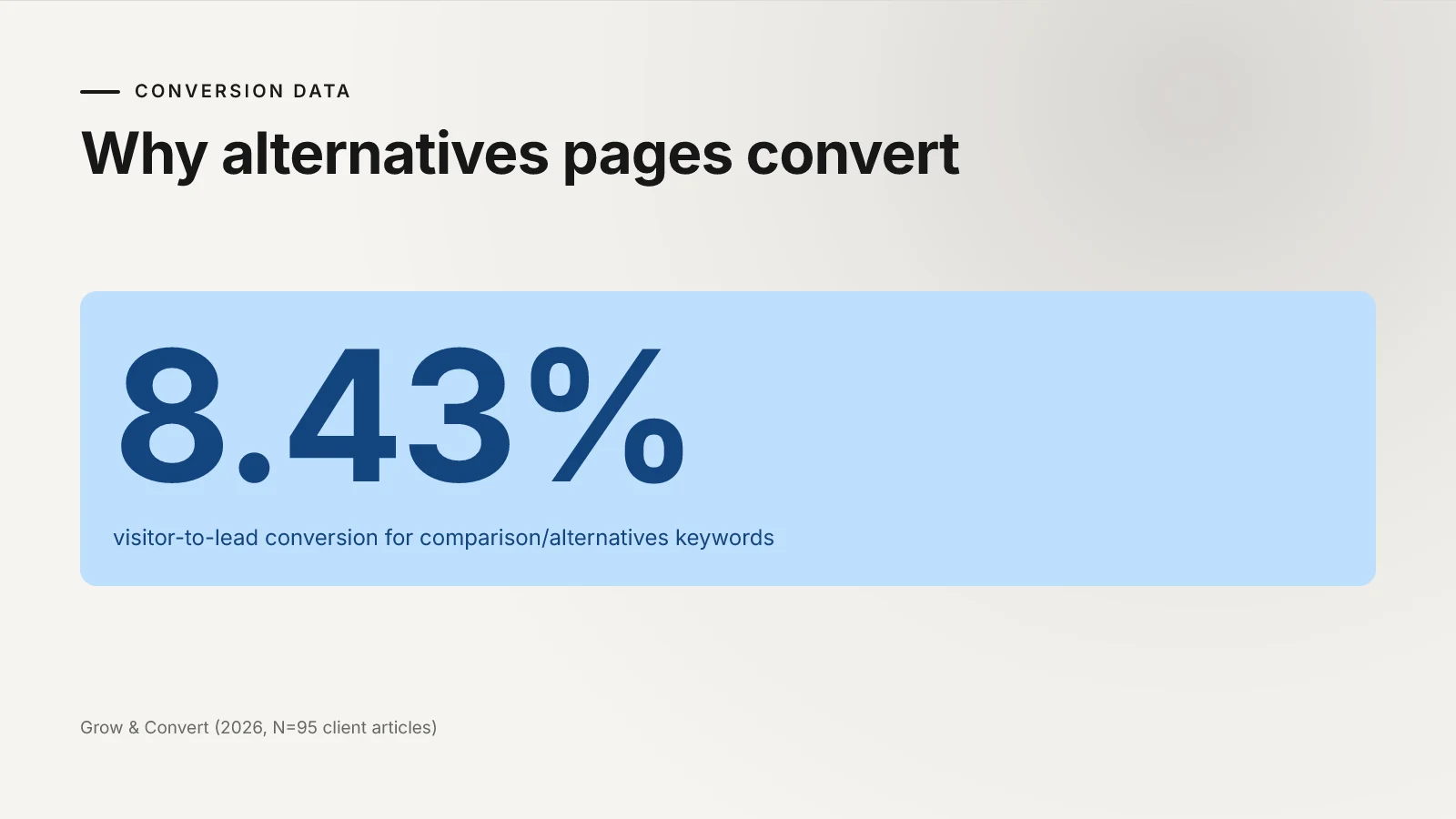
The page that wins is the one that recognizes these situations explicitly rather than opening with "looking for alternatives to X? Here are 10 options!" — and the conversion data says winning is worth it: Grow & Convert's intent-level measurements (updated 2026, N=95 client articles, vendor-published) put comparison/alternatives keywords at 8.43% visitor-to-lead conversion, the top band of any content type they measured. Usual labels apply — one agency's portfolio, benchmarks not promises — but the direction is unambiguous: these are the most valuable visitors your site can attract.
The Page Structure That Serves a Switcher
Alternatives pages are list-format — one product, many candidate replacements — and the structure follows from the switcher's mental state (craft consensus, not measured research):
1. Open by naming the departure reasons. Two or three sentences: "Most people looking to replace X have hit one of three things: the price cliff at [tier], the missing [capability], or more tool than the job needs. This list is organized around those." You've just proven the page understands them — and earned the read.
2. State your criteria and your bias. One honest paragraph: what you compared (pricing, the capabilities people leave X over, migration path) and who you are ("we make one of the tools below; we've marked it and compared it by the same criteria"). Disclosed bias is credibility; discovered bias is a bounce.
3. A scannable summary table. Every alternative, one row each: best-for, starting price, the standout capability, the notable gap. Real cells, not checkmark theater — this table is what gets screenshot, quoted, and cited.
4. One substantial section per alternative. For each: who it actually fits, honest strengths, honest limitations, pricing reality, and — the underused touch — which departure reason it solves ("if you're leaving X over price, this is the strongest like-for-like at half the cost"). Five to eight alternatives with real analysis beat fifteen with boilerplate; padding the count dilutes the page and the trust.
5. Your product, in its honest slot. Include yourself, marked as yours, held to the same criteria — best-for, limitations and all. Position honestly rather than first-by-default; a self-aware #3 converts better than a suspicious #1.
6. A "maybe stay" section. Genuinely underused: "If [situation], X is still your best option." It costs you nothing — those readers weren't switching to you anyway — and it's the strongest single credibility signal on the page.
7. Migration notes and FAQ. Export/import reality, contract timing, "can you use both during transition" — the practical questions that block switches, each an FAQ-schema and AI-answer candidate.
One page per "[competitor] alternatives" query, maintained — the same one-intent-one-page rule as comparison pages, which handle the head-to-head "X vs Y" queries this format doesn't.
Honesty as Ranking Strategy
On alternatives pages, honesty isn't just conversion craft — it's the ranking strategy itself, through three mechanisms:
The SERP sets the credibility bar. "[Competitor] alternatives" results are a mix of review platforms, community threads, and vendor pages — and searchers visibly prefer the first two, precisely because vendor lists are assumed rigged. A vendor page only competes by being the exception: same criteria applied to yourself as everyone else, real limitations named, a "stay with X if" section. You're not competing with other vendors' propaganda; you're competing with Reddit's honesty, on Reddit's terms, with better structure.
Links and mentions only accrue to usable pages. Alternatives pages earn links when third parties — bloggers answering "what should I switch to," community members sharing a resource — find them safe to recommend. Nobody links to a sales page wearing a listicle costume. The honest version becomes referenceable, and those accumulated mentions are the off-page fuel that eventually outranks the review platforms on your specific queries.
The answer layer amplifies the same selection. AI assistants answering "what are good alternatives to X" synthesize from sources they can defend — balanced roundups, not self-serving ones. As covered in BOFU content and AI search, those answers already lean heavily on third-party sources; a genuinely balanced vendor page is the only kind with a chance of joining them.
We practice this where you can check: Inbounder's compare pages apply fixed criteria to ourselves and competitors alike, concede real strengths, and tell bad-fit readers to buy elsewhere. And the hard rule from the comparison-page ethos applies doubly here: no fabricated proof, ever — no invented user counts, no unverifiable "users switching to us report…" claims. (Our article generation enforces this with a hard gate: review and case-study claims are blocked unless real proof exists. Whatever your tooling, adopt the rule.)
The deeper point founders resist: the honest page and the effective page are the same page. Every hedge you're tempted to remove is doing sales work with the only audience that matters — the skeptical, ready-to-buy reader.
Alternatives Pages vs Comparison Pages: Which and When
The two formats are siblings, often confused, worth separating deliberately:
Different searcher state. "X vs Y" has two finalists and wants adjudication — a comparison page. "X alternatives" has a rejection and wants a shortlist — this playbook. The alternatives searcher is earlier in choosing but further in leaving; they haven't picked a destination, which is exactly why the format that helps them assemble options converts so well.
Different competition. Vs-queries are usually thin — often only the two vendors bother. Alternatives queries attract review platforms and listicle farms, so the bar is higher and honesty (previous section) is how a vendor page clears it.
Different maintenance surface. A vs page tracks one competitor; an alternatives page tracks six or eight. Budget accordingly — it's the difference between a quarterly half-hour and a quarterly afternoon.
How they work together:
- Build the pair for each major competitor: "[competitor] alternatives" (this format) plus "[you] vs [competitor]" (head-to-head). The alternatives page catches the leaver early and can link to the vs page for the reader who narrows to you — a natural, high-intent internal funnel entirely within your site.
- Sequence by where you're losing deals. If prospects keep choosing a specific incumbent, the vs page is urgent. If a competitor's users are visibly unhappy (price hike, acquisition), their alternatives page is urgent.
- Interlink the set into a cluster. Alternatives pages, vs pages, and the supporting jobs-to-be-done articles should form an interlinked group per the topic cluster model — the cross-links are both crawl architecture and the buyer's actual research path.
One format choice to make consciously: your own "[you] alternatives" query. It exists once you have brand presence, someone will rank for it, and the counterintuitive move — publishing an honest page yourself, treating your competitors fairly and restating who you're actually for — at least puts your voice in the room where you're being left. Not obligatory; worth deciding rather than defaulting.
Maintenance and Decay: The Unsexy Moat
Alternatives pages decay faster than any other content type you'll publish, because they make claims about six to eight moving targets simultaneously. Pricing changes, plans get renamed, features ship, products get acquired or shut down — and every stale cell is a credibility leak to a reader with the competitor's pricing page open in the next tab.
The discipline that separates compounding pages from decaying ones:
- A quarterly verification pass, calendared. Per alternative: pricing page rechecked, plan names verified, the "notable gap" claim retested (feature gaps close!), links still valid. Thirty to sixty minutes per page, and it's the highest-ROI hour in your content operation — this pass is what your listicle-farm competitors will never do.
- Event-driven updates within days. Competitor price hikes, acquisitions, and shutdowns are both maintenance triggers and demand spikes on your query. The page that's accurate the week everyone's searching wins disproportionately.
- A visible verification date. "Pricing and features verified July 2026" — accountability for you, differentiation for the reader, and an honest freshness signal rather than a cosmetic date bump (which, as we've said elsewhere, fools no one and spends credibility).
- Prune as ruthlessly as you add. A dead or pivoted product on your list marks the whole page abandoned. Removing an alternative is maintenance too.
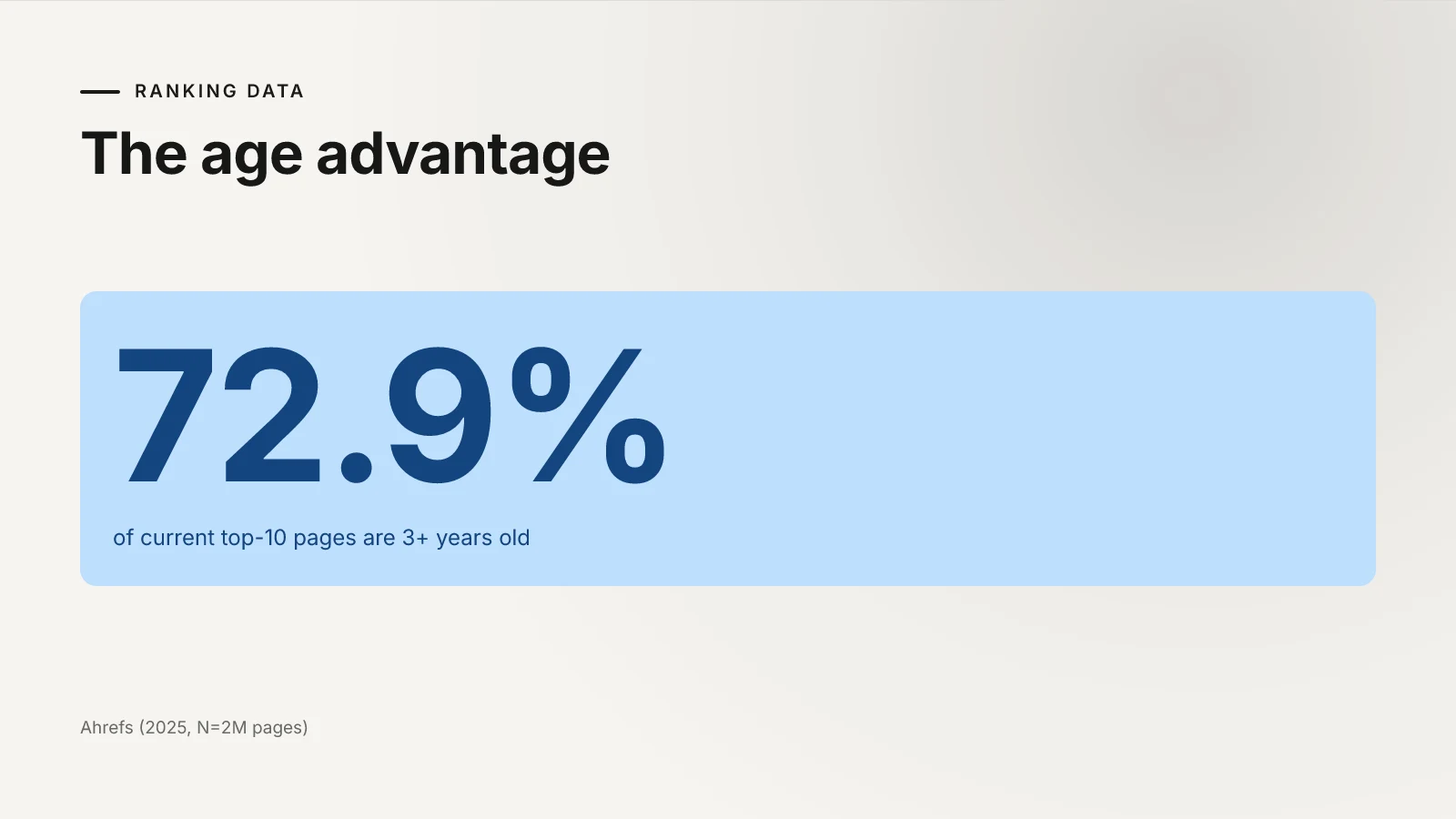
Here's why the grind pays structurally: Ahrefs' time-to-rank data (updated 2025, N=2M pages) found 72.9% of current top-10 pages are 3+ years old. Rankings favor aged pages — but an alternatives page only survives to age three if it's maintained, because a stale one sheds links, engagement, and eventually position. Maintenance is how you get to keep the age advantage you're accruing. The page you publish this quarter and verify every quarter after is on a path to being the entrenched result newcomers can't dislodge; the same page abandoned is on a path to being the embarrassment someone screenshots.
Budget honestly at portfolio scale: five alternatives pages ≈ one maintenance afternoon per quarter. If you can't sustain that, build three pages instead of five — coverage you can maintain beats coverage you can't, every time.
Beyond Google: Where Alternatives Queries Actually Live
The "alternatives" question gets asked in more places than Google's search box, and the page you build serves several of them at once:
AI assistants. "What are good alternatives to X" is a natural chat query, and the answer engines assemble their responses largely from third-party sources — Siege Media's March 2026 study of 1,000 buying prompts (57,095 citations, measured via Peec.ai) found Reddit appearing in 62% of LLM responses and 80–95% of citations going to third-party sources rather than vendor sites. The realistic play for your own page is the Google-adjacent engines (AI Overviews, Perplexity) that lean on classic retrieval, where a ranked, balanced, table-equipped alternatives page is liftable source material. The full picture — including why ChatGPT specifically favors third-party voices — is in BOFU content and AI search.
Communities. Reddit and niche forums host the authentic version of every alternatives thread, and those threads outrank vendor pages on many queries. Participate honestly where you're a genuine user of the tools discussed, disclose your affiliation always, and never astroturf — beyond ethics, communities detect and punish it, durably. A well-maintained alternatives page sometimes earns organic mentions in these threads precisely because it's usable; that's the only version of "Reddit strategy" that compounds.
Review platforms. G2, Capterra and similar host structured "top alternatives to X" pages that rank hard and feed AI answers (G2 alone appears in ~5% of LLM buying responses per the same study). You don't control these, but your presence and honest review base there is its own BOFU surface — complementary to, not replaced by, your page.
Your own sales motion. The quietest payoff: a genuinely honest alternatives page is a sales asset. Reps (or you, founder-selling) can send it mid-deal — "here's how we compare to everything you're evaluating, limitations included" — and it does trust-building work no deck can.
The measurement note, honest as always: track these surfaces with sampled checks, not vibes — the N-of-M receipts method applies to "alternatives" prompts exactly as it does to any buying query. Cited or not, you'll know, with receipts, which is more than most vendors can say about their listicles.
Frequently Asked Questions
What is an alternatives page?
An alternatives page targets "[product] alternatives" searches — queries from people actively looking to replace a tool they use or just rejected. It's a list-format page presenting five to eight genuine replacement options with honest analysis of each: who it fits, strengths, limitations, and pricing. Because the searcher is assembling an exit shortlist with budget in hand, these queries sit in the highest published conversion band of any content type — 8.43% visitor-to-lead in Grow & Convert's updated-2026 measurements (vendor-published).
Should you include your own product on an alternatives page?
Yes — include it, clearly marked as yours, held to the same criteria as every other option, with its limitations stated. Disclosed bias reads as credibility; discovered bias reads as deception and loses the page. Position yourself where you honestly belong rather than first-by-default, and include a "stay with [competitor] if…" section — it costs nothing (those readers weren't switching to you) and it's the strongest trust signal on the page.
How many alternatives should you list on the page?
Five to eight, each with substantial honest analysis — who it fits, real strengths and limitations, current pricing, and which switching reason it solves. That depth beats fifteen entries of boilerplate: padding the count dilutes both the page's usefulness and its credibility, and every added product enlarges your maintenance surface (each one's pricing and features must be re-verified quarterly to keep the page accurate).
How often should you update an alternatives page?
Quarterly as a calendared minimum — re-verify every listed product's pricing, plan names, and your claims about their gaps — plus event-driven updates within days when a listed competitor changes pricing, gets acquired, or shuts down (those events also spike the query, so accuracy that week pays disproportionately). Show a "verified [month year]" date, and only move it when you've actually re-verified. Maintenance is what lets the page survive to the 3+ year age that 72.9% of top-10 results have (Ahrefs, updated 2025).
Why do Reddit threads outrank vendor alternatives pages?
Because searchers prefer them and engines follow: alternatives-seekers assume vendor lists are rigged, so authentic community threads earn the clicks and engagement — and the pattern extends into AI answers, where Siege Media's March 2026 study of 1,000 buying prompts found Reddit in 62% of LLM responses with 80–95% of citations going to third-party sources. A vendor page competes by being the exception — same criteria applied to itself, real concessions, a "stay put if" section — which is also the only version third parties will link to and answer engines can safely cite.
Related articles
Comparison Page SEO: How to Build vs Pages That Convert
Comparison pages sit in the highest measured conversion band of any content type — and most of them still fail, because they're written as propaganda with a table. Here's the full craft: structure, the honesty that actually ranks, schema, and the failure modes that kill vs pages slowly.
BOFU Content: The Founder's Guide to Bottom-of-Funnel SEO
BOFU content answers the questions buyers ask right before they choose — and it converts at a different order of magnitude than everything else on your blog. Here's the full founder's guide: the data, the five formats, how it fits topical authority, and timelines nobody else will give you straight.
Bottom of Funnel Keywords: How to Find High-Intent Terms
Bottom-of-funnel keywords are the searches buyers make right before choosing — and they're systematically invisible in volume-sorted keyword tools. Here's how to find them: modifier patterns by business type, the conversion bands each intent carries, and a 0–3 scoring system that formalizes the judgment.
BOFU Content and AI Search: Where Buying Answers Come From
When buyers ask ChatGPT what to buy, the answers are built overwhelmingly from third-party sources — Reddit in 62% of responses, your website almost never. Here's the measured picture of where AI buying advice comes from, and the split strategy that follows from taking it seriously.
Topic Clusters: What They Are and How to Build One (2026)
A topic cluster is a group of pages on one subject: a pillar page that covers the whole topic, plus supporting pages that each answer one narrower question. Every supporting page links to the pillar, the pillar links to each of them, and related pages link to each other. Those links show search engines and AI assistants that your site covers the subject end to end.
Build topical authority with Inbounder
Visual topic clustering, AI-powered content generation, and direct CMS publishing — all in one platform.