Pain Point SEO: The Grow & Convert Framework, Explained
Pain Point SEO wasn't invented by a tool vendor — it was coined in 2018 by the agency Grow & Convert, who then spent years publishing the conversion data to back it. Here's the framework explained faithfully, the numbers behind it, and an honest account of what changes when software runs it.
By Nathan Rofkahr, Founder of Inbounder · Updated

Pain Point SEO Was Coined by Grow & Convert — Credit Where Due
Pain Point SEO is a content strategy framework created by Grow & Convert, the content marketing agency founded by Benji Hyam and Devesh Khanal. They coined the term in 2018, built their agency practice around it, and — unusually for this industry — have kept publishing measured conversion data from their own client work to test it ever since. If the idea has a home, it's their blog, and if you want the framework from its source, read them.
We're saying this at the top, in a founder's guide published by a software company, for a reason. Pain Point SEO has been quietly absorbed into a hundred tools' marketing pages and agency decks, usually uncredited, usually flattened into "target high-intent keywords" — which loses most of what makes it useful. The framework deserves better, and so does the attribution. Inbounder's entire BOFU-first stance is downstream of their work: agencies proved that conversion-first content strategy works; our job is making it runnable by a founder without an agency budget. That's homage, and it only counts as homage if you name the source.
The one-sentence version of the framework: choose content topics by their likelihood to convert, not their search volume. That inversion — small in wording, radical in consequence — reorders every editorial decision you'll make. The rest of this article explains the framework as Grow & Convert present it, the data they've published to support it, and then the part that's ours to add: an honest account of which pieces of Pain Point SEO an agency does better, and which pieces change when software runs the process.
The Framework, Faithfully
Pain Point SEO starts from a critique of the standard content playbook. The standard playbook — pick high-volume keywords, rank, and let a fraction of the traffic convert — quietly assumes all traffic converts at similar rates. Grow & Convert's observation from running client engagements was that this assumption is wrong by an order of magnitude: content targeting searches that express a problem or a buying decision converts massively better than content targeting popular informational topics, and the volume-first playbook therefore systematically produces the wrong content.
The framework's positive claims:
1. Start from pain points, not keyword lists. The raw material is your customers' actual problems — gathered from sales conversations, customer interviews, and support questions — translated into the searches people with those problems make. Keyword tools then validate and refine; they don't originate.
2. Rank ideas by conversion likelihood. For every candidate topic, ask where the searcher sits relative to a purchase. Grow & Convert map this to a hierarchy of keyword intents that will look familiar to anyone who's read our BOFU keyword guide: comparison and alternatives queries at the top, versus-queries, category searches, and jobs-to-be-done queries below, broad informational topics last.
3. Accept small volumes. High-converting keywords have low search volume, almost as a law. The framework treats a 50-visit-a-month keyword that produces customers as strictly better than a 5,000-visit keyword that produces newsletter unsubscribes.
4. Write content that actually resolves the pain — including pitching the product. Pain Point SEO content isn't shy about the product, because the searcher's problem is the product's job. The house style is honest, specific product-in-context writing rather than "10 tips" neutrality.
Every piece of this is teachable, and none of it requires their agency — which they'd tell you themselves. What it requires is the discipline to keep choosing conversion likelihood when the volume numbers whisper otherwise.
The Evidence They Published
What separates Pain Point SEO from most content-marketing frameworks is that its originators publish measurements. Two datasets matter, both discussed at length elsewhere in this cluster and summarized here with their epistemics attached:
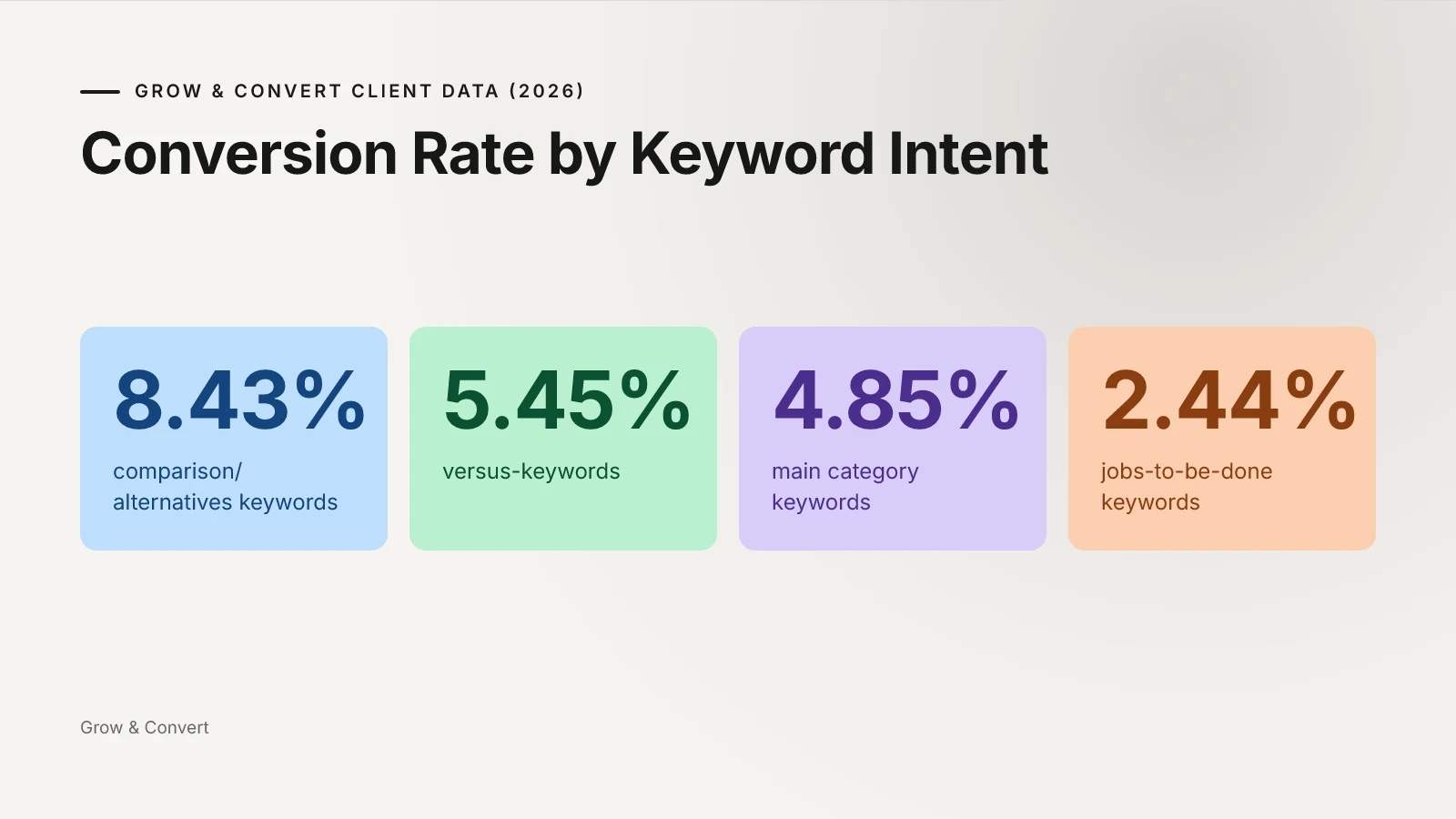
The conversion-by-intent data (updated 2026). Across 95 articles of their own client work, Grow & Convert measured visitor-to-lead conversion by keyword intent: comparison/alternatives keywords 8.43%, versus-keywords 5.45%, main category keywords 4.85%, jobs-to-be-done keywords 2.44%, TOFU/high-volume keywords ≤1%, against a typical blended blog conversion of 0.5–2%. This is the empirical spine of the framework — the intent hierarchy isn't a taste preference, it's the observed conversion ordering.
The Geekbot case study (2022). One client, 64 posts: the 22 BOFU posts drove 77% of 1,745 conversions, with BOFU pages converting at 4.78% versus 0.19% for TOFU — the ~25x gap that made the case study a reference point.
The honest labels: both datasets are vendor-published — measured by the agency, on the agency's clients, in support of the agency's methodology. That's not a dismissal; their methodology writeups are transparent, and self-published practitioner data is how most of this industry's real knowledge enters the record. But it means the right posture is: direction strongly supported, magnitudes approximate, replication absent. N=95 articles is one portfolio; N=1 client is a case study. Nobody — including Grow & Convert — has run the randomized version of this experiment, and nobody's numbers should be quoted to your board as guarantees.
What makes the evidence persuasive despite the caveats is that we're aware of no published counter-evidence: no published dataset shows informational content out-converting buying-intent content. The volume-first playbook's defense has always been reach and brand, never conversion — and for a founder who needs pipeline before brand, that concession settles the argument.
Why It Beats the Volume-First Playbook
It's worth being precise about why volume-first strategies keep failing founders, because the failure is structural, not executional:
Traffic is a power law; budgets are linear. Ahrefs' 2023 study of ~14 billion pages found 96.55% get zero Google organic traffic. Volume-first strategies buy lottery tickets in that distribution with content that — even when it wins — converts at ≤1%. The expected pipeline per article is the product of two long odds.
The conversion gap is bigger than any achievable traffic gap. A founder can't out-publish HubSpot, but doesn't need to: at the published bands, one ranking alternatives page (8.43%) carries the pipeline of several equally-trafficked informational posts (≤1%). Intent is the only lever where a solo operator gets order-of-magnitude advantages.
Volume-first metrics hide failure for years. Traffic graphs go up and to the right while pipeline stays flat, and the standard prescription — publish more — deepens the hole. Pain Point SEO fails fast and legibly instead: your comparison page either ranks and converts within two quarters or it doesn't, and either way you learn something true about your positioning.
The volume-first playbook was built for a different buyer. It descends from an era of content teams, gated ebooks, and nurture sequences — machinery that converts anonymous TOFU traffic into eventual pipeline at scale. If you have that machinery, TOFU volume can work. Founders doing their own SEO don't, which makes the ≤1% band a dead end rather than a top of funnel.
None of this makes informational content worthless — it builds the topical authority that helps commercial pages rank, and it has brand value that conversion tracking can't see. The claim is narrower and better-supported: as a sequencing rule under constrained resources, conversion-likelihood ordering dominates volume ordering, and the published data all points one way.
What an Agency Does That Software Can't
Grow & Convert run Pain Point SEO as a service, and honesty requires saying: some of what makes their engagements work does not survive translation into software, ours included.
Customer interviews with judgment. The framework's raw material is pain, and the highest-grade ore comes from a skilled interviewer asking your customers why they really bought. Software can transcribe and cluster those conversations; it cannot yet conduct them with the follow-up instincts of a good strategist, and canned survey questions are a weak substitute.
Positioning calls. Deciding which pains to lead with, which competitors to compare against by name, and how to frame a category is strategy — high-context, judgment-heavy, and consequential when wrong. An experienced agency has seen the movie dozens of times across clients. A founder with a tool is seeing it once, live.
Taste under ambiguity. When the data is thin — new category, few searches, no clear competitors — the framework runs on editorial taste, and taste is the least automatable input in this entire discipline.
Accountability with hands. An agency ships whether or not you had a good week. A tool waits for you. For some founders that difference is the whole difference.
So when is the agency the right answer? Roughly: when you can afford one (quality content agencies typically price in the thousands per month), when your category's positioning is genuinely unsettled, or when founder hours are the scarcest resource you have. Grow & Convert and agencies like them earn their fees on exactly the judgment layers above.
The software case is different, and it's the next section — but note what it isn't: it isn't "software does the same thing cheaper." It's that specific, well-defined layers of the framework — intent classification, integrity checking, measurement — are things software does more consistently than any manual process, while the judgment layers stay yours.
What Changes When Software Runs the Framework
Here's the honest platform take — what actually changes when Pain Point SEO's mechanical layers move into software:
Intent stops being artisanal. In the agency workflow, keyword intent is classified by an experienced strategist, well but manually and per-engagement. In software, every keyword carries a funnel-stage label and an Ahrefs-style business-potential score (0–3) as a property, computed the same way every time — which means a founder can sort a 500-keyword list by conversion likelihood in one click instead of one workshop. The classification is the framework's most mechanizable insight, and mechanizing it is pure gain.
Integrity gets enforced, not just intended. Pain Point SEO content pitches the product inside the pain — which creates a standing temptation to invent proof: fake testimonials, unverifiable "customers love us" claims, imaginary case-study numbers. Human processes police this with conscience and review; software can police it structurally. Inbounder's article generation blocks review and case-study claims outright unless real proof exists to cite — a gate, not a guideline. Whatever tool or process you use, build that rule in: BOFU readers are at peak skepticism, and fabricated proof converts worse than no proof while risking far more.
The portfolio gets watched. Strategy drift is invisible day to day — you write what's easy and six months later the portfolio is accidentally TOFU. A machine checking intent mix continuously catches it; Inbounder's Content Health panel flags a portfolio with zero BOFU-intent keywords, citing the same Grow & Convert bands this article cites, precisely because that drift is the most common quiet failure.
Distribution and outcomes close the loop. The framework's promise is conversions, which means publication and performance tracking are part of the method, not an afterthought — did the page ship, does it rank, does it convert, per keyword intent.
What doesn't change: the interviews, the positioning calls, the taste, the honesty of the final edit. Agencies proved the framework; software makes its mechanical layers cheap and its integrity layers enforceable; the judgment stays with you. That division of labor is the whole product philosophy, and we're comfortable stating it plainly because the originators' work stands on its own with or without us.
Run Pain Point SEO Yourself This Month
A four-week, founder-paced version of the framework — tool-optional, judgment required:
Week 1 — collect pains. Reread your last ten sales conversations and your support archive. Write every problem, objection, and competitor mention as a one-line pain. Interview two or three recent customers if you can ("walk me through the day you decided to look for a tool like this"). Target: 20–40 raw pains.
Week 2 — translate to keywords and score. Convert each pain into the searches a person with that pain makes, using the modifier patterns by business type. Score each 0–3 on business potential; tag each with its intent band. Cut the 0s and 1s without sentiment.
Week 3 — sequence and write the first page. Sort by band (alternatives/versus → category → JTBD), then by winnability. Write the top item — usually a comparison page or alternatives page. Follow the framework's content rule: resolve the pain fully, pitch the product where it honestly fits, fabricate nothing.
Week 4 — ship, link, and schedule the rest. Publish, interlink from your strongest pages, request indexing, and calendar the remaining list at one to two pages weekly. Set the six-month judgment date now, per the post-count math — Pain Point SEO changes what you write, not how long Google takes.
Then hold two disciplines for the six months: keep choosing the low-volume high-intent keyword when the tool tempts you with volume, and keep the product pitch honest when a fabricated proof point would be easier. The first discipline is the framework; the second is what makes it durable.
And read the originators. Grow & Convert's own writing on Pain Point SEO is the primary source, it's free, and this article is the map, not the territory.
Frequently Asked Questions
What is Pain Point SEO?
Pain Point SEO is a content strategy framework that chooses topics by their likelihood to convert rather than their search volume — starting from customers' actual pains (gathered from sales calls and interviews), translating them into the searches people with those pains make, and prioritizing high-intent, usually low-volume keywords like comparisons, alternatives, and jobs-to-be-done queries. Content then resolves the pain directly, including pitching the product where it honestly fits.
Who coined the term Pain Point SEO?
The content marketing agency Grow & Convert coined Pain Point SEO in 2018 and still publish the data the framework rests on. Unusually for the industry, they've published measured conversion data from their own client work to support the framework, including intent-level conversion bands (updated 2026) and the 2022 Geekbot case study. Their blog at growandconvert.com is the primary source.
Does Pain Point SEO actually work?
The published evidence supports it, with honest caveats: it's vendor-published by the framework's originators. Grow & Convert's data across 95 client articles (updated 2026) shows comparison/alternatives keywords converting at 8.43% versus ≤1% for high-volume informational terms, and their Geekbot case study (2022, one client) found 22 BOFU posts driving 77% of conversions. We're not aware of a published dataset showing the opposite pattern. Treat the direction as well-supported and the specific numbers as benchmarks, not guarantees.
Is Pain Point SEO the same as BOFU content?
They overlap heavily but aren't identical. Pain Point SEO is Grow & Convert's full framework — pain collection through customer research, conversion-likelihood prioritization, and product-forward content. BOFU content describes the content types (comparison, alternatives, pricing, use-case, integration pages) that the framework's prioritization usually surfaces first. In practice, running Pain Point SEO produces a mostly-BOFU content plan, with jobs-to-be-done articles extending it toward the middle of the funnel.
Do you need an agency to run Pain Point SEO?
No — the framework is fully teachable, and its originators document it openly. An agency adds skilled customer interviewing, positioning judgment, and accountability, which are real advantages if the budget is there. The mechanical layers — intent classification, business-potential scoring, portfolio monitoring, integrity checks against fabricated proof — are exactly what software does consistently; the judgment layers (which pains to lead with, honest final edits) stay with you either way.
Related articles
BOFU Content: The Founder's Guide to Bottom-of-Funnel SEO
BOFU content answers the questions buyers ask right before they choose — and it converts at a different order of magnitude than everything else on your blog. Here's the full founder's guide: the data, the five formats, how it fits topical authority, and timelines nobody else will give you straight.
Bottom of Funnel Keywords: How to Find High-Intent Terms
Bottom-of-funnel keywords are the searches buyers make right before choosing — and they're systematically invisible in volume-sorted keyword tools. Here's how to find them: modifier patterns by business type, the conversion bands each intent carries, and a 0–3 scoring system that formalizes the judgment.
How Many BOFU Posts Do You Need to Generate Leads?
Nobody will give you a straight answer to this question because the straight answer is uncomfortable: there is no verified threshold. Here's what the measured data actually supports — one ranking BOFU post can generate leads, most new pages don't rank, and the famous frequency numbers are zombies.
Comparison Page SEO: How to Build vs Pages That Convert
Comparison pages sit in the highest measured conversion band of any content type — and most of them still fail, because they're written as propaganda with a table. Here's the full craft: structure, the honesty that actually ranks, schema, and the failure modes that kill vs pages slowly.
How to Build Topical Authority: The 90-Day Founder Sprint (2026)
You build topical authority by publishing one interlinked cluster — a pillar plus about 12 answer-first articles on a topic you can own — in a focused 90-day sprint. Here is the exact plan, including what 13 unindexed articles on our own site taught us to do differently.
Build topical authority with Inbounder
Visual topic clustering, AI-powered content generation, and direct CMS publishing — all in one platform.