Topical Authority Case Studies: 5 Real Examples
Case studies on topical authority reveal a consistent pattern: the sites dominating broad, competitive keywords aren't necessarily the ones with the biggest backlink profiles. They're the ones...
By Nathan Rofkahr, Founder of Inbounder · Updated

Key Takeaways
- Topic clusters consistently outperform isolated blog posts for ranking on broad, competitive keywords, as documented by Semrush's research on topical authority (Semrush)
- HubSpot's pivot to a pillar-and-cluster model produced measurable organic traffic gains by restructuring existing content, not just creating new pages
- NerdWallet built dominance in personal finance by going deeper on subtopics than competitors with higher domain authority
- Canva combined programmatic content generation with topical clusters to capture thousands of long-tail design queries at scale
- Zapier's strategy of creating a page for nearly every software integration built a content moat competitors still haven't matched
- Siege Media's client work demonstrates that topical authority strategies translate across industries, not just in tech or SaaS
- The common thread across all five: exhaustive subtopic coverage matters more than publishing frequency alone
Theory Is Nice. Results Are Better.
Why Case Studies Are the Fastest Way to Learn Topical Authority
Topical authority is a site's perceived expertise on a subject, earned by publishing comprehensive, interlinked content that covers a topic from every meaningful angle. Google's systems increasingly reward this depth over raw backlink counts.
You can read a hundred guides explaining the concept. But watching how real companies executed it (where they started, what they prioritized, what the results looked like) gives you something theory can't: a mental model for execution.
Semrush's research on topical authority (Semrush) confirms that content hubs and topic clusters consistently outperform isolated pages when competing for broad search terms. That finding alone should reshape how you think about your content calendar.
So instead of rehashing the theory, here are five companies that put it into practice, and the patterns that matter for building topical authority on your own site.
Case Study 1: HubSpot's Topic Cluster Model
The Strategy: Pillar Pages + Systematic Cluster Content
HubSpot didn't just write about topic clusters. They bet their entire blog strategy on them.
Around 2017, HubSpot's marketing team noticed something frustrating. They had thousands of blog posts, yet many competed against each other for the same keywords. Their internal linking was a mess. And despite their enormous domain authority, certain broad terms kept slipping away.
Topic cluster is a content architecture model where a single comprehensive "pillar" page covers a broad topic, while multiple related "cluster" articles link back to it and to each other. HubSpot popularized this framework, then documented their own results on their blog (HubSpot).
What made HubSpot's approach worth studying wasn't just the structure. It was the ruthlessness of the reorganization. They audited existing content, consolidated duplicate posts, redirected underperformers, and rebuilt their internal linking from scratch. This wasn't a "publish more" strategy. It was a "reorganize everything you already have" strategy.
The results? Pages organized into topic clusters saw improved search visibility for their target broad terms. Beyond rankings, the pillar pages became genuinely useful resources that earned links naturally because they were the most comprehensive thing available on each topic.
The takeaway for you: If you already have dozens of blog posts, your first move isn't to publish more. Audit what you have, identify which posts cluster around the same themes, and restructure your internal linking. That alone can produce ranking improvements without writing a single new word.
Case Study 2: NerdWallet's Dominance in Personal Finance
How Topical Depth Beat Higher-DA Competitors
NerdWallet's SEO story is, frankly, a little absurd. They compete against banks, government institutions, and media giants with domain authority scores in the 90s. Yet NerdWallet consistently outranks them for terms like "best credit cards" and "how to invest money."
Topical depth refers to the degree to which a site covers all meaningful subtopics, questions, and angles within a subject area. As detailed in a comprehensive SEO analysis by Detailed.com (Detailed.com), NerdWallet's organic dominance stems from covering personal finance with an almost obsessive granularity.
Consider this: NerdWallet doesn't just have a page about credit cards. They have pages about credit cards for students, credit cards for bad credit, credit cards for travel, credit cards with no annual fee, credit cards for small businesses, and dozens more. Each page targets a specific intent. Each links to related pages. And collectively, they signal to Google that NerdWallet understands credit cards better than anyone else.
This matters because it illustrates a key difference between topical authority and domain authority. A bank might have a higher DA score overall, but NerdWallet's concentrated depth on personal finance topics makes it the more authoritative source for those specific queries.
The mechanism is straightforward: when Google sees a site thoroughly covers every facet of a topic, it develops higher confidence in that site's expertise. So even a site with lower overall authority can outrank juggernauts, as long as its topical coverage runs deeper.
What you should steal from NerdWallet: Map every subtopic, question, and comparison query within your niche. Then systematically create content for each one. The power isn't in any single page. It's in the network.
Case Study 3: Canva's SEO Playbook for Ranking Broad Design Topics
Programmatic Content + Topical Clusters at Scale
Canva's organic growth is one of the most studied in SaaS (and for good reason). Foundation Inc's analysis of Canva's SEO strategy (Foundation Inc) documented how the company went from a design tool to one of the most visited websites on the internet, largely through search.
Programmatic SEO is the practice of generating large numbers of pages automatically using templates and databases, targeting long-tail keyword variations at scale. Canva combined this with a topical cluster approach, and the combination was devastating for competitors.
Their playbook had two layers:
- Template landing pages for every conceivable design need: "birthday invitation template," "resume template," "Instagram story template," thousands of them, each automatically generated but optimized for a specific query
- Educational content clusters around broader design topics: color theory, branding basics, social media design tips, each supported by interlinked blog posts
The programmatic pages captured high-intent, long-tail traffic. The educational clusters built topical authority around broader terms. Together, they created a flywheel where each new page strengthened the authority of every other page in the cluster.
What's genuinely clever about Canva's approach is that the programmatic pages weren't thin content. Each template page provided real value: a usable template you could customize immediately. Google rewards pages that satisfy user intent, and these pages did exactly that.
For SaaS founders, the lesson is specific: if your product solves problems across multiple use cases, consider whether programmatic landing pages combined with educational content clusters could capture the full breadth of search demand in your space.
Case Study 4: Zapier's "SEO Moat" Through Topic Coverage
Building Authority Across Thousands of Integration Topics
Zapier's content strategy might be the purest example of topical authority as a competitive moat. Detailed.com's analysis of Zapier's SEO (Detailed.com) revealed the scale of what they built: thousands of pages, each covering a specific app integration or workflow.
SEO moat is a competitive advantage built through content and search visibility that becomes increasingly difficult for competitors to replicate over time. Zapier's moat works because the sheer volume and interconnectedness of their content would take any competitor years to match.
Think about it from a pure math perspective. Zapier integrates with thousands of apps. For each pair of apps, they created a dedicated page: "How to connect Slack and Google Sheets," "How to connect Mailchimp and Salesforce," and so on. The combinatorial possibilities are enormous.
But volume alone isn't what makes this work. Each page links to related integration pages, to broader "how to automate" guides, and back to category pages. The internal linking structure creates a dense web of topical signals telling Google: "Zapier is the authority on software automation."
This strategy also demonstrates why topical relevance in link building matters so much. When other sites link to Zapier's integration pages, those links carry topical relevance that reinforces Zapier's authority on automation topics specifically.
The barrier to entry this creates is real. A new competitor can't just "do SEO." They'd need to produce thousands of high-quality, interlinked pages to even begin competing for the same broad terms. That's years of work (and most startups don't have that kind of patience).
Case Study 5: Siege Media's Client Results Through Topical Strategy
Agency-Level Topical Authority in Action
Siege Media's publicly shared case studies (Siege Media) offer something the other examples don't: proof that topical authority strategies work across industries, not just for tech giants with unlimited resources.
Content marketing ROI is the measurable return generated from content investments, typically tracked through organic traffic growth, keyword rankings, and estimated traffic value. Siege Media's case studies document these metrics across clients in finance, SaaS, ecommerce, and other verticals.
What makes their results relevant for growth-stage companies is the methodology. Rather than publishing hundreds of posts and hoping for the best, Siege Media's approach focuses on:
- Keyword opposition to benefit (KOB) analysis to prioritize topics with the best ratio of search volume to ranking difficulty
- Strategic content creation targeting specific topical gaps competitors haven't filled
- Internal linking architecture designed to pass authority from high-performing pages to newer content
And here's a useful reminder: you don't need to build a 10,000-page content empire to see results. Even a focused topical authority strategy for ecommerce or niche SaaS can produce significant organic growth with 50 to 100 well-structured, interlinked pages.
The pattern across Siege Media's case studies is consistent: clients who committed to comprehensive topic coverage, rather than sporadic keyword targeting, saw compounding organic traffic growth over 6 to 12 months.
Patterns From All 5 Case Studies
After examining these five examples, the recurring themes are hard to ignore:
- Structure beats volume. Every company prioritized how content connected over how much they published. Internal linking architecture was central to every strategy.
- Depth on subtopics signals expertise. NerdWallet and Zapier didn't rank for broad terms by targeting those terms directly. They ranked by covering every subtopic underneath them.
- Existing content is an asset. HubSpot's biggest gains came from reorganizing content they already had. Audit before you create.
- Programmatic and editorial content complement each other. Canva's combination of template pages and educational clusters is a model worth studying for any product-led company.
- Compounding takes time. Across every case study, meaningful results showed up after months of consistent execution. Not weeks.
Action Steps: Apply These Lessons to Your Site Today
You don't need Canva's engineering team or HubSpot's content budget. But you do need a plan. Start here:
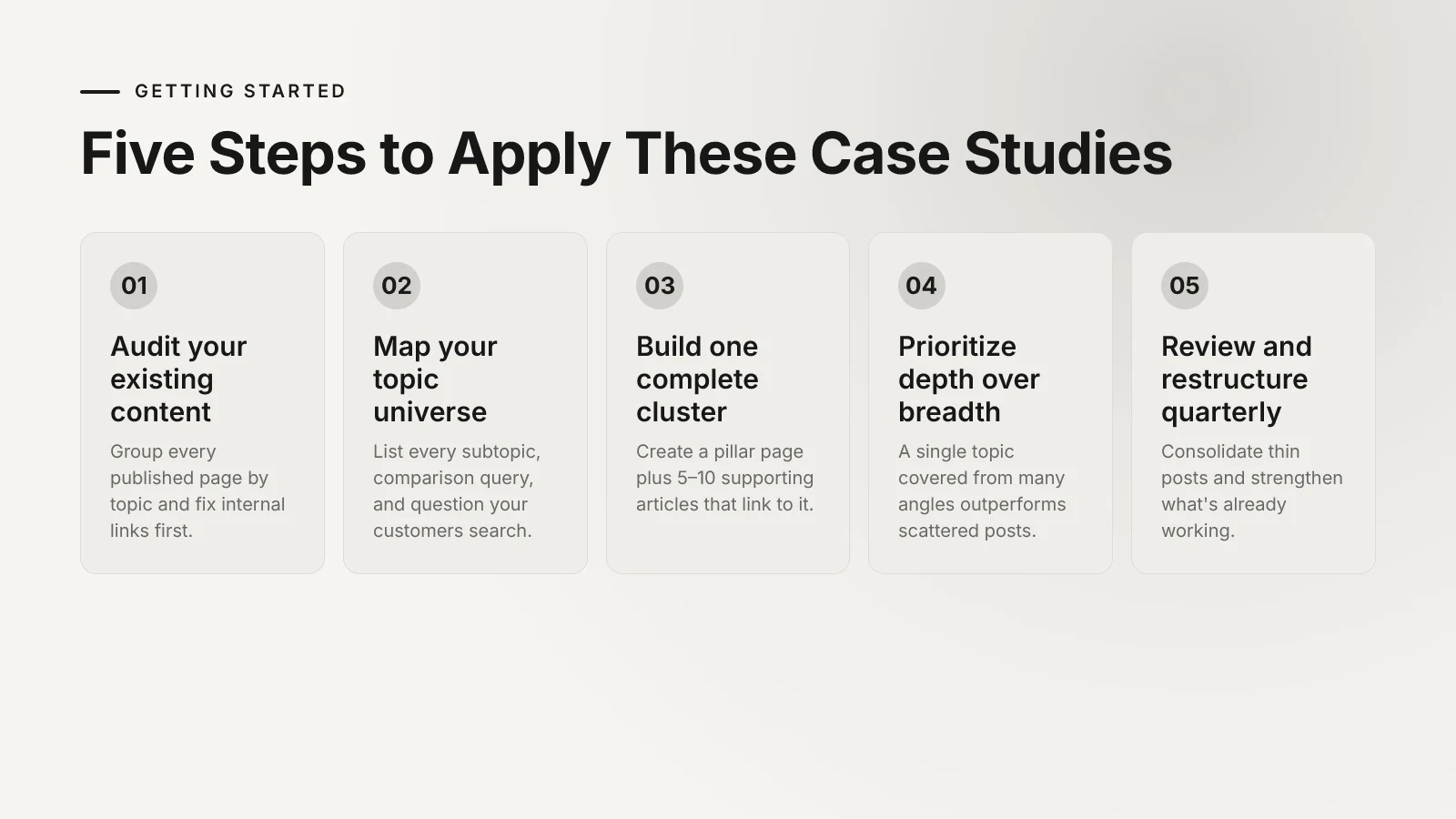
- Audit your existing content. Group every published page by topic. Identify clusters that already exist, even if they're not linked properly. Fix internal links first.
- Map your topic universe. For your core subject, list every subtopic, comparison query, and question a potential customer might search. This becomes your content roadmap.
- Build one complete cluster. Pick your highest-priority topic. Create or designate a pillar page. Then publish 5–10 supporting articles that link to it and to each other.
- Prioritize depth over breadth. A single topic covered from 15 angles will outperform 15 unrelated blog posts. Concentrate your effort.
- Review and restructure quarterly. As you publish more, revisit your clusters. Consolidate thin posts. Add internal links. Strengthen what's already working.
If you want a more detailed framework for execution, the guide on how to build topical authority in 9 proven steps walks through each phase in detail. Or, if you'd rather hand this off, explore what a topical authority service actually delivers before committing.
Frequently Asked Questions
What are the best case studies on topical authority?
The most documented examples include HubSpot's topic cluster model, NerdWallet's personal finance dominance, Canva's programmatic SEO playbook, Zapier's integration content moat, and Siege Media's cross-industry client results. Each demonstrates a different approach to ranking for broad topics through comprehensive subtopic coverage.
How long does it take to build topical authority?
Most case studies show meaningful results after 6–12 months of consistent execution. HubSpot and NerdWallet both built their authority over years, though initial ranking improvements from restructuring existing content can appear within weeks.
Can small sites compete with high-authority domains using topical authority?
Yes. NerdWallet's success against banks and financial institutions proves concentrated topical depth can outperform raw domain authority. A smaller site covering a niche more thoroughly than a large competitor will often rank higher for queries within that niche.
What's the difference between topical authority and domain authority?
Domain authority measures a site's overall link profile strength. Topical authority measures how comprehensively a site covers a specific subject. A site can have moderate domain authority but strong topical authority in a focused niche, which is often enough to outrank higher-DA competitors.
Do you need thousands of pages to build topical authority?
No. Zapier and Canva operate at massive scale, but Siege Media's case studies show 50–100 well-structured, interlinked pages can produce significant results for focused niches. Quality of coverage and internal linking matter more than raw page count.
Is topical authority more important than backlinks?
They work together, but topical authority is increasingly important as Google's algorithms evolve. A strong internal linking structure and comprehensive topic coverage can compensate for a smaller backlink profile, especially in less competitive niches.
Related articles
How to Build Topical Authority: The 90-Day Founder Sprint (2026)
You build topical authority by publishing one interlinked cluster — a pillar plus about 12 answer-first articles on a topic you can own — in a focused 90-day sprint. Here is the exact plan, including what 13 unindexed articles on our own site taught us to do differently.
Topical Authority vs Domain Authority: Key Differences
Topical authority vs domain authority is the SEO debate that quietly separates teams who rank from teams who chase vanity metrics for years.
Topical Relevance in Link Building: Proven Guide
Topical relevance in link building determines whether your backlinks actually move rankings or just pad a spreadsheet. And most link building budgets bleed money on links that look impressive but...
Build topical authority with Inbounder
Visual topic clustering, AI-powered content generation, and direct CMS publishing — all in one platform.