Topical Authority for Ecommerce: 5-Step System
Topical authority for ecommerce is the strategy of building comprehensive content coverage around your product categories so search engines recognize your store as a trusted resource, not just...
By Nathan Rofkahr, Founder of Inbounder · Updated

Key Takeaways
- Product pages alone can't establish topical authority; you need educational content surrounding every major category
- Mapping buyer-journey topics reveals dozens of content opportunities most ecommerce brands ignore entirely
- Pillar buying guides serve double duty as ranking assets and conversion tools when structured correctly
- Category pages should function as topic hubs, not just product grids with a one-sentence intro
- Topically relevant backlinks to your content hub lift rankings across your entire product catalog, not just individual pages
- Internal linking between educational content and product pages creates the topical clusters Google rewards
- Measuring topical authority requires tracking entity coverage and organic visibility at the category level, not just individual keyword rankings
Your Product Pages Alone Won't Rank. Build the Fix.
Why Ecommerce Sites Struggle With Topical Authority
Topical authority is a search engine's confidence that a website deeply covers a subject, not just mentions it. For ecommerce, this is a structural problem. Most stores are built around transactions: category pages, product pages, maybe a sparse FAQ. That architecture tells Google what you sell, but it says almost nothing about what you know.
And Google cares about what you know. A lot.
Think about it from the algorithm's perspective. Two stores sell running shoes. Store A has 200 product listings. Store B has 200 product listings PLUS 40 articles covering pronation types, marathon training plans, shoe care guides, and comparison posts between trail runners and road shoes. Which store does Google trust to answer the query "best running shoes for flat feet"?
Store B. Every time.
According to Semrush's ecommerce SEO research, ecommerce sites with educational content hubs consistently see higher organic visibility than product-only sites. That gap widens over time because content compounds. Each new article strengthens the topical signal of every other page in the cluster.
The frustrating part? Most ecommerce teams know they should create content. But they publish randomly, without a system connecting that content back to revenue. So the blog sits in a corner collecting dust while the product pages fight for scraps.
That stops now.
Step 1: Identify Your Product-Adjacent Topics
The Buyer Journey Map for Topic Discovery
Product-adjacent topics are the questions, comparisons, and educational needs that surround a purchase decision but don't directly describe a product. These are the topics your customers Google before they're ready to buy.
Say you sell espresso machines. Your product pages cover the machines themselves. But your customers are searching for "how to pull a perfect shot," "espresso vs drip coffee caffeine," "best grinder for espresso," and "how to clean an espresso machine." Every single one of those queries is a content opportunity that feeds topical authority back to your product catalog.
To map these systematically, start with your top 5–10 product categories. For each one, identify topics across three stages:
- Awareness stage: "What is [concept]?" and "Why does [feature] matter?" queries
- Consideration stage: Comparisons, "best X for Y," and buying guides
- Post-purchase stage: How-to guides, maintenance tips, and advanced usage content
Tools like Google's "People Also Ask," Semrush's Topic Research, and even your customer support tickets reveal exactly what your buyers need to know. That last source (support tickets) is criminally underrated. Your support team hears the same 20 questions every week. Each one is a content idea already validated by real demand.
When you build topical authority with a proven step-by-step approach, this mapping phase becomes the foundation everything else rests on. Skip it, and you end up with a random collection of blog posts that don't reinforce each other.
Step 2: Build Buying Guide Pillar Pages
How to Structure Pillar Content That Drives Sales AND Rankings
Pillar content is a comprehensive, long-form page that covers a broad topic in depth and links out to more specific cluster articles. In ecommerce, your best pillar pages are buying guides. Not the fluffy "top 10" listicles every affiliate site churns out. Real, detailed guides that help someone make a confident purchase decision.
This is where you can genuinely separate your store from the competition. And REI has basically written the playbook.
According to analysis from Detailed.com, REI's expert advice content hub drives massive organic traffic to their product pages. Their guides cover topics like "How to Choose a Backpack" and "What to Wear Hiking" with genuine depth, including sizing charts, feature explanations, and scenario-based recommendations. These aren't thinly veiled product pitches. They're actually useful, which is precisely why they rank.
The mechanism behind this is worth understanding. When Google sees a buying guide that thoroughly covers "how to choose a camping tent," and that guide links to your tent category page and individual product pages, it creates a semantic relationship. The guide proves expertise. Internal links transfer that authority signal to your commercial pages. Those commercial pages rank better as a result.
Structure your pillar buying guides with these elements:
- A clear decision framework that walks through the key factors (e.g., "choosing by use case, then by budget, then by features")
- Detailed explanations of technical terms your buyers encounter (what does "hydrostatic head" actually mean for a tent?)
- Comparison tables where appropriate, linking to specific products
- Internal links to cluster content (your how-to guides, comparison posts) and to relevant product/category pages
Each pillar page should target a high-volume consideration-stage keyword and serve as the hub for an entire cluster of supporting content. Aim for 2,000+ words, but only because the topic genuinely requires that depth, not because length alone helps. (Google doesn't hand out bonus points for word count.)
Step 3: Create Educational Cluster Content
How-To Guides, Comparison Posts, and Buyer Checklists
Cluster content refers to focused articles that cover specific subtopics within a broader theme, all linking back to a central pillar page. This is where you build the density of coverage that signals real authority.
For each pillar buying guide, you'll want 8–15 cluster articles. Sounds like a lot. But when you've done the topic mapping from Step 1, you'll realize you already have the ideas. The work is execution.
Effective cluster content types for ecommerce include:
- How-to guides: "How to Season a Cast Iron Skillet," "How to Measure Your Ring Size at Home"
- Comparison posts: "Ceramic vs. Stainless Steel Cookware: Which Is Right for You?"
- Buyer checklists: "First Apartment Kitchen Essentials Checklist"
- Problem-solution articles: "Why Your Espresso Tastes Bitter (And How to Fix It)"
Connecting Educational Content to Product Pages
Each cluster article should link to the pillar page, to at least one relevant category page, and to 2–3 specific products where naturally appropriate. This internal linking structure for topical authority is what transforms scattered blog posts into a cohesive content hub.
But don't force product links where they don't fit. If you're writing about troubleshooting bitter espresso, a natural mention of your grinders or your recommended beans makes sense. A shoehorned link to your espresso machine accessories page does not. Google's systems (and your readers) can tell the difference.
Step 4: Optimize Category Pages as Topic Hubs
Adding Topical Depth to Category and Collection Pages
Most ecommerce category pages are wastelands. A heading, maybe a sentence of intro copy, and a grid of products. That's a missed opportunity of almost absurd proportions.
Category page optimization is the practice of adding substantive, topically relevant content to your category and collection pages so they function as topic hubs rather than simple product listings.
Research published in the Journal of Marketing Research (Bleier, Harmeling, and Palmatier, 2019, available through Harvard Business School) found that personalized and informative content on commercial pages significantly increases purchase intent. The same principle applies to category pages: when you add genuine informational value, you increase both rankings and conversions.
So what does this look like practically? Add 300–500 words of expert editorial content to your top category pages. Cover what the category includes, who it's for, key decision factors, and link to your pillar buying guide. Some brands add mini-FAQs directly on category pages, which also generate rich snippet opportunities.
One critical detail: place this content below the product grid, or use a tabbed layout. You want the products visible first for users who are ready to buy. The supporting content serves both the search engine and the browser who needs more context.
When you're measuring your topical authority progress, track organic impressions and rankings at the category level. That's where the compounding effect becomes visible.
Step 5: Earn Topically Relevant Links to Your Content Hub
Link Building Strategies Specific to Ecommerce
You've built the content. Now you need external signals telling Google that other sites trust your expertise too. But not just any links. Topically relevant links are backlinks from websites that cover subjects related to your content, and they carry significantly more weight than generic links from unrelated domains.
Research from Ahrefs (Search Traffic Study, 2020) found that pages with backlinks from topically related sites tend to rank higher than those with links from unrelated sources, even when the unrelated links come from higher-authority domains. Relevance beats raw authority.
For ecommerce content hubs, effective link-earning tactics include:
- Original research and surveys: Survey your customers about buying habits in your niche, then publish the results. Journalists and bloggers link to original data.
- Shareable tools and calculators: A paint coverage calculator, a ring size converter, a mattress firmness quiz. These attract links naturally because they're genuinely useful.
- Expert roundups and collaborations: Partner with industry experts to create definitive guides. Contributors share and link to content they helped create.
- Digital PR around your guides: Pitch your best buying guides to journalists writing seasonal roundups or gift guides.
Understanding topical relevance in link building helps you prioritize which links to pursue. A single link from a respected niche blog often moves the needle more than ten links from generic directories.
And here's why the whole system works: your educational content is far easier to earn links to than your product pages. Nobody links to a product page unless they're doing a review. But a thorough, genuinely helpful buying guide? That's linkable. Links flow to the content, internal links distribute that authority to the pages that generate revenue. Simple (in theory, anyway).
Summary: Ecommerce Topical Authority Fuels Revenue Growth
Topical authority marketing for ecommerce isn't a content marketing nice-to-have. It's a structural advantage that compounds over time. The brands that build these content networks don't just rank for more keywords. They build defensible organic traffic that's genuinely difficult for competitors to replicate.
The investment is real. Building 50–100 pieces of cluster content takes months. But the alternative, competing on product pages alone against Amazon and every other retailer, is a race to the bottom.
Action Steps: Build Your Ecommerce Content Hub
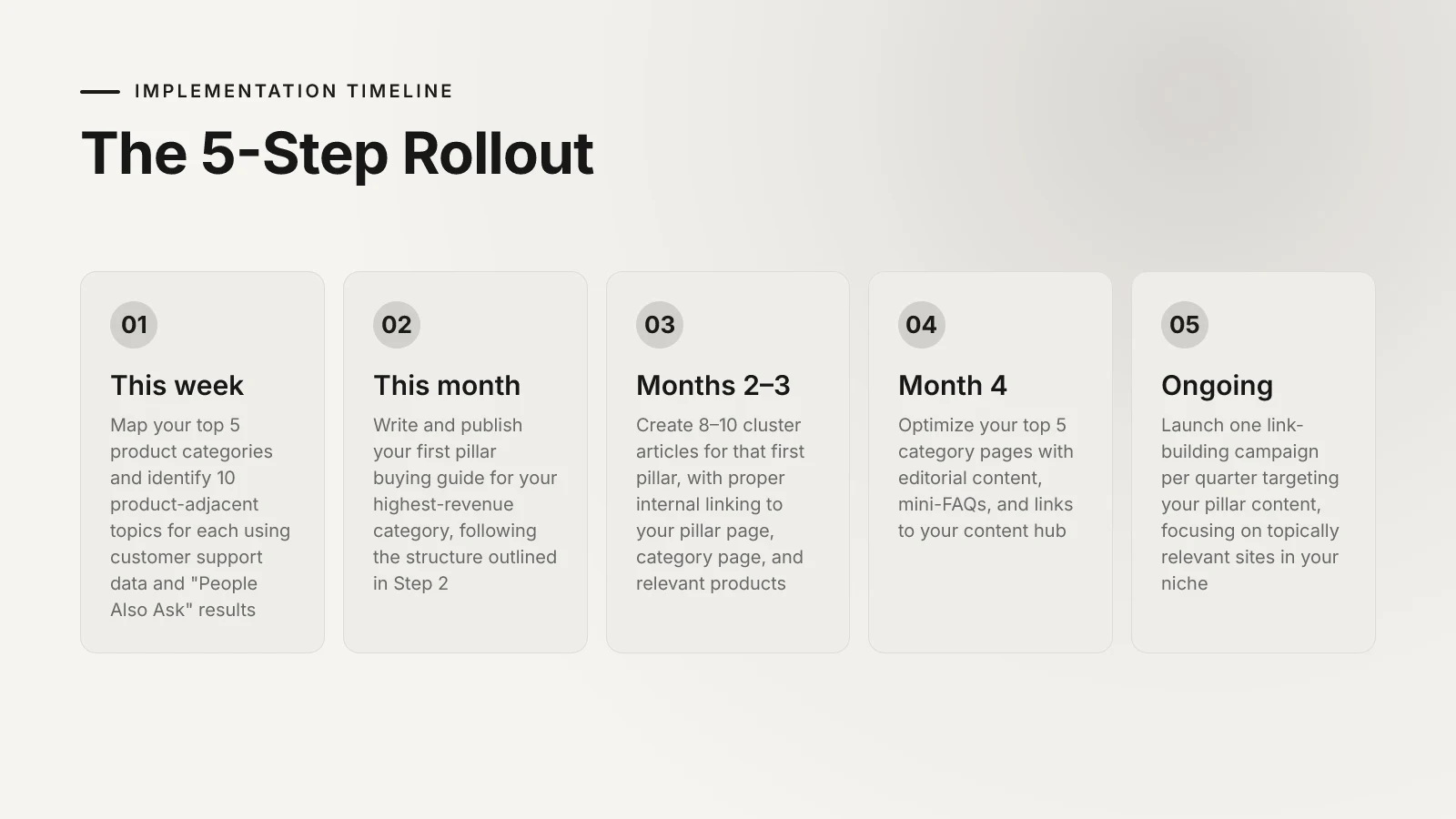
- This week: Map your top 5 product categories and identify 10 product-adjacent topics for each using customer support data and "People Also Ask" results
- This month: Write and publish your first pillar buying guide for your highest-revenue category, following the structure outlined in Step 2
- Months 2–3: Create 8–10 cluster articles for that first pillar, with proper internal linking to your pillar page, category page, and relevant products
- Month 4: Optimize your top 5 category pages with editorial content, mini-FAQs, and links to your content hub
- Ongoing: Launch one link-building campaign per quarter targeting your pillar content, focusing on topically relevant sites in your niche
If you want the complete roadmap beyond ecommerce, the full guide to building topical authority in 9 steps covers the foundational framework this system is built on.
Frequently Asked Questions
What is topical authority for ecommerce?
Topical authority for ecommerce is the degree to which search engines recognize an online store as a comprehensive, trustworthy source on the subjects surrounding its products. It's built by creating educational and informational content that covers your product categories in depth, not just listing items for sale.
How long does it take to build topical authority for an ecommerce site?
Most ecommerce sites start seeing measurable improvements in organic visibility within 4–6 months of consistent content publishing. The compounding effect accelerates after 20–30 cluster articles are live and properly interlinked. Full topical authority across multiple categories typically takes 12–18 months of sustained effort.
Do you need a blog to build ecommerce topical authority?
A blog is the most common format, but it's not the only one. Buying guides, resource centers, video tutorials, and enriched category pages all contribute to topical authority. What matters is the content exists on your domain, covers topics comprehensively, and links to your commercial pages.
How is topical authority different from domain authority?
Domain authority refers to a score predicting a website's overall ability to rank, based largely on backlink profiles. Topical authority is more specific: it measures how well a site covers a particular subject area. A site can have high domain authority but low topical authority in a given niche, and vice versa.
Can small ecommerce stores compete with large retailers on topical authority?
Absolutely. Smaller stores often have a significant advantage because they can go deeper on niche topics large retailers ignore. A specialty cookware shop can produce far more detailed content about carbon steel pans than a general retailer ever would. That depth is exactly what builds topical authority in focused niches.
What types of content build topical authority fastest for ecommerce?
Buying guides and comparison posts tend to generate the fastest results because they target high-intent, consideration-stage keywords with relatively lower competition. How-to guides and educational content build the broadest topical coverage over time, while original research earns backlinks that accelerate the entire process.
Related articles
How to Build Topical Authority: The 90-Day Founder Sprint (2026)
You build topical authority by publishing one interlinked cluster — a pillar plus about 12 answer-first articles on a topic you can own — in a focused 90-day sprint. Here is the exact plan, including what 13 unindexed articles on our own site taught us to do differently.
Internal Linking for Topical Authority: The Hub–Spoke–Mesh Method
Structure internal links in three layers: a hub pillar linking down to every supporting article, spokes linking back up, and a mesh between siblings where the overlap is real. Here's the full method — shaped by the indexing failure on our own blog.
Measuring Topical Authority: 5 Essential Metrics
Measuring topical authority requires tracking five specific metrics that most SaaS founders completely ignore, even while obsessing over vanity numbers like domain authority.
Build topical authority with Inbounder
Visual topic clustering, AI-powered content generation, and direct CMS publishing — all in one platform.