AEO: The Founder's Guide to Answer Engine Optimization
Ranking on Google no longer guarantees anyone sees your answer. Here's how answer engines pick what to cite, the five levers you control, and how to start without an agency.
By Nathan Rofkahr, Founder of Inbounder · Updated
What Is Answer Engine Optimization?
Answer engine optimization is the practice of structuring content so AI systems like ChatGPT, Perplexity, and Google's AI Overviews can pull it out and cite it directly in their answers.
It overlaps with SEO without being the same job. SEO competes for a click. AEO competes for a citation, which sometimes means winning the moment without ever getting the visit.
If your site ranks fine but you never see your brand mentioned in an AI answer, that gap is the whole problem this guide solves.
Below: how answer engines decide what to cite, the five levers you actually control, which tools can run this without an agency, and the mistakes that keep good pages out of AI answers.
Background and Context: Why "Getting Found" Means Something Different Now
Search used to mean ten blue links and a results page you scrolled through. You'd click two or three, compare, and land somewhere.
That model is breaking down. Answer engines are software systems (ChatGPT, Perplexity, Google's AI Overviews) that generate a direct response to a query instead of a list of links. The user asks a question. The system reads multiple sources, synthesizes an answer, and hands it over in a paragraph. No clicking required.
This matters because of where traffic actually comes from now. SparkToro's 2024 clickstream study, built on Datos panel data, found that 58.5% of US Google searches ended without a click to any result (SparkToro, 2024 Zero-Click Search Study). AI Overviews and chat-based answers speed that pattern up instead of reversing it.
So the real shift isn't that Google is dying. It's that the page one result isn't always a page anymore. Sometimes it's a sentence, built from your content, with your name mentioned or quietly left out depending on how well your page was structured for extraction.
That's the game now. And most small teams are still playing the old one.
What Changed in How People Ask Questions
Type "best CRM for a 5-person sales team" into Google five years ago and you'd get ten listicles to compare yourself. Ask the same thing to ChatGPT today and you get an answer. Maybe three names, a sentence of reasoning each, done.
The query didn't change. The expectation did. People increasingly ask answer engines the way they'd ask a knowledgeable friend: full sentences, specific context, follow-up questions. "What's the best CRM for a 5-person sales team that's not HubSpot" is a conversation, not a keyword string.
That shift rewards content written to actually answer a question, not content written to rank for a search term. Which is a much bigger deal than it sounds.
How AEO Differs From Generative Engine Optimization
These two terms get used interchangeably, and that's causing real confusion for teams trying to build a strategy around either one.
Generative engine optimization is the broader practice of optimizing content for any AI system that generates original text as output, including chatbots, AI search assistants, and summarization tools. AEO is best understood as the applied, answer-specific subset of that: it's GEO focused narrowly on getting cited as the source behind a direct answer.
Think of it this way. GEO is the discipline. AEO is the tactic you use inside that discipline when the goal is a citation in a specific Q&A-style response. In practice, for a small team, the distinction barely changes what you do day to day. You're still writing clear, well-structured, well-sourced content. But the difference matters when you're reading industry commentary, because writers use "GEO" to talk about the whole AI-search picture and "AEO" to talk about optimizing the answer itself.
Where Answer Engines Fit Alongside Google Search
Google hasn't been replaced. It's been layered.
AI Overviews sit on top of traditional search results for a huge share of queries now, pulling from the same indexed web but compressing it into a summary before the user ever scrolls to a result. Meanwhile, standalone answer engines like ChatGPT and Perplexity operate as a parallel discovery channel entirely, one where your page never has to rank on Google at all to get surfaced, because these tools crawl and retrieve independently.
So your content now has to perform in three different environments: classic blue-link SEO, AI Overviews riding on top of Google, and standalone answer engines with their own retrieval logic. Optimizing for only the first one leaves the other two to chance.
How Answer Engines Actually Decide What to Cite
This is where most explanations get hand-wavy. It shouldn't be. The mechanics are fairly consistent across systems, even though the branding differs.
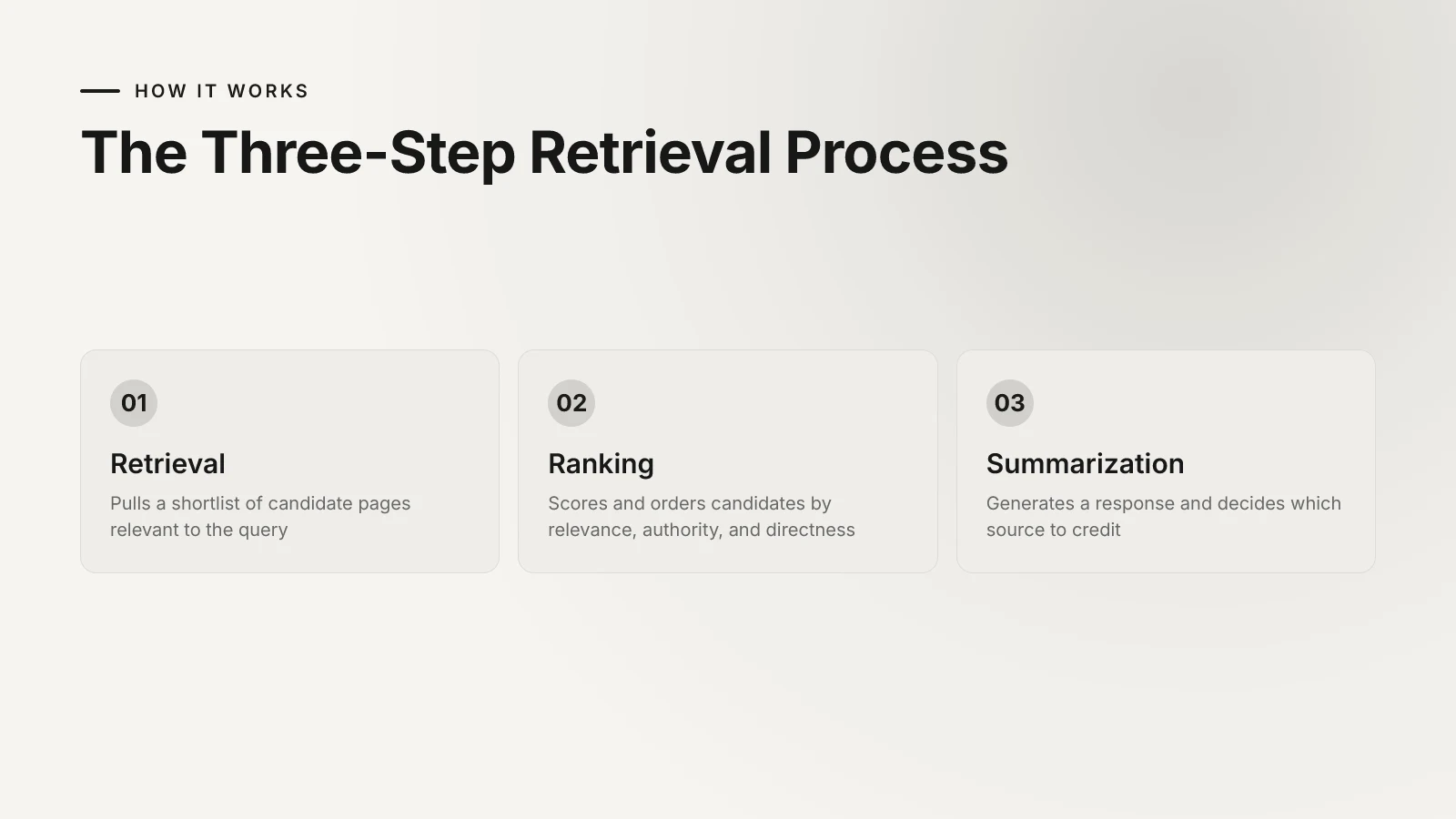
Every answer engine runs some version of a three-step process: retrieval, ranking, and summarization.
Retrieval is the step where the system pulls a shortlist of candidate pages that seem relevant to the query, usually from a search index or a live crawl. Ranking is the step where those candidates get scored and ordered based on relevance, authority, and how directly they address the question. Summarization is the final step, where the model reads the top-ranked content and generates a response, deciding in real time which source (or sources) to pull language from and credit.
Here's what that means in practice. A page can be technically well-optimized for retrieval, show up in the candidate pool, and still get skipped during summarization because the actual answer is buried under three paragraphs of preamble. The model is scanning for extractable, quotable, self-contained statements. If your answer doesn't appear until paragraph six, you've lost the citation to a competitor who put it in sentence one.
This is also why topical depth can matter as much as raw backlink count here. No provider publishes how its retrieval weighs a site's coverage of a subject, but a page from a site with a dense, interlinked cluster on a topic gives a retrieval system more relevant context to draw on than a single standalone post with heavy backlinks and nothing around it.
The AEO Framework: Five Levers You Control
None of this is magic. It comes down to five structural decisions you make on every page you publish.
- Direct-answer structure: Put the actual answer in the first 1-2 sentences after a heading, before any setup or context. Answer engines favor content that front-loads the point.
- Structured data and schema: Mark up FAQs, how-tos, and key facts with schema so machines can parse your content's structure without guessing at it. Treat it as a supporting signal rather than the primary driver; it helps parsing but won't earn a citation on its own.
- Topical depth and internal linking: Cover a subject thoroughly across interlinked pages rather than one isolated post, so retrieval systems see your domain as a reliable source on the topic.
- Source clarity and citations: Name your sources, your data, and your claims explicitly. Vague, unattributed claims give a model less to verify and quote, and give readers less reason to trust you.
- Freshness signals that are actually real: Update content when the underlying facts change, not just the timestamp. Cosmetic date changes on stale content are easy for readers to spot, and it's a poor bet that search engines won't notice too.
The first lever does the most work for the least effort. Rewriting your opening paragraph to answer the question immediately, instead of building up to it, is often the single highest-leverage change you can make to an existing page. If you want a structured way to check your existing pages against all five levers, the AEO checklist for SaaS content walks through each one with specific fixes.
Structured Data and Schema, in Practice
Schema markup is the part teams skip because it sounds technical. It's really just a translation layer. You're taking information that's already on your page and labeling it in a format machines can parse without ambiguity.
FAQ schema, HowTo schema, and Article schema are the three most relevant types for AEO. Implementing them correctly on a WordPress or Webflow site usually takes less time than writing the content itself, especially with a JSON-LD template rather than building markup from scratch. If this is new territory, start with Google's own structured data documentation. One caveat: Google retired HowTo rich results in 2023 and FAQ rich results in 2026, so the Rich Results Test won't confirm those two types even when the markup is correct.
AEO vs. Traditional SEO vs. Generative Engine Optimization
This is where the terminology gets genuinely confusing, so let's be precise instead of gesturing vaguely at "they're all kind of the same thing."
Traditional SEO is the practice of optimizing a page to rank higher in a search engine's list of results, measured mainly by position and click-through rate. AEO is the practice of optimizing a page to be extracted and cited as the source of a direct answer, measured by citation frequency rather than ranking position. GEO is the umbrella term covering optimization for any generative AI system, AEO included, across the full range of how those systems might use your content, not just in direct-answer format.
Where do they overlap? More than you'd think. Clear writing, strong topical authority, accurate sourcing, and solid technical structure help you in all three contexts at once. A page that ranks well on Google because it's genuinely the best resource on a topic is also a strong candidate for AI citation, because the signals that indicate quality to a search algorithm and to a retrieval model aren't that different.
Where they diverge is in what "winning" looks like. SEO success is a top-three ranking and a healthy CTR. AEO success can mean zero clicks and a citation with your brand name attached inside a ChatGPT response, something your analytics dashboard won't show you unless you're specifically watching for brand mentions in AI outputs. That's a different success metric, and treating them as identical is how teams end up optimizing for the wrong outcome. For a side-by-side breakdown of what each one optimizes and measures, see AEO vs GEO vs SEO.
Answer Engines You Need to Optimize For
Not all answer engines retrieve content the same way, and treating them as one target is a mistake.
Google AI Overviews pull mainly from Google's existing index, which means standard technical SEO, crawlability, and page structure still matter enormously here. If Google can't crawl and index your page in the first place, it doesn't matter how well-written your answer is.
ChatGPT and Perplexity behave differently depending on mode. ChatGPT's browsing-enabled responses retrieve live web content, while Perplexity is built around real-time retrieval and citation by design, showing sources inline with every answer. Perplexity in particular rewards clear sourcing and recent publication dates because its entire interface is built around transparency of citation. To find out whether ChatGPT already uses your pages, follow how to check if ChatGPT cites your site. To improve the odds, read how to get cited by ChatGPT without domain authority.
Voice assistants and conversational search (Siri, Alexa, Google Assistant) lean even harder on structured data and concise, single-sentence answers, because the output format is audio with no visual scanning available. A 40-word answer that reads fine in text becomes unbearable at conversational speaking pace. If your content can't be compressed into one clean spoken sentence, voice assistants will usually skip it in favor of a competitor's page that can.
Tools That Run an AEO Program Without an Agency
This is the part that should feel like relief if you've been dreading a retainer. You don't need to hire anyone to start. You need a system.
An AEO-capable content workflow typically needs four pieces working together: keyword and query research that identifies actual questions people ask, a content planning layer that groups related topics into clusters instead of isolated posts, a writing process that produces direct-answer structure by default, and a way to measure whether your content is actually getting pulled into AI answers.
Most small teams cobble this together from disconnected tools (a keyword tool here, a writing assistant there, a spreadsheet tracking what's published). That works, barely, until the spreadsheet becomes the bottleneck. For a fair look at what monitoring tools actually do, see best AEO tools. For where AI agents help and where they don't, see AI SEO agents for AEO.
What an AEO Score Measures, and Why It's a Proxy, Not a Guarantee
An AEO score is a composite metric that estimates how likely a page is to be retrieved and cited by an answer engine, based on structural factors like answer placement, schema presence, topical depth, and source clarity.
It's useful. It's also not a guarantee. No scoring tool can see inside OpenAI's or Google's retrieval models, so an AEO score is always an informed estimate built from publicly observable patterns, not a direct measurement of citation probability. Treat it the way you'd treat a domain authority score: directionally useful, worth improving, not worth obsessing over as if it were ground truth. We looked at how well these scores line up with real citations in do AEO scores predict AI citations?
Do It Yourself, Use a Tool, or Hire Help?
The honest answer: it depends on what you actually need done versus what you need decided.
A tool makes sense when you or someone on your team can execute the strategy but needs leverage on the research, structuring, and publishing grunt work. An agency makes sense when you need someone else to own the strategic thinking entirely, not just the execution. Most early-to-growth-stage teams without dedicated content headcount are closer to the first category than they realize. They don't lack judgment. They lack the hours to do keyword research, build a brief, write a draft, add schema, and publish it, eight times a week, every week, forever.
Common AEO Mistakes That Keep Content Invisible to AI
Some of these are embarrassingly easy to fix. Most teams just don't know to look for them.
Writing for keywords instead of questions. A page optimized around "project management software" as a keyword phrase reads nothing like a page that answers "what's the best project management software for a remote team of 10." The second version mirrors how people actually phrase queries to AI systems. The first version mirrors how people typed into Google in 2015.
Publishing one-off posts instead of clusters. A single article on a topic, no matter how well-written, signals less topical authority to a retrieval system than a well-organized cluster of interlinked pages covering the subject from multiple angles. Isolated posts also tend to get orphaned, with no internal links pointing to or from them, which makes them harder for crawlers to find and harder for readers to stumble into.
Burying the answer. This one is almost comically common. A page will have a genuinely good, specific answer to the query, three paragraphs down, after a long throat-clearing introduction about why the topic matters. Answer engines don't wait around for you to get to the point. Neither do readers, honestly.
Faking freshness. Changing a "last updated" date stamp without changing the actual content is easy for any reader who checks to spot, and it's a poor bet that search engines and language models won't notice too. It can undercut trust in every date on your site, not just that one page.
We've seen these failures up close in our own topical-authority cluster, including the topic clusters guide. We share the numbers in AI SEO agents for AEO. Publishing a cluster is the start, not the finish.
The fix going forward is straightforward even if it's not glamorous: use contextual in-body links between related articles instead of sidebar-only links, merge pages that compete for the same intent, move the direct answer to the first sentence of every section, and only update a timestamp when the content underneath it actually changes.
Why This Matters: The Compounding Case for Starting Now
Zero-click search isn't a temporary blip. SparkToro's 58.5% figure comes from data running through May 2024, the month Google rolled AI Overviews out in the US, so it describes the baseline before AI answers became a regular part of results pages.
Waiting for "more data" before adjusting your content strategy means watching competitors get cited while you get neither the click nor the mention. The teams building topical depth and direct-answer structure now aren't doing it because it's trendy. They're doing it because retrieval models reward domains with a track record, and a track record takes time to build. Starting six months from now means being six months behind domains that started today.
Where to Go Next in This Cluster
- AEO vs GEO vs SEO: what each discipline optimizes and how you measure it
- Best AEO tools: a fair look at monitoring tools and what they can't tell you
- How to check if ChatGPT cites your site: a free monthly routine
- AEO checklist for SaaS content: 12 checks to run on your top pages
- AI SEO agents for AEO: what to automate and what to keep
- Background reading: what is AI visibility?, LLM SEO explained, AI share of voice benchmarks
Key Takeaways
- Answer engine optimization means structuring content so AI systems can extract and cite it directly, which is a different goal than ranking for a click.
- Answer engines retrieve, rank, and summarize in three distinct steps, and content that buries its answer past the first sentence often loses the citation even when it's technically relevant.
- The five core levers are direct-answer structure, schema markup, topical depth with real internal linking, clear source attribution, and genuine (not cosmetic) freshness.
- AEO, SEO, and GEO overlap heavily on quality signals but diverge on what success looks like: ranking position versus citation frequency versus broad generative visibility.
- Google AI Overviews, ChatGPT, Perplexity, and voice assistants each retrieve content differently, so a single-platform strategy leaves coverage gaps.
- An AEO score is a useful directional proxy for citation likelihood, not a guarantee, since no outside tool can see inside a model's actual retrieval logic.
- Clusters of interlinked content consistently outperform isolated one-off posts for signaling topical authority to retrieval systems.
Start with the page your business depends on most, whether that's a pricing page, a comparison post, or your most-visited blog article, and run it through the structural levers covered above before touching anything else. If you want a systematic way to catch the gaps most teams miss, the AEO checklist for SaaS content walks through exactly that, one fixable issue at a time.
Frequently Asked Questions
Is AEO replacing SEO?
No. AEO is layering on top of SEO rather than replacing it, since most answer engines, including Google's AI Overviews, still rely heavily on traditional indexing and crawlability to source their answers. Strong SEO fundamentals remain the foundation that AEO builds on, not a separate track.
Do I need separate content for AI search?
Not usually separate content, but often a different structure. The same page can serve both traditional search and answer engines if it leads with a direct answer, includes clear schema, and is backed by topical depth elsewhere on the site, rather than requiring a duplicate version built just for AI.
How long until AEO shows results?
There's no fixed timeline, since it depends on your domain's existing authority, how much of your content needs restructuring, and how competitive the topic is. Most teams find that citation visibility builds gradually alongside topical authority rather than appearing overnight after a single optimized post.
What is an answer engine, exactly?
An answer engine is a software system that generates a direct response to a user's query by retrieving and synthesizing information from multiple sources, rather than returning a ranked list of links. ChatGPT, Perplexity, and Google's AI Overviews are all examples.
Does schema markup actually help with AI citations?
Schema markup helps by giving retrieval systems an unambiguous, machine-readable structure to parse, which reduces the guesswork involved in understanding what a page is about and where the key answer lives. It doesn't guarantee a citation, but it removes a common barrier to one.
Can a small team realistically compete with larger sites on AEO?
Yes, because citation in an answer engine depends more on structural clarity and topical depth than on domain size or backlink volume alone. A smaller site with a tightly organized, well-structured cluster on a specific topic can out-compete a much larger, more generic site on that narrow subject.
What's the difference between AEO and generative engine optimization?
Generative engine optimization is the broader discipline of optimizing content for any AI system that produces generated text, while AEO is the more specific practice focused on earning direct citations in answer-style responses. AEO sits inside GEO as a particular application of it.
Free tool
Score your page’s AEO free
Free. No signup. Takes about 10 seconds.
Related articles
AEO vs GEO vs SEO: What's Different and What to Do First
Three acronyms, one shared foundation, and three different ways to win. Here's what actually changes between SEO, AEO, and GEO, and the order a small team should tackle them.
AEO Checklist for SaaS Content: 12 Checks for Your Top Pages
A page that reads well can still be invisible to answer engines. These 12 checks show whether AI can find, parse, and quote your SaaS pages, and which fixes to make first.
How to Check if ChatGPT Cites Your Site
There's no Search Console for ChatGPT. You can still find out whether it cites you by combining three free signals, and a simple monthly routine keeps you from chasing noise.
Best AEO Tools: An Honest Look for Founders
Most AEO tools track citations. Few tell you how to earn them. Here's what five options actually do, based on their own sites, and what to check before you pay for any of them.
Build topical authority with Inbounder
Visual topic clustering, AI-powered content generation, and direct CMS publishing — all in one platform.